
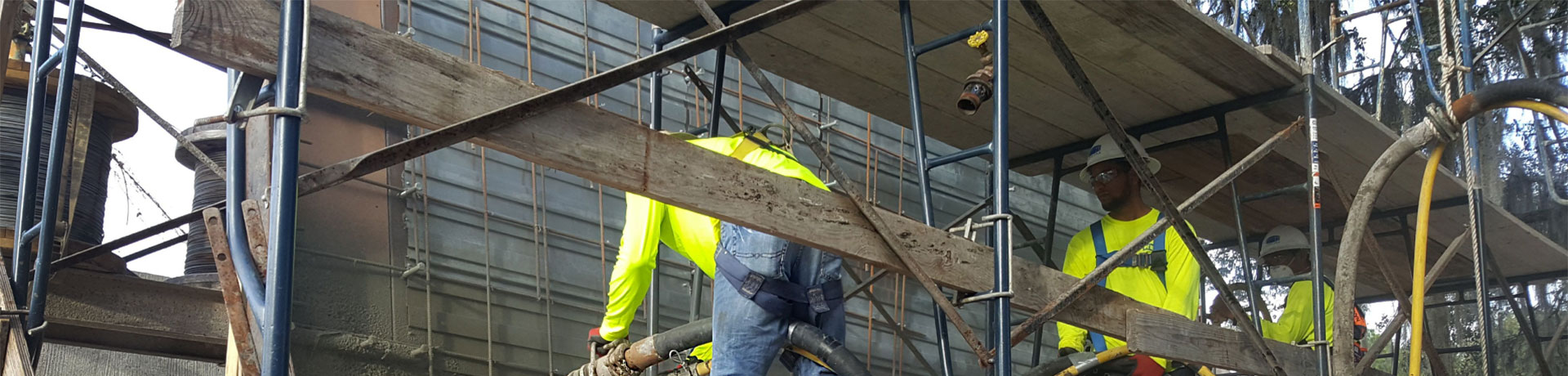
Shotcrete, both wet- and dry-mix, have been used to repair and reline sewer structures for many decades and has held up well as a lining or repair material. It is important to have the work done by a qualified shotcrete specialty contractor and to specify a durable concrete mixture design. The following are links to articles which may also be of interest to you:
We’re proposing to install a new shotcrete shear wall against existing 8 in. (203 mm) CMU walls for a project of ours. STRUCTURAL has provided a steel reinforcement cage across each wall plane, which is tied to the existing CMU wall with a series of anchors running horizontally and vertically. Between this new shotcrete wall and existing CMU wall, we are calling for a vapor barrier layer to retard moisture migration from the exterior to the interior. At this point, we are considering going with a PROSOCO Cat-5 fluid-applied vapor barrier system over the CMU but were curious how this might interface with the shotcrete. Have you dealt with this vapor barrier issue before, or seen similar installations? Would the steel reinforcing cage be adequate to support the shotcrete by itself during application, or should we be concerned about the surface of the backup wall?
Shotcrete has been placed against fluid-applied waterproofing and other smooth surfaces, which would likely be similar to the surface you are concerned with. An experienced shotcrete contractor should be able to install this shear wall, taking care to apply the shotcrete in a sequence which inhibits the material from sagging or sloughing. The key is hiring a good, well-experienced shotcrete contractor.
The reinforcing bar size and spacing can help provide support for building up the shotcrete. The spacing should be no greater than 12 in. (305 mm) on center each way and must be rigid.
We are the Architects of Record for a multi-family rehabilitation here in Portland, OR. The existing building is three stories plus a half basement. It is a historic building and is also an unreinforced masonry building. As a result, it requires significant seismic upgrades. Our structural engineer is proceeding with a design that uses several 4 in. (102 mm) thick shotcrete walls as shear elements throughout the building. In most instances, these walls are being constructed adjacent to an existing wall to minimize their impact to the existing floor plans. This seems fine against the exterior masonry walls but we have concerns where the shotcrete is to be installed directly adjacent to a standard architectural partition (gypsum wall board and wood studs). We are planning on plywood sheathing to act as a one-sided form to prevent the shotcrete application from harming the existing stud wall. However, we were curious if we should also include a water barrier so that the application did not allow moisture to migrate into the existing walls during the installation. Is this assumption correct? And if so, is there a performance or product recommendation that you can offer for this purpose?
Shotcrete has been used in similar structural upgrades for decades quite successfully. There are many ways to ensure that the moisture from the fresh shotcrete would not impact the existing partitions. Methods for protection include use of green board (as used in a shower or bath), plywood, painted coatings, moisture-resistant sheeting, and so on.
Shotcrete is placed with a low water-cement ratio (w/c) and the water is needed by the shotcrete to hydrate the cement and harden. As long as the existing surface or treated surface does not actively absorb the moisture, the shotcrete will use the available internal moisture to hydrate the cementitious materials.
I am involved with an above-grade canal replacement project that used shotcrete. The forms were recently pulled from one of the vertical walls, and extensive defects were visible throughout the wall length. Reinforcing bar shadowing occurred at nearly every vertical bar as well as numerous void pockets of various depths (some even up to 3 in. [76 mm]). Demolishing and replacing the wall is not a viable option. I am responsible for developing repair recommendations to the client and would like to know if there are any standards for shotcrete tolerances, specifically in regards to defects. I am going to specify that a repair mortar be used for repairing the defects and would appreciate any insight into this, as well as any wisdom that could be offered in dealing with reinforcing bar shadowing.
This seems to be two questions:
1. The repairs should be accomplished as recommended in ICRI Technical Guidelines: the area to be repaired should be chipped out to sound concrete, sandblasted or waterblasted to remove any bruised material, dampened to a saturated surface-dry condition, and patched with a reputable and known repair mortar.
2. ACI 506 defines “shadow” as any porous areas behind an obstacle, such as reinforcement. Proper shotcrete application by an experienced nozzleman with adequate equipment and crew will create shotcrete sections that have minimal shadowing and voids. However, sometimes upon stripping of the backside forms there is a noticeably darker coloration of the concrete surface immediately behind reinforcing bars. This darker coloration often does not have porous areas, but is an indication that the reinforcing bar is close to the form and, although good, dense material has been placed, it has a slightly higher cement paste content and thus appears darker on the surface. Sounding the area of discoloration should identify any porous areas that should be repaired, as mentioned previously.
It should be noted that this is not unique to shotcrete. Cast concrete that is not properly placed and fully consolidated often exhibits voids and rock pockets that need to be repaired upon stripping of the forms.
Would epoxy-coated reinforcing bar be required for a shotcrete site retaining wall that does not have waterproofing behind it?
Shotcrete is a method of placing concrete and the properties of properly placed shotcrete are equal to those of cast concrete. We have seldom seen the use of epoxy-coated reinforcing bar in retaining walls with or without waterproofing. (The California Department of Transportation builds many retaining walls with cast concrete and with shotcrete and seldom uses epoxy-coated reinforcing bar or waterproofing.)
It is important that you use a contractor qualified and experienced in this type of work and who uses ACI Certified Nozzlemen and a qualified crew.
I am building a perimeter overflow pool and need to know the best way to finish the trough. I have one shotcrete company that wants to hand-finish the 6 in. (152 mm) wide trough; another wants to shoot up to foam. Can you tell me which is best and why?
This is a classic performance-versus-prescription situation. The owner or customer should specify the desired end product and the contractor should choose the means and methods. Although they may both provide a great product, what works for one contractor or what he/she is comfortable doing may be completely different than another contractor.
We’re designing two steel stacks to be located in Texas and subject to hurricane winds. The diameters are 9.19 and 4.92 ft (3 and 1.5 m), respectively. Both stacks are 118 ft (36 m) high. To reduce the vortex shredding oscillation effects, we want to increase the mass of the stacks by means of internal gunite lining. Our calculation provides good results considering approximately 2 in. (51 mm) thick interior liner. For this scope, is it better to consider external or internal lining? Would there be any advantage to applying an external liner with respect to the interior solution? Which of these two is the most cost-effective solution?
Shotcrete would work well either for the stack exterior or as an interior lining. The 2 in. (51 mm) thickness could be easily applied on either the outside or inside surfaces.
For the 9 ft (3 m) diameter stack, it would be easier and more cost-effective to scaffold and gun the inside of the stack. The work could be done with less difficulty, from an interior hanging platform suspended with sky climbers. There would be less cost involved with rigging than there would be with scaffolding or rigging around the outside circumference of the stack.
For the 4.92 ft (1.5 m) diameter stack, there is much less room to work inside, so unfortunately it may need to be gunned on the outside.
I am lowering the roof of the draft tube on a hydropower dam. The work is all overhead and has a slope to it. The new roof profile will be lowered from 2 in. (51 mm) (initial edge) to 6.25 ft (approximately 2 m) thick. The plan is to use rock anchors to transfer the load to the existing concrete, and tie in a reinforcing bar grid at the lower section of the new roof profile (4 in. [102 mm] cover). Shotcrete is being planned for the infill material. The traditional ACI 318 design method was used for sizing reinforcing bar. The concern I have in the design is the application of the shotcrete. The plan is to allow the contractor to install a wire mat (or reinforcing bar mat) approximately 2 in. (51 mm) from the existing concrete roof, then apply shotcrete until reaching the reinforcing bar location, up to 6 ft (1.8 m) thick, then apply the finish layers. I have concerns about how thick shotcrete can be applied overhead. I have received feedback from some shotcrete companies that one can apply up to 4 ft (1.2 m) thick overhead layers, yet others say to never apply more than 4 in. (100 mm) layers. I also have concerns of delamination between the shotcrete and the existing concrete during the installation process, and potential shotcrete falling under its own weight in the thicker locations. Do you know of any situation where shotcrete was installed overhead to thicknesses of 6 ft (1.8 m)? How thick can the shotcrete be before additional reinforcement is required to hold it for overhead applications? Is there a recommended maximum thickness for overhead application of shotcrete being placed before additional reinforcement is required? For the area that is 6.25 ft (2 m) thick, should I be using multiple layers of reinforcement (or fiber reinforcement) to prevent fallout?
This is a very challenging potential installation and there could be several potential approaches. For the shotcrete to bond to the existing concrete, the existing surface should be properly prepared, removing any unsound concrete, then roughened and cleaned to allow for a good bonding interface. You mentioned using rock anchors or bolts. These should be installed before any shotcrete.
For each 6 in. (152 mm) layer, a layer of welded wire reinforcement or structural fibers should be used. These, in conjunction with the rock bolts, should ensure the stability of each layer of the shotcrete from falling.
The surface reinforcement should not be installed before most of the area is within 6 to 8 in. (152 to 203 mm) of the final surface.
There is currently similar thicknesses being placed on the East Side Access in New York City to build back the overbreak for the initial tunneling to the “A-line” or profile that was intended for the mining.
We are an architectural design firm that specifies extensive amounts of shotcrete to mimic rockwork in our designs for large-scale animal exhibits. We often encounter differing views on the need for galvanized or coated reinforcing bar in our shotcrete work, especially when they are used as pool lining walls containing salt water. Can you tell us your opinion on whether galvanizing or coating of reinforcing bar is necessary if both integral and surface waterproofing are specified?
Shotcrete is a process of placing concrete. The need to use galvanized or any other type of reinforcing is, or should be, based on the needs of the project and the preference of the structural design engineer. For liquid-containing concrete structures, the designer may review ACI 350-06, “Code Requirements for Environmental Engineering Concrete Structures,” which has specific concrete material, cover, and reinforcing requirements for concrete exposed to a variety of chemical and saltwater exposures. (The aforementioned ACI Committee 350 publication may be purchased from the American Concrete Institute at www.concrete.org”.)
How soon after a surface is shotcreted can it be submerged with stream water? What if the water has no velocity?
Shotcrete is a means of placing concrete and the same precautions should be taken. Once the shotcrete had taken final set, exposing it to water and submerging it in water should enhance its curing. If it is a pool or other deep structure, you should ensure that the shotcrete or concrete is strong enough to withstand any hydrostatic loading due to the filling of the structure.