
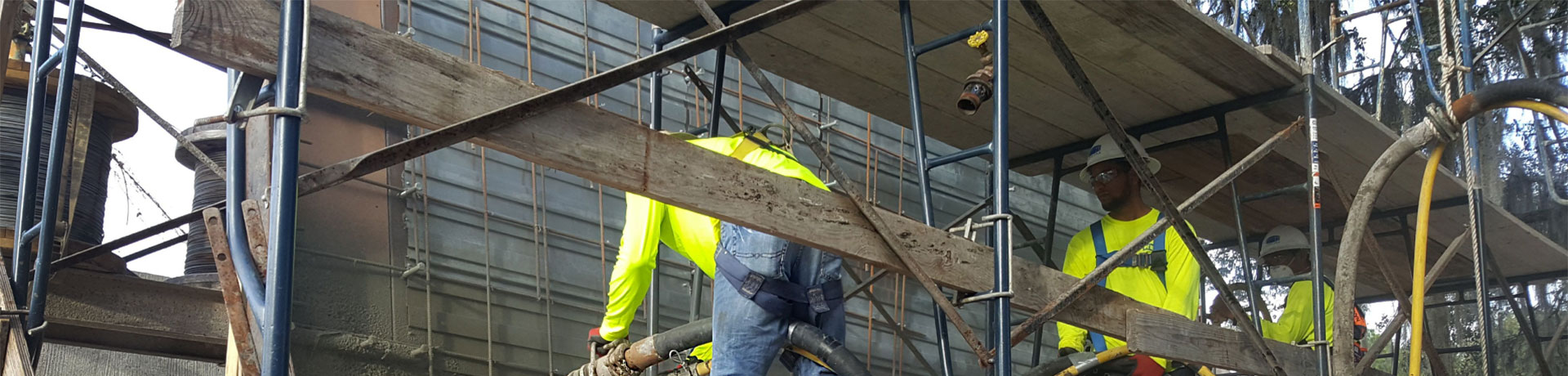
Shotcrete has been used for residential concrete construction, often for domed or other curved shapes. It has also been used to provide a structural skin over internal insulation panels in more rectangular layouts. Since shotcrete is concrete projected at high speed (between 60 and 80 mph [97 to 129 km/h]) many insulation products do not withstand the impact and abrasion associated with shotcrete impact. In many cases when shooting over an insulating foam panel that cannot withstand the high velocity impact, shotcrete isn’t used, but a low-velocity plaster/grout mix is spray applied over the insulation. Here’s a link to the PCA website with a page on residential housing using a foam inner panel: https://www.cement.org/think-harder-concrete-/homes/building-systems/shotcrete. You can also find similar system information doing a web search for “shotcrete foam panel.”
We have an existing cut slope approximately 328 ft (100 m) high (3:1 vertical:horizontal) with cut benches and need to apply shotcrete onto the slope surface at a height of approximately 230 ft (70 m) from the road level. Is it possible to reasonably transfer and apply shotcrete mixture at such a height from the road level? What type of transfer hoses and equipment is preferable? Is dry-mix or wet-mix shotcrete preferable?
Yes, either dry-mix or wet-mix process can and have been used at this height. Because either process can be used in these conditions, you should use an experienced shotcrete contractor who will pick the best method based on their firm’s shotcrete capabilities. Factors such as the shotcrete contractor’s specific shotcrete equipment, material availability, site constraints, remoteness of the location, and crew experience will influence their choice.
I would like to know if there is any parameter for test panel dimensions and inclination of proposed shotcrete surfaces represented by the test panels. I also would like to know if there is any specification for frequency of making test panels during the shotcrete project duration. In general, what is the specified type of panels and number of them to be specified and to what time frequency should a contractor assemble them for quality control purposes?
ACI 506.2-13, “Specification for Shotcrete,” is an excellent resource for answering your questions. ACI 506.2 addresses both preconstruction panels and test panels used for material quality control during construction. ACI 506.2, Section 1.5.1.4, requires that when preconstruction panels are required, the Contractor shall “Construct test panels for each proposed shotcrete mixture, each anticipated orientation, and each proposed nozzleman.” Preconstruction test panels vary in size to adequately represent the embedded reinforcement and section thicknesses in the work to be done.
Test panels shot during construction for evaluation of material properties are covered in ACI 506.2, Section 1.6.3.1, which states: “Construct a test panel for each mixture, each nozzleman, and each work day or for every 50 yd3 (38 m3) placed—whichever results in the most panels. The face dimensions of a test panel shall be a minimum of 16 x 16 in. (406 x 406 mm) with a minimum depth of 5 in. (127 mm). For toughness testing in accordance with ASTM C1550, the face dimension shall be 30.5 in. (775 mm) in diameter and 3 in. (76 mm) thick. Shoot test panels in a vertical orientation only unless otherwise specified.”
ACI 506.2-13 has extensive provisions for the submittals, testing, materials, and execution of shotcrete work by a shotcrete contractor. It cites many of the ASTM testing standards appropriate for shotcrete construction. We recommend you review the document in its entirety to become familiar with current industry standards.
We have 18 ft high, 12 in. thick (5.5 m high, 205 mm thick) walls to shotcrete and need horizontal cold joints to place the shotcrete in three pours (three height sections). How do we create the joint?
Shotcrete is routinely used in creating retaining walls or soil-nailed walls in this fashion. Designers and inspectors often confuse placement of multiple layers of shotcrete in building out a section with cold joints experienced in cast-in-place concrete construction. Unlike cast-in-place concrete, shotcrete provides thorough consolidation and densification by high-velocity impact of fresh concrete material on the receiving surface. The high-velocity impact of shotcrete on a hardened, previous shot layer (or existing concrete surface) provides a strong abrasive blast to open up the surface, and then provides an immediate exposure of that hardened surface to fresh cement paste. As a result, shotcrete exhibits excellent bond to concrete and previously shot surfaces. Thus, the structural action between the sections acts as a monolithic section without any weakened planes.
In shotcrete construction, surface preparation between layers to provide full bond is important. ACI 506.2-13, “Specification for Shotcrete,” specifically addresses this in the requirements of Section 3.4.2.1 and 3.4.2.2 that require:
3.4.2.1 When applying more than one layer of shotcrete, use a cutting rod, brush with a stiff bristle, or other suitable equipment to remove all loose material, overspray, laitance, or other material that may compromise the bond of the subsequent layer of shotcrete. Conduct removal immediately after shotcrete reaches initial set.
3.4.2.2 Allow shotcrete to stiffen sufficiently before applying subsequent layers. If shotcrete has hardened, clean the surface of all loose material, laitance, overspray, or other material that may compromise the bond of subsequent layers. Bring the surface to a saturated surface-dry condition at the time of application of the next layer of shotcrete.
An experienced shotcrete contractor should routinely provide proper surface preparation between shotcreted sections, and use skilled crews with ACI certified nozzlemen to place and cure the shotcrete placements.
We have a concrete tunnel repair project, where expansion joints in a 10 x 10 ft (3 x 3 m) tunnel need to be repaired. The joints are on the top, bottom, and both sides of the tunnel; therefore, we have vertical and overhead applications. The detail calls for deteriorated concrete to be removed to a depth of about 6 in. (152 mm), existing reinforcing steel to be cleaned and preserved, and old waterstop removed and new PVC waterstop installed. How far can shotcrete be pumped for an application in a tunnel? We are looking at about 200 ft (61 m) for the shotcrete to be pumped from the supply to the repairs. Is this constructible?
Yes, this is definitely a great application for shotcrete. Either wet- or dry-mix shotcrete can easily be used in tunnels with hose lengths of 200 ft (61 m). An experienced shotcrete contractor will be able to select the appropriate process based on the site, availability of material, and their particular equipment and trained shotcrete crews.
Is there a reference where I can obtain some guide regarding the tensile strength of fiber-reinforced shotcrete (steel and poly)?
ACI 506.1R-08, “Guide to Fiber-Reinforced Shotcrete,” is a good reference for general use of fibers in shotcrete. If looking at underground applications for shotcrete, ACI 506.5R-09, “Guide to Specifying Underground Shotcrete,” will also offer guidance. The ACI 506 documents are available in hard copy format on our bookstore website with ASA member discounts (shotcrete.org).
Because shotcrete is a method for placing concrete, many, if not most, of the properties of fiber-reinforced concrete, as found in ACI 544 committee documents, are applicable to shotcrete.
I have a very small job to do that would normally be handled by a gunite or sprayed-on application. I need to form the inside of a concrete box into a cylindrical shape. I would like to get a few hints or suggestions on how I might accomplish the “gunite” solution using my hands/tools only. Does this require a special mix of the mortar mixture?
Shotcrete is concrete placed at high velocity to achieve compaction. It is dependent on the projection of material with air velocity of 60 to 80 mph (97 to 129 km/h) from the nozzle to consolidate the concrete material in place. It cannot be hand-applied. You may consider hand-applied pre-packaged mortar mixtures to achieve your results, although strength and durability may be less than a similar section with shotcrete because the hand-applied material is not fully compacted. Another alternative is to create an inner cylinder and cast concrete in the space between the box and the form. The concrete could then be vibrated for consolidation.
We are planning on placing shotcrete over rock face and are concerned about water seeping out of the rock and forming ice behind the shotcrete. Could you please offer some insight?
Shotcrete is a functionally impermeable material when properly designed and placed. Thus, if water accumulates between the rock substrate and shotcrete, depending on temperatures and thickness of the shotcrete, it may freeze. As with all concrete, shotcrete material can be air-entrained to enhance resistance to freezing-and-thawing exposure. You should consult with an experienced engineer to determine whether the type of rock, geometry of the sections, and anchoring of the shotcrete (such as with soil nails or rock bolts), along with the bond of shotcrete to the rock, will provide the desired performance.
What is the standard materials delivery rate velocity for shotcrete applications?
Recent research into velocity of the material stream shot from the nozzle is approximately 60 to 80 mph (97 to 129 km/h) in the middle of the stream. Outer portions of the stream are slowed and show speeds of about 45 mph (72 km/h). Here’s a link to the Technical Tip published in the Fall 2013 Shotcrete magazine that provides more complete documentation of the research: shotcrete.org/wp-content/uploads/2020/01/2013Fal_TechnicalTip.pd.
I’ve been testing shotcrete cores for compression strength according to ACI 506, ASTM C1604, and ASTM C1385. The only thing that we have been doing out of specifications is the panel. Our panels are 18 x 18 in. (457 x 457 mm). We have been coring at the center of the panel 2 days after it has been cast. We test these cores at 7 and 28 days, and the strength of cores reflects passing at 7 days but failing at 28 days. Can you please tell me what could be the cause of this?
ASTM C1140/C1140M-11, “Standard Practice for Preparing and Testing Specimens from Shotcrete Test Panels,” is the appropriate ASTM standard for producing and coring test panels. ASTM C1140 specifies panel size as a minimum of 24 x 24 in. (610 x 610 mm) with a minimum 3.5 in. (89 mm) depth. Without more information on the materials used in the shotcrete and the type of shotcrete, it is impossible to identify what may be causing the lower compressive strength tests.
The compressive strength should increase between 7 and 28 days on a curve equivalent to cast concrete. Strength degradation between 7 and 28 days may be a result of poor shotcrete application or problems with coring or curing of the samples.