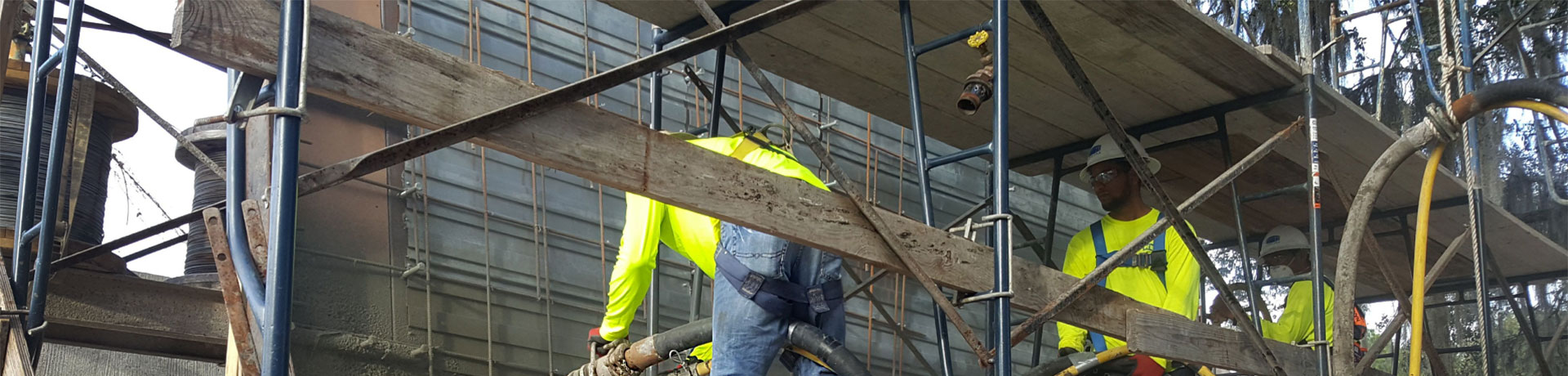
Shotcrete is a placement method for concrete. So, standard concrete tests for shrinkage are applicable. You will find an article from Shotcrete magazine, “Shotcrete Testing—Who, Why, When, and How,” helpful. The specific section on drying shrinkage tests says:
“Drying shrinkage of the shotcrete can be tested using general provisions of ASTM C157. Because the shotcrete is shot into a large panel and not into the relatively small mold specified by ASTM for the shrinkage test beam, it is recommended that a beam approximately 11.25 in. (285 mm) in length be sawed from a test panel. As most shotcrete uses coarse aggregate less than 1 in. (25 mm), a 3 in. (75 mm) thick panel with a 3 in. (75 mm) wide cut should approximate the ASTM requirements. The A/E should specify in the contract documents drying shrinkage limits that are appropriate for the design of the structure.”
Shotcrete is a placement method for high-quality concrete. Here’s a link to an article of a rehabilitation of a concrete-supported lighthouse in the St. Lawrence Seaway (Pointe de la Prairie Lighthouse) that provides a lot of detail on an installation like yours, including saltwater exposure in a tidal zone. Additionally, this project also has regular freezing-and-thawing exposure (shotcrete.org/wp-content/uploads/2020/01/2014Sum_Sustainability.pdf).
Another project with tidal zone exposure involved repair of bridge pier pile caps on the East Coast of Florida. The article details the project parameters and testing conducted to verify the quality of the shotcrete placement (shotcrete.org/wp-content/uploads/2020/01/2012Win_White.pdf).
Shotcrete compressive strength should be tested using cores from test panels. Shotcrete cannot be shot into closed cylinder forms and be representative of the in-place shotcrete. ASTM C1140-11 and C1604-05(2012) provides the panel configuration and compression testing requirements. However, if using the wet-mix process for shotcreting and one wants to verify the compressive strength, air content, or temperature of ready mixed concrete materials as delivered, rather than as shotcreted in place, samples can be taken from the truck before pumping. These cylinders would follow ASTM C31-15 for making and curing concrete test specimens.
Shotcrete is a placement method for concrete. If the berm is composed of granular materials, one wouldn’t expect the shotcrete to actually bond to the soil. Rather, placing a thin shotcrete layer would create a uniform, relatively impermeable layer of concrete to prevent water from penetrating through and washing out the soil underneath. The emulsion may help to stabilize the soil to help withstand the pressure of shotcreting directly against the berm, but many similar soil stabilization projects will shotcrete directly onto the natural soils. Also, when considering using the emulsion, be aware that some oils may contain ingredients (like sulfur) that can attack the concrete over time. You should consult with an engineer or concrete materials specialist to ascertain whether the specific oil you want to use will have a long-term effect on the shotcreted layer.
Some mines have used chain link mesh in shotcrete in severely deforming ground and claim that it is better in holding the ground than mesh after large deformations, in which the shotcrete sustains major cracking with deformations. Other than for such unusual applications, we do not recommend the use of chain-link reinforcement in shotcrete. It cannot be fixed “tight” and as such is susceptible to vibration and movement during shooting, resulting in shotcrete sloughing and formation of voids in the shotcrete. Also, the mesh interconnections are conducive to the formation of voids during shooting. Additionally, there don’t appear to be any consistent material standards on the strength, flexibility, or brittleness of the steel (or other materials) used in the fencing material, so a designer has no way to establish the tensile or flexural strength of the concrete sections. In brief, don’t use chain-link mesh if you want to produce quality, durable shotcrete.
Shotcrete is a placement method for concrete. When the pool shotcrete contractor uses quality materials, properly sized and maintained equipment, and experienced crew members, the shotcreted pool shell should be watertight. Proper shotcrete application would also not exhibit voids, honeycomb, or major seepage through the pool shell. Before replastering, the pool shell should be evaluated and all defects (voids, cracks, porous sections, deep holes, and so on) repaired using industry-standard methods and materials. You may consider retaining a professional engineer or experienced pool consultant to evaluate the pool shell and make specific recommendations on the appropriate repair for your specific issues. You can use our Buyers Guide (shotcrete.org/products-services-information/buyers-guide/) to locate consultants in your area. You also may want to review our pool-specific Position Statements on our website at shotcrete.org/products-services-information/resources/. The “Watertight Shotcrete for Swimming Pools” would be particularly informative for you to assist in discussions with your pool contractor.
Because shotcrete is a placement method for concrete, standard concrete repair techniques are applicable. If the repair is being done by shotcreting new concrete on the existing concrete, the repair should include these steps:
- Chip the poor or weak concrete back to sound concrete.
- If reinforcing bars are exposed, they should be cleaned of any rust.
- If more than half of the perimeter of a reinforcing bar is exposed, the concrete should be chipped back to provide at least a 0.75 in. (19 mm) space behind the bar to allow shotcrete to flow around the back of the bar.
- Before shooting any additional shotcrete, the surface should be cleaned and then wetted to a saturated surface-dry condition (SSD).
- SSD means the substrate is damp, but there is no flowing water. It should feel damp to the touch, but no water is picked up on your hand when placing it against the surface.
- Do not use bonding agents, as they can interfere and reduce the bond of the new shotcrete to the old shotcrete surface.
- When the new shotcrete is in place, the contractor should initiate water curing as soon as possible. In warm, dry, or windy weather, fogging of the fresh surface immediately after finishing would be helpful.
- Water curing (where the concrete is kept continuously moist) should be supplied for at least 7 days.
Shotcrete is a placement method for concrete. So, standard concrete tests for shrinkage are applicable. You will find an article from Shotcrete magazine, “Shotcrete Testing—Who, Why, When, and How,” helpful. Here’s a link to the archived PDF of the article (shotcrete.org/wp-content/uploads/2020/01/2011Sum_Hanskat.pdf). The specific section on drying shrinkage tests says:
“Drying shrinkage of the shotcrete can be tested using general provisions of ASTM C157. Because the shotcrete is shot into a large panel and not into the relatively small mold specified by ASTM for the shrinkage test beam, it is recommended that a beam approximately 11.25 in. (285 mm) in length be sawed from a test panel. As most shotcrete uses coarse aggregate less than 1 in. (25 mm), a 3 in. (75 mm) thick panel with a 3 in. (75 mm) wide cut should approximate the ASTM requirements. The A/E should specify in the contract documents drying shrinkage limits that are appropriate for the design of the structure.”
Shotcrete is a placement method for concrete. Lightweight concrete usually ranges from 90 to 115 lb/ft3 (1400 to 1800 kg/m3). In wet-mix shotcreting, lightweight concrete should use presoaked aggregate to make the mixture pumpable. When it’s pumpable, as with conventional concrete mixtures, it is then accelerated to a high velocity by air at the nozzle and projected onto the surface. Lightweight aggregates can also be used directly in dry-mix, and there you don’t need to worry about pumpability because the dry materials are conveyed through the delivery hose. Water is added at the nozzle.
Here’s the specific reference on lightweight from ACI 506R-16, “Guide to Shotcrete”:
2.1.3.2 Lightweight aggregates—Lightweight aggregates should conform to ASTM C330/C330M if used in shotcrete. The aggregate should meet one of the gradations shown in Table 1.1.1. Wet-mix shotcrete with lightweight aggregate is seldom used and is difficult to pump because the aggregate absorbs water, which reduces the consistency of the mixture. Presaturating the lightweight aggregate before batching improves pumpability. Lightweight aggregate mixtures have been shot for wall and floor construction. Shotcrete is frequently employed for fireproofing structural steel members using lightweight aggregates in the mixture.
We suspect that cellular concrete cannot be shot because it uses injection of a pre-formed foam into a cement slurry and is highly fluid. That would preclude any stacking of material to make a vertical surface, and would instead just be pumped in place like a high slump concrete.
Shotcrete is a placement method for concrete. All normal concrete experiences drying shrinkage that creates a volume change in the hardened concrete. Pools will also experience volume change in the concrete due to thermal changes, especially summer to winter seasonal swings. Contraction and expansion joints are common in all kinds of concrete liquid-containing structures especially with walls of this length. Though we can’t provide a firm design recommendation you should consider these factors:
- What are the weather conditions when the pool is anticipated to be built? If during hot summer months, could there be enough seasonal temperature swing to require expansion joints?
- If expansion joints wouldn’t be needed would contraction joints be needed to handle anticipated temperature swings, and drying shrinkage?
- Will the pool be empty for extended times (this could lead to more shrinkage or direct exposure to solar gain or cold conditions?
- Is the pool to be kept full or empty during the winter months? (if the pool is in a geographic region where extending freezing conditions are prevalent)
Overall, the design for a shotcrete pool should be the same as one for a cast concrete pool.