
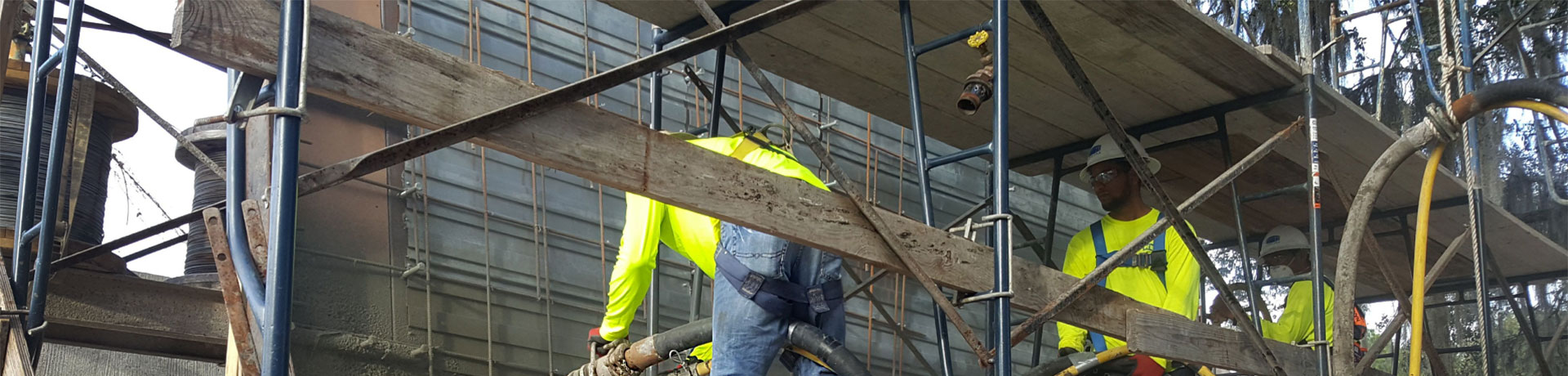
Shotcrete is a placement method for concrete construction. Shotcrete-placed concrete should be properly cured to provide desired strength and reduce potential shrinkage. ACI 308.1-11, “Specification for Curing Concrete,” and ACI 308R-16, “Guide to External Curing of Concrete” are excellent reference documents. ASA recommends curing a minimum of 7 days, and prefers curing with water, maintaining a continuously wet surface condition for the 7-day period. If using a curing membrane instead of water curing, ASA recommends applying the curing membrane at twice the curing membrane manufacturer’s recommended application rate, and applying in two layers with the second perpendicular to the first. If applying a coating over the final concrete surface, you should check with the coating supplier to verify the duration and properties required before application of the coating.
We are looking for the application of shotcrete on tidal waters. We are located on Lower Puget sound in Washington state and need examples where this has been used and is holding up under the moving tides. The examples don’t have to be applied to our area; the same conditions may apply to other saltwater areas.
Shotcrete is a placement method for high-quality concrete. Here’s a link to an article of a rehabilitation of a concrete-supported lighthouse in the Saint Lawrence Seaway (Pointe de la Prairie Lighthouse) that provides a lot of detail on an installation similar to yours, including salt-water exposure in a tidal zone: (shotcrete.org/wp-content/uploads/2020/01/2014Sum_Sustainability.pdf). Plus, this project also has extreme freezing-and-thawing exposure.
We had a spa added to an existing pool. The shotcrete was too liquid and sloughed off to the bottom. The shotcrete contractor scooped the sloughed material from the bottom with his hands and put it back on the wall. There are fissures and holes in the wall. There was also reinforcing steel close to the surface of the wall. The cold joint at the existing pool wall wasn’t prepared. They added a shotcrete seat to the existing pool over the old Marcite with no removal or roughening up of the surface. They then refused to water cure it. There wasn’t enough reinforcing steel and formwork from the pool company, so the shotcrete contractor had to stop and add more steel from steel I had lying around. So, the shotcrete sat in the truck for quite a while before shooting. We are concerned about the quality of the pool.
You are correct in suspecting quality issues with your pool. These are the specific issues that lead to poor quality, that can affect the serviceability and durability of your pool.
- Shotcrete placement requires high velocity and impact for compaction of the concrete. Hand-applying “sloughed-off” concrete would not provide proper compaction needed for producing monolithic concrete sections. The resultant fissures and voids in your pool reflect the lack of proper velocity and compaction.
- Proper preparation of the substrate is essential for good bond and creating a concrete section that acts monolithically. The surface needs to have any materials that would interfere with the bond removed, be roughened, cleaned, and brought to a saturated surface-dry condition before shotcrete placement. This article from Shotcrete magazine gives more details on how and why surface preparation is important (shotcrete.org/wp-content/uploads/2020/01/2014Spr_TechnicalTip.pdf).
- Concrete cover over the reinforcing bar is critical for maintaining corrosion protection of the embedded steel, and thus providing long-term durability. Low cover will often result in premature corrosion and subsequent spalling of the concrete cover, reducing the serviceability and life of the pool concrete.
- Curing is important for all concrete, and especially for the relatively cement-rich concrete we use for wet-mix shotcrete. Curing essentially provides additional water to hydrate the cement in the concrete, and produces stronger, less permeable concrete. Not curing concrete yields concrete that is weaker, more permeable, and ultimately less suitable for creating a watertight pool shell.
- You haven’t indicated the actual time concrete sat for “a while.” Industry standards are that concrete should be placed within 90 minutes of the introduction of water to the mixture unless special precautions are taken. Water is usually added at the ready mix plant. If concrete sits too long it can start to lose workability. At the point of losing workability, some contractors will add additional water on site over and above the concrete mixture design requirements, but this “retempering” produces concrete that is weaker and more permeable than the original design mixture.
Based on your input, you have many good reasons to ask the contractor to provide full remediation of these quality issues.
We are a small community in south central Illinois with a deteriorating masonry building issue that drastically needs to be addressed. I have been looking at your shotcrete product and I am thinking that this may be the most efficient and economical way to protect these exposed surfaces from the elements and stabilize these structures. My question to you is: Have any other communities used this product for this purpose, can this product be used in a situation such as ours, or am I just barking up the wrong tree? The wall in question is three stories tall, about 40 ft (12 m); the exposed wall was interior multi-course thick masonry from the late 1800s-era.
Your proposed project is a great application for shotcrete. We’ve seen shotcrete used for enhancing structural integrity of historic masonry structures across the country. Often shotcrete is used on the back side of the wall to add structural strength while preserving the exterior appearance. In effect, we build a structural concrete wall in-place behind the old wall. Shotcrete has the natural advantage of not requiring any formwork, and can create a good bond to the existing wall, letting the structure elements work together. Here’s a link to a past article from Shotcrete magazine documenting the restoration of a historic brick building (shotcrete.org/wp-content/uploads/2020/01/2009Win_SCM01pg08-12.pdf). If you don’t need to preserve the exterior appearance, you can certainly shotcrete the exterior of the wall using the same approach. You can finish the interior (or exterior) surfaces in a variety of ways to provide the architectural appearance you desire. Shotcrete is a placement method for concrete, so using shotcrete will provide a final structure with the strength and durability of cast concrete. By the way, the term “gunite” is the old tradename for what we currently call “dry-mix shotcrete.” Let us know if you have any further questions.
We are in the swimming pool design and construction industry as a general contractor. We subcontracted a large percentage of the work to complete a project — namely, the shotcrete of the pool shell, and were very unhappy with the results. The walls are not plumb and areas are not shot to the full thickness. We didn’t check out the contractor’s current work and he is incapable of making any repairs. We have done corrective chipping and bush hammering to get the walls plumb and areas at the proper grade. However, many areas need to be filled to the proper thickness up to 2 in. (50 mm). Can this be done with either a dry or wet mix? Do you need to bush hammer a recessed area to accept a minimum amount of new material in lieu of a feather edge? Is a wet mix acceptable to fill these areas given that the aggregate in it is generally up to 0.375 in. (9.5 mm) or so? With the dry mix being primarily concrete sand and cement it would seem more practical.
As you discovered, experience of the shotcrete contractor is key to a successful project. It takes an experienced and knowledgeable shotcrete team (the project manager, supervisor, pump or gun operator, nozzlemen, and finishers) to get a quality job. Answering your specific questions:
- Can this be done with either a dry or wet mix? Yes, either wet or dry mix will produce good results. You must be sure to properly prepare the substrate including chipping/bush hammering back to sound concrete, fully cleaning the surface and then bringing the surface to a saturated surface-dry condition (SSD).
- Do you need to bush a recessed area to accept a minimum amount of new material in lieu of a feather edge? Feather edging will create a very thin layer that would have more potential to spall when exposed to shrinkage or seasonal thermal movements. We recommend creating a square shoulder at least 0.75 in. (19.0 mm) deep to create an acceptable thickness of the patching layer.
- Is a wet mix acceptable to fill these areas given that the aggregate in it is generally up to 0.375 in. or so? With the dry-mix being primarily concrete sand and cement it would seem more practical. Wet-mix with a coarse aggregate can be shot in thin layers, but with a 0.375 in. coarse aggregate may require more finishing due to impact depressions of the aggregate in the shot surface. A dry-mix material without coarse aggregate may be easier to fill in the thin layers. Dry mix is typically less productive in volume placed per hour than wet mix, but in this relatively small-volume repair application, either process should be fine.
Are there published tolerances for shotcrete, specifically wall thickness, plumbness, and irregularities in surface, or should these tolerances be provided on the construction drawings? ACI 117 provides these tolerances for cast-in-place concrete, but specifically states it does not apply to shotcrete.
ACI 117 provides an excellent guide for tolerances for concrete structures. Although shotcrete is concrete, ACI 117 specifically excludes shotcrete because shotcrete’s unique method of placement permits a wider variety of applications and uses than that of form-and-pour concrete. Shotcrete can generally be finished to the tolerances required for the application. For example, lining a channel might not need close tolerance control, while an Olympic luge/sledding track or skateboard park may require very exacting tolerances. ACI 506.2-16, “Specification for Shotcrete,” in the Tolerances section (and the Mandatory checklist item) requires the specifier producing the contract documents to provide the tolerances required for the project. ACI 506R-16, “Guide to Shotcrete,” Section 3.8, Tolerances, provides a more descriptive commentary. Pertinent portions of that section include:
- Tolerances provide an indication of the finished product expected by the owner, but meeting tolerances may require additional effort and cost. Tolerances given by ACI 117.1R, for placement of reinforcing steel, cover over reinforcing steel, and overall alignment of cast-in-place structural members should be generally the same for shotcrete. Tolerances that require distinct values for shotcrete construction are cross-sectional dimensions, cover, and surface finish (or flatness). Therefore, specifying tolerances that can be consistently achieved are needed so that project expectations can be met at a reasonable cost.
- Specified tolerances should be based on use and function and can be the same as concrete, but are typically broader. Some finished surface tolerances may be waived to achieve proper coverage over existing reinforcement.
Although some shotcrete structures have been allowed greater tolerances than allowed for concrete, shotcrete structures can be built to the same degree of accuracy and tolerance as cast-in-place concrete.
You should review the entirety of Section 3.8, Tolerances, in ACI 506R-16 to get a complete description of tolerances for shotcrete placements.
We have a question about the shotcrete setup strength for the exclusion zone in underground shotcrete work. New York and others are requiring a shotcrete exclusion zone (an area excluded from personnel) based upon either time or strength. The UK asks for an engineered approach to this minimum strength. Do you have any information on this?
The minimum strength for safety must be established by the designer based on the specific structural and geotechnical aspects of the project. The minimum strength value may also be influenced on whether using fiber-reinforced shotcrete or plain shotcrete. The early-age strength was tested with a Meyco Needle Penetrometer after creating a time (early) strength curve with minimum tests at 10 minutes and 30 minutes with Needle Penetrometer; then at 3 hours and 6 hours with Hilti Studs; then at 1, 7, and 28 days with cores. Thus, the curve was calibrated for the specific mixture and environmental conditions. It was also useful to identify when early strength (and potentially long-term strength) was lacking.
Will the new ACI Tech Note for core evaluation (ACI 506.6T-17, “Visual Shotcrete Core Quality Evaluation”) replace ACI 506.2-95, “Specification for Shotcrete”? That document has some sections about core evaluation.
ACI 506.2-95, “Specification for Shotcrete,” is the deprecated version, and is no longer published (it isn’t readily available on the ACI website). Thus, the Tech Note along with the current ACI 506.2-13, “Specification for Shotcrete,” is the current industry standard for evaluating cores. An engineer may specify use of the outdated ACI 506.2-95; however, they are opening up their exposure because it isn’t the current standard. This is similar to the exposure if an engineer uses a much older version of ACI 318, and not the current one.
We have a client who wants to reline the surface of a brick drying room made from bricks and used to dry bricks. The temperature doesn’t exceed 400°F (200°C). Apart from the usual shotcrete best practice, do you recommend the addition of any additives to make the shotcrete/reinforcement more suitable for the heating and cooling cycles?
Generally, sand/cement in standard concrete mixtures starts breaking down around 400 to 500°F (200 to 260°C) because the portland cement starts to dehydrate. It loses strength with every phase and will have no strength after 1000°F (540°C). Putting it on brick depends on the shape of the brick surface. Uneven surfaces with holes will hold much better than flat brick. If the brick is flat, placing more than a couple of inches (±50 mm) may delaminate and fall off the wall without anchors of some sort. You could probably use a 2 x 2 in. (50 x 50 mm) or 3 x 3 in. (75 x 75 mm) mesh. In refractory, we consider low temperatures at 1700 to 1800°F (930 to 980°C). In the higher temperature refractory, we use calcium aluminate cement and “traprock,” which is a fine crushed limestone aggregate. The mixture ratios would be the same as a typical sand and cement gunning mixture. This is what traditionally has been for coal bunkers and coal dryers or any other sections in the 1700°F (930°C)-plus temperature range.
I am an architect and we have a client that is planning to do some major landscaping to his yard. He would like to consider shotcrete to create stone-type walls and outcroppings. Can you advise us on this? Would this be an appropriate application? Should he also just consider having a landscape company install boulders in lieu of a shotcrete-type landscape?
Shotcrete placement for a concrete wall gives the owner the advantages of concrete durability and the appearance of rock. Shotcrete has been used extensively for creating false rock faces for zoos, water parks, highways, and retaining walls. However, because shotcrete placement and carving to look like natural rock requires quite a bit of labor, the costs to do so may be more extensive than simply placing boulders.