
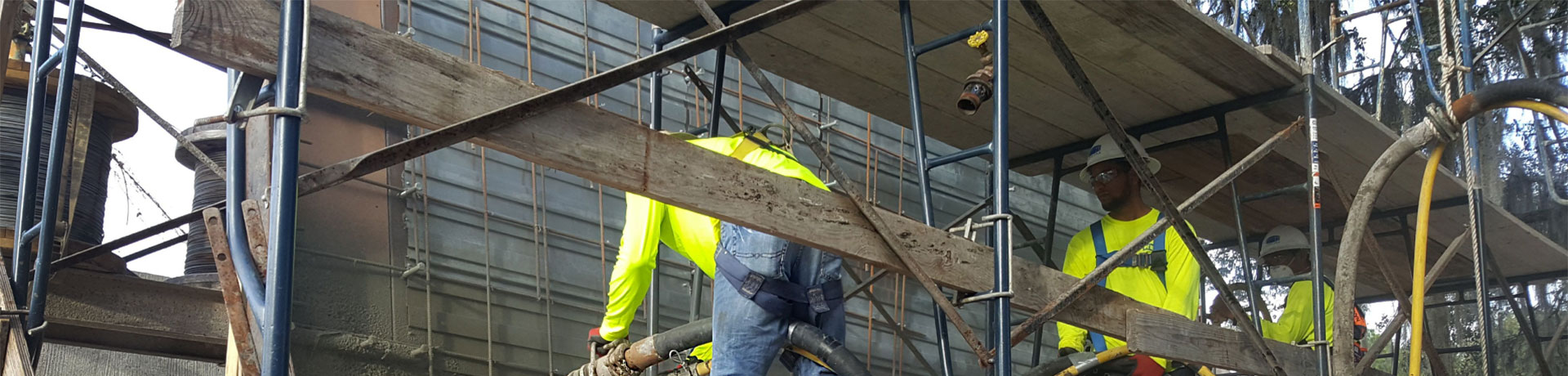
ACI 506R-16 discusses surface preparation requirements for various substrate surfaces and notes that for earth surfaces shotcrete shall not be placed on frozen ground. There does not appear to be any specific temperature requirement for other substrate materials, however. For concrete or masonry sub-straight surfaces, are there temperature requirements for shotcrete application in situ­ations where bond is not required?

All surfaces receiving shotcrete should be above freezing. The mandatory requirements of ACI 506.2-13, “Specification for Shotcrete,” specifies:

“3.4.5 Cold weather shotcreting—Unless otherwise specified, shooting may proceed when ambient temperature is 40°F and rising. Stop shooting when ambient temper­ature is 40°F and falling, unless measures are taken to protect the shotcrete. Shotcrete material temperature, when shot, shall not be less than 50ºF. Do not place shotcrete against frozen surfaces.”

Your question then asks about substrate temperatures for sections not requiring bond. The concern of frozen concrete is not only bond, but an issue with freezing of some thickness of the concrete that would prevent strength gain. For requirements on this, ACI 301-16, “Specifications for Structural Concrete,” would likely apply and 5.3.2.1(b) requires:

“5.3.2.1(b) Cold weather—Concrete temperatures at delivery shall meet the requirements of 4.2.2.5. Do not place concrete in contact with surfaces less than 35°F. Unless otherwise specified, this requirement shall not apply to reinforcing steel.”

There is a discrepancy between ACI 301 and ACI 506.2. The ACI 301 value (35°F) is somewhat more conservative, though ACI 506.2 provisions (32°F) have proven to produce quality shotcrete. You may consider asking the Engineer of Record for your project what minimum substrate temperature is acceptable on your specific job.

I am working on a restoration of a small 1870s train station constructed of serpentine stone in the Philadelphia, PA, area. In many areas, the stone has deteriorated, leaving deep “divets” in the exterior wall faces and in some cases, there is no stone at all. Our intent is to build (infill) the walls back to a flush face for stucco treatment for the lower portions of the wall and to repair or replace stone above that point. Is there a minimum amount of treatment recommended for a shotcrete application? If it can be used for such an application, is reinforcing required? The stone is rather friable, and I don’t want to attach too much to it for fear of further damaging the stone. If shotcrete is not an appropriate approach for this repair, can you advise of other repair methods?

This is a great application for shotcrete placement of high-quality concrete without formwork. If you are merely adding shotcrete to fill out to a uniform surface profile without any structural requirements, you may not need reinforcement. However, it may still be advisable to include fibers in the shotcrete mixture to help control plastic shrinkage cracking. Generally, you would want to keep a minimum thickness of 1 in. (25 mm) to provide enough thickness for finishing. If you need the shotcreted sections to be self-supporting and carry loads as structural concrete, you should consult with a structural engineer to determine the appropriate thickness and reinforcement for the expected loads. Shotcrete is a placement method for concrete so standard reinforced concrete design is appropriate for shotcreted sections.

How much shotcrete coverage is required over No. 4 reinforcing bar?

Shotcrete is simply a placement method for concrete. The specified concrete cover over reinforcing bar is usually included in contract documents for construction and values vary depending on exposure conditions. ACI 318 provides cover requirements for structural concrete in buildings, and ACI 350 provides cover requirements for concrete liquid-containing structures. Local building codes and fire codes may also require specific cover in concrete construction. If your project doesn’t specify the cover requirements, we recommend you consult with a professional engineer experienced in the type of project you are working on to learn what the code requirements may be.

I would like to better understand the limitations related to the height of install when it comes to gunite application. Since gunite is a dry concrete mixed with water at the nozzle of the applying apparatus, I have been told by others in the industry that the application is only intended for use on walls less than 4 or 5 ft tall. If that is the case, it is safe to assume that the gunite application strategy should not be used for below-grade vaults exceeding a height of 5 ft? I am looking for design literature specific to gunite.

Dry-mix shotcrete adds mixing water to the dry concrete materials as the concrete materials flow through and out the nozzle. Gunite is the original tradename for dry-mix shotcrete. Though you may not find design information using the old gunite name, you will find numerous current design references to dry-mix shotcrete. This includes ACI 506R-16, “Guide to Shotcrete”; ACI 506.2, “Specification for Shotcrete”; ACI 506.6T-17, “Visual Shotcrete Core Quality Evaluation Technote”; ACI 372, “Guide to Design and Construction of Circular Wire-and-Strand-Wrapped Prestressed Concrete Structures”; ACI 350-06, “Code Requirements for Environmental Engineering Concrete Structures”; ACI 350.5, “Specifications for Environmental Concrete Structures”; as well as seven ASTM standards that directly cover shotcrete. ACI 318-19, “Building Code Requirements for Structural Concrete,” has also added specific shotcrete provisions. Dry-mix shotcrete has been used for decades to build structural concrete walls over 50 ft (15 m) high in circular prestressed concrete tanks that withstand a full head of water pressure. This is substantially greater water pressure than your 5 ft vault wall would experience. There are no limitations in the dry-mix placement process that would preclude use in high walls. Both dry-mix and wet-mix shotcrete using quality materials, proper equipment, and experienced placement crews will produce in-place concrete of equal strength, durability, and low permeability. However, generally wet-mix shotcrete can offer placement rates up to four times higher than dry-mix. Thus, in thicker, longer walls, wet-mix shotcrete may be more cost effective because it can be placed faster.

I’m not satisfied with my subtrades blowout procedures for the shotcrete lines. I’m not an expert in this; however, the way they are doing it does not look safe. I’ve tried to Google and reach out to other shotcrete companies but have not had any luck. They use a hopper that concrete is pumped into and is disbursed through lines that are moved manually; this step is normal. But when they have a blockage or cleaning the line when done, they have two workers sit on the end. They use compressed air. There must be a better way to clean and clear a blockage than having human bodies as weights. Please give me some guidance.

ASA’s “Safety Guidelines for Shotcrete” specifically addresses hose blockages. Use of compressed air to clear blockages or for cleaning the lines is not recommended. The Guidelines state:

“With the variety of shotcrete material delivery systems available, and their placement on individual job sites, the Contractor should establish site-specific safety procedures applicable to the specific delivery systems and site conditions for blockage removal. Any field procedures for clearing blockages should not use compressed air as means to remove or dislodge blockages.”

Using water to clear blockages or the delivery lines when finishing shooting is the recommended procedure. However, if compressed air is used, the hose end must be securely fastened with a substantial fastening system that can routinely and safely handle the forces created if the concrete is discharged explosively. Shotcrete contractors have developed cleanout bins that clamp the hose end into a heavy steel tank and collect the waste concrete from the line for disposal. Others have created clamps that firmly hold the end of the hose to a loader bucket or other heavy piece of equipment, thus depending on the weight of the equipment to hold the hose end. Simply having two people sitting on the hose end is not safe and can result in injury to crew members. Even when holding the hose end with a clamping system on heavy equipment, clearing the line can cause an explosive discharge of concrete with material flying in a wide path from the hose. Unless planned for and contained, the material stream can hit adjacent workers, facilities, equipment, and vehicles.

Surely you are aware of the recent OSHA regulations regarding Respirable Crystalline Silica (RCS). Does ASA have any information about typical levels of RCS generated during indoor shotcreting? Do you have any recommendations for an apparatus to test levels to ensure safety of our workers and OSHA compliance?

ASA has closely followed the development of the new OSHA rules for a couple of years before they were put into effect. You can find several articles in Shotcrete magazine that specifically address the rules in consideration of shotcrete application. In the Summer 2016 issue, an article, “OSHA’s New Crystalline Silica Rule–Potential Impact on Shotcrete Operations,” addressed many of the concerns. Unfortunately, with the wide variety of shooting conditions, there are no generic values. The reason for this is that the levels can vary significantly due to a variety of factors, including:

  1. The materials used—this includes comparing wet-mix to dry-mix and the variations in variability of concrete mixture design ingredients (for example, silica fume, fly ash, and accelerator).
  2. Equipment
    1. Dry-mix gun type (rotary or chamber), using a predampener or not (type of wet-mix pump likely doesn’t make much difference)
    2. Size of air compressor (more air might result in more dust)
    3. Delivery line and hose (1.5 in. [40 mm] hose versus 2 in. [50 mm]) can change volume of flow, and then level of acceleration and nozzle stream dispersion as a function of air volume)
    4. Nozzle type can significantly affect the material stream
  3. Shooting location (inside or enclosed, or open air)

With so many variables it is difficult, if not impossible, to get any reliable “generic” number for shotcrete as a whole. Many of our shotcrete contractors are using air quality consulting firms or testing labs who have the monitoring equipment. You may want to note that silica fume is amorphous silica, not crystalline, so it is not hazardous. Most exposure to crystalline silica is through sawing, cutting, or grinding of hardened concrete. We expect that most shotcrete contractors will need to establish a reliable, accurate level by on-site testing because shotcrete is not directly covered in Table 1 of the OSHA rule.

I am looking through Chapter 20 of ACI 350-06, “Code Requirements for Environmental Engineering Concrete Structures and Commentary,” and I don’t see any suggested methods for repair—only that the structure (or any repair) must meet specified criteria (strength, load testing, etc.) for serviceability. I am trying to find some reference allowing shotcrete to be used to reestablish the thickness of an existing structure that has inadequate cover over reinforcement. Can you provide any guidance?

The ACI 350 Code doesn’t really cover repair in detail because it is more about new environmental structures. Shotcrete is concrete; it provides excellent bond to properly prepared concrete substrates and it inherently creates a composite section with the existing concrete that acts monolithically. The supplemental shotcrete could be considered an additional layer of concrete that acts monolithically and thus provides the needed concrete cover. Reference-wise, you could refer to the article “Shotcrete Placed in Multiple Layers does NOT Create Cold Joints” in the Shotcrete magazine archive, as it discusses the bond issue between layers. There are research papers that discuss a 200 psi (1.4 MPa) bond shear stress is needed for a bonded concrete overlay to act monolithically, and that bond pulloff (tensile) test results should be multiplied by 2 or 3 to represent the bond shear capacity. Because we typically well exceed a 145 psi (1.0 MPa) tensile bond pulloff strength, properly applied shotcrete will easily exceed the 200 psi requirement for the bond to act monolithically.

An additional factor in providing additional cover with shotcrete is that shotcrete has very cement-rich paste, along with low permeability, and thus provides a better alkaline environment to combat corrosion of embedded reinforcement, so is effectively giving even better cover than normal form-and-pour concrete.

Shotcrete is very rarely used in Belize. I am building a new home and purchased a shotcrete machine to apply exterior finishes to houses, and most importantly to my new pool. A very good contractor here (who has built many hand-plastered pools) has told me that we cannot use shotcrete in Belize because of the type of sand that we have. Is this true? Can the consistency of the sand make it impossible to use shotcrete?

Shotcrete is a placement method for concrete. If the sand can be used for concrete, it should be acceptable for shotcrete placement. To some extent, the type of shotcrete equipment may make a difference. If shooting wet-mix shotcrete, the concrete mixture must be able to be pumped. For pumpability, we do recommend a smooth gradation of the fine aggregate. If shooting dry-mix shotcrete, the sand gradation has much less effect, and you should be able to shoot most any sand in your concrete mixture.

I live in NW Florida, Fort Walton Beach. In 1987 a previous owner gutted and substantially rebuilt my house. The exterior brick walls were covered with wire mesh and over 1 in. (25 mm) of coquina shell shotcrete. I bought the house in 1993. I am forever trying to reduce my bills. I would like to find any information I can use to reduce my home insurance. Do you have any links to anyone that has data about my siding being more fire resistant or wind resistant than ordinary masonry/brick veneers? Any guidance you can provide will be greatly appreciated.

“Coquina shell shotcrete” is not a well-defined concrete material. Though it may have been promoted to you as shotcrete, it may well have been a stucco-like application accomplished with low-velocity plastering equipment, and thus not high-velocity shotcrete placement. Without physical characteristics of the in-place material (strength, density, type, and amount of reinforcement), it is hard to delineate the structural enhancement the coating may provide. You could have an evaluation by an engineer or testing lab to ascertain the characteristics of the in-place material. Then refer to ACI 216.1-14, “Code Requirements for Determining Fire Resistance of Concrete and Masonry Construction Assemblies,” to see whether your composite system has enhanced fire resistance as compared to brick alone. Regarding wind resistance, you would need to have a structural engineer evaluate the composite system for any potential increase in strength against wind loadings.

I have some hairline cracks visible in the outer 3 in. (75 mm) thick shotcrete outer shell of a monolithic dome home. How concerned should I be about them? The outer coat was applied 10 months ago and they seem to be spreading. The shotcrete was applied over chain-link fencing. These cracks are several feet long and most are from doorway or window openings. What is the best/easiest way to repair these?

The design of any concrete structure must consider loadings and environmental conditions. This includes drying shrinkage of the concrete, and daily and seasonal thermal changes that introduce stresses within the concrete sections. Domes are thin-shell concrete structures and stress concentrations are expected around any openings through the shell. Typically, the design engineer will provide additional reinforcing bars around openings and especially at corners of openings to accommodate the buildup of stresses in these locations. Also, chain-link fence is not considered as acceptable concrete reinforcement, as it cannot accept tension in a straight orientation within the concrete. Proper concrete reinforcement is either deformed reinforcing bars or steel mesh with smooth wires laid out in an orthogonal pattern.

You should have a professional engineer with experience in concrete shell design and construction evaluate your dome home for structural integrity. If the cracking is determined to not affect the structural integrity, epoxy or polyurethane grout injection is routinely used to seal cracks in concrete.