
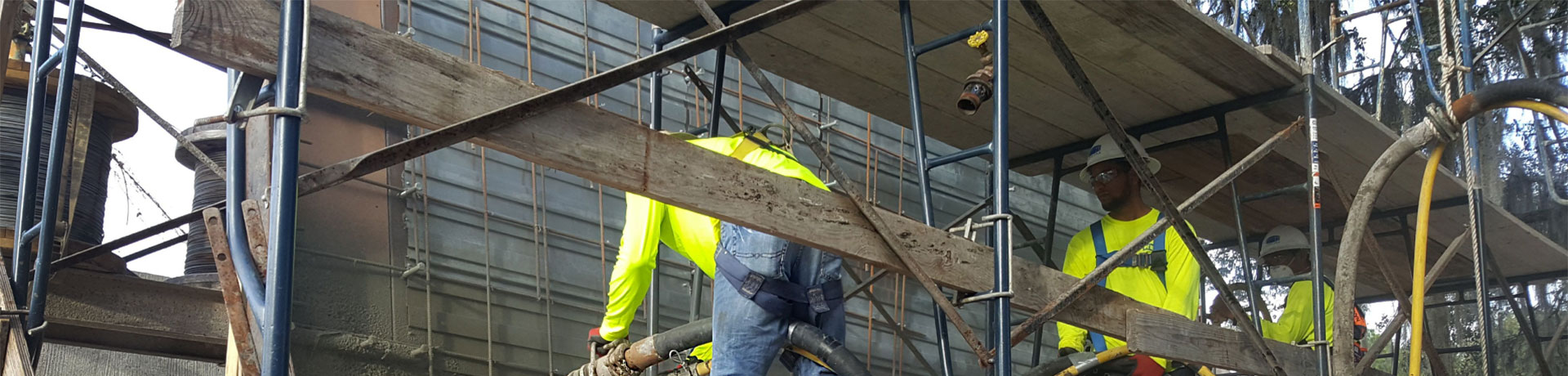
Shotcrete properly applied to a well-prepared existing concrete surface will create an excellent bond and structurally act as a monolithic system without joints or layers. Pulloff testing of shotcrete applied to concrete will often fail in the underlying concrete substrate, and not at the bond interface or within the shotcrete section.
Shotcrete is a method of placing concrete and should have similar watertightness characteristics. These characteristics can be enhanced with admixtures and supplementary cementitious materials such as silica fume. Please refer to the images of cores from shotcrete applied to existing concrete.
Do we need to coat reinforcing steel after sandblasting and prior to placement of product?
The answer is no; shotcrete will bond well to sandblasted reinforcing bar on overhead or vertical applications. Shotcrete, like conventionally placed concrete, can be placed over uncoated black bar or bar that is coated with rust inhibitors. In repair areas where there is heavy scale on the reinforcing bar and spalling of the concrete, the repair can sometimes include some sort of reinforcing bar treatment or inclusion of a rust inhibitor in the shotcrete mixture. It depends on the situation and the assessment of the design engineer as to what is necessary.
We are replacing an undersized box culvert carrying a creek under a road with a vehicular bridge. To reduce excavation limits, we are using top-down caisson wall construction with shotcrete facing between caissons for abutments and wingwalls. The shotcrete will be placed in lifts as soil is excavated between abutment/wingwall caissons. The architectural pattern for the face of the abutments and wingwalls is a rectangular pattern of an indented, V-shaped notch. The notches have a maximum depth of 2 in. (51 mm). The structural portion of the shotcrete wall will be 12 in. (305 mm) thick with steel reinforcement. Can this horizontal and vertical V-notch pattern be formed or stamped into the face of the structural wall (with additional thickness as required for pattern) in one wall placement? Or does the pattern have to be a separate placement after the structural wall is cured? If this is done in two placements, I assume that we would need reinforcing bars from the structural portion of the wall into the architectural placement and reinforcement within the architectural placement to lock it in place. What is the minimum required thickness of the architectural layer to account for reinforcing bar embedded from the structural layer and the required reinforcing bar in the architectural layer?
There are many ways to approach this situation. It would be difficult, but not impossible, to install all of the work in a top-down sequence and end up with an architecturally uniform surface.
Approach 1: Install a minimal initial layer top-down with either fibers or welded wire reinforcement. Install dowels from the caissons into the structural facing layer. Install the facing from the bottom up with preplaced V-strips to make the pattern. Finish to the outermost face of the detail strips. Alternately tool the details, but likely more like 1 in. (25 mm) instead of 2 in. (51 mm).
Approach 2: Install the structural wall top-down, encapsulating the outer reinforcing steel to a plane at the depth of the detail strips. Prepare the surface by sandblasting or water blasting to create a favorable bonding surface. Install detail strips to the face of the roughened wall. Place and finish the finish layer to the depth of the detail strips.
If the base layer is properly prepared, the bond should be very good and adding dowels would be redundant. There is nothing wrong with redundancy and if so, the minimum layer thickness would be 2 to 3 in. (51 to 76 mm).
The nature of this work will mandate the use of a highly qualified shotcrete subcontractor who has experience in installing similar-quality architecturally significant walls.
Why is there not more extensive use of fiberglass reinforcing bars? It seems like it would be a natural choice for most projects involving shotcrete in wet applications, as well as conventionally placed concrete, especially in the types of jobs we do, such as the rehabilitation of existing concrete channels that usually contain acidic waters. I understand that anything other than steel is more expensive, but isn’t prevention now cheaper than remediation later?
Although similar in dimensions, fiberglass reinforcing has distinctly different structural properties when compared to conventional steel reinforcement. This is a question better answered by the fiberglass reinforcing industry or the structural engineering community. As the American Shotcrete Association, we do not get involved in the engineering design of structural sections. However, it should be pointed out that properly designed and applied shotcrete provides a very corrosion-resistant environment around embedded steel reinforcement, providing excellent long-term durability in normal exposure conditions.
I have a client with an old, soft-stone masonry building of approximately 150 years of age. The mortar is badly deteriorated and the stone is quite friable. I am advocating the use of shotcrete as an application to the interior face of the walls that will restore both in-plane and out-of-plane strength to the building walls. My client has expressed concern that there may be incompatibility issues between the stone masonry and the shotcrete both from a structural stiffness perspective as well as from a moisture intrusion perspective. (We have successfully used shotcrete over stone masonry in the past.) Do you have any information you can share with me on this topic? Do you have either examples of incompatibility or successful use of shotcrete over stone masonry?
As you have noted, shotcrete has been used extensively to reinforce unreinforced or under-reinforced masonry walls and rock walls. It has been used on the Crater Lake Lodge to strengthen and stabilize a rock wall foundation and any number of other projects. In California, shotcrete has been used to strengthen or repair walls since the 1933 Long Beach Earthquake. It was used to strengthen the California State Capitol (3 ft [0.9 m] thick brick walls) in the late 1970s and all of the older unreinforced masonry walls for the San Francisco School District. To the best of our knowledge, there have been no failures of shotcrete strengthening on the West Coast in the past 80 years.
We are involved in the design of a hydro project in a section of a water-conveyance power tunnel; we are considering using shotcrete reinforced with welded wire reinforcement as a final liner. In this particular section, the tunnel is under an internal water pressure of 189 psi (1.3 MPa) and water velocities in the range of 16.4 ft/s (5 m/s) can be expected. We have not found any examples of such a design/use at this water velocity and are concerned about long-term durability and potential erosion of the shotcrete and entrainment of fragments into the turbine/powerhouse. Would you have any information regarding the ability of shotcrete to resist water erosion, particularly at 16.4 ft/s (5 m/s)? (Any examples would be appreciated.) What additive can be used to reduce the porosity of the projected mixture?
Shotcrete is simply a placement method for concrete, so characteristics of concrete that are resistant to erosion are equally applicable to shotcrete. ACI 210R-93, “Erosion of Concrete in Hydraulic Structures,” has guidance on flow characteristics that lead to erosion of concrete. Also, ACI 350-06, “Code Requirements for Environmental Engineering Concrete Structures and Commentary,” Sections 4.6.2 and 4.6.3, also provide guidance on concrete mixture characteristics helpful for protecting against cavitation erosion. Properly designed shotcrete mixtures can easily meet the ACI 350 4.6.3 concrete requirements.
In 2000, Rusty Morgan compiled a list of some 37 water supply tunnels that had been lined with shotcrete (a copy of the data sheet can be supplied upon request). Shotcrete was not the final lining in all of these tunnels and not all the inverts were lined with shotcrete. The evaluation does not document the water velocity in these tunnels, but could be ascertained by contacting the project owners.
It should be noted, however, that the 16.4 ft/s (5 m/s) water flow rate is not particularly fast. The water velocity needs to be in excess of 39.3 ft/s (12 m/s) before cavitation erosion can be expected (refer to A. M. Neville, Properties of Concrete) and cavitation would be the most likely cause of erosion of the concrete surface.
Supplemental cementitious materials including microsilica, fly ash, and slag will generally reduce the porosity of the hardened concrete. Microsilica is used in many shotcrete mixtures, as it helps to reduce rebound, as well as gives the fresh concrete better adhesion and cohesion that can allow for thicker or overhead placements.
We have a large project involving shotcreting soffits in an underground parking garage. The shotcreting overhead is not the problem; the problem is properly screeding the excess shotcrete from the ceiling leaving a semi-smooth finish.
Properly screeding and finishing overhead shotcrete is very challenging. The contractors who do this type of work properly have very well-trained and skilled tradesmen throughout the crew, including the nozzlemen, rodman, and finishers. Shotcrete that is not screeded and finished properly will likely suffer bonding and other issues.
Could you provide information regarding the appearance of efflorescence on a newly constructed 2 million gal. (7.57 million L) holding tank? The tank was constructed correctly and has held water for over 6 months. A leak test shows no water loss over a 72-hour period, and no moisture has been seen on the surface, but efflorescence has been noted. The tank was painted after the shotcrete was properly cured. (The applied paint was inspected by a NACE inspector and found to be approximately 7 mils [0.2 mm] and meets the specification.) At what point will this stop and what is the best practice to prevent it from happening again? Would covering the areas where it has occurred with additional paint seal the cracks??
Efflorescence is common on many exposed concrete and cement mortar applications. Generally it is seen when cracks in concrete or mortar are exposed to water rather than accumulating within the crack. The basic mechanism creating efflorescence is when concrete is exposed to water for a long time; excess free lime (calcium hydroxide) in the cement paste goes into solution with water (leaches). Then when that water eventually leaves the crack and dries on the surface, the white residue of calcium hydroxide creates what is termed “efflorescence.”
It is very common to see efflorescence on brick structures where the mortar joints are exposed to rainwater that leaches out the calcium hydroxide and the resulting white efflorescence is highlighted on the dark-colored face of the brick. In concrete tanks, it is often found in cracks that can accumulate water for a sufficient time to leach the calcium hydroxide. The bottoms of vertical cracks or low areas in horizontally oriented cracks often show the greatest buildup of efflorescence. These can be surface cracks that are exposed to rainwater or through wall cracks that are exposed to water contained within the tank.
Although the tank was cured properly to help deal with long-term drying shrinkage, surface cracking on shotcrete often results from early-age plastic shrinkage cracks. These are shallow cracks that form within hours (or minutes, in extreme conditions) of placement due to rapid evaporation of water from the exposed surface of fresh concrete (common in exposed floor slabs or in your case the fresh shotcrete wall surface).
To answer your question regarding when it will stop, the answer is it won’t unless the cracks are sealed, or water is prevented from getting into the cracks. Cement-rich shotcrete has more than enough free lime to continue the leaching for decades. Although surface-applied coatings may initially span small cracks, as the walls of tanks expand and contract due to filling and emptying, and undergoing daily and seasonal thermal changes, the surface cracks will open and close slightly and eventually mirror through the coating. Coatings designed to tolerate moving cracks would likely be much thicker than the 7 mils used on your project. If the cracks are through-wall cracks that are seeping from the contained water, the crack will need to be sealed, most commonly by injection of polyurethane grout or interior surface coatings.
To answer your question on how to prevent this in the future, early-age plastic shrinkage cracks can be reduced by fogging the fresh shotcrete surface to keep the surface humidity high and reduce evaporation of the water at the surface of the concrete. Also, using fibers in the shotcrete can help reduce plastic shrinkage cracking. In hot or windy climates, placing the final layer of shotcrete during the coolest or calmest time of the day may help, too.
To answer the question if additional paint would seal the cracks, simply coating with an additional 7 mil (0.2 mm) coating would provide a temporary seal, but more than likely the crack will mirror through after some period of exposure. A coating designer would need to evaluate the crack widths and potential movement to design a coating system that would provide a long-term seal.
Finally, the efflorescence caused by exposure to rainwater is generally only a visual defect and doesn’t affect the long-term structural integrity or durability of the tank. Many owners tolerate efflorescence on the tanks and simply clean it off when it becomes objectionable.
Can you refer me to the standards for adding water to ready mixed shotcrete?
Wet-mix shotcrete is a placement method for concrete. Ready mixed concrete used for wet-mix shotcrete needs to meet the requirements of ACI 506.2-13, “Specification for Shotcrete.” ACI 506.2 specifies concrete materials shall meet ASTM C94/C94M, “Standard Specification for Ready-Mixed Concrete.” ACI 506.2 also requires you shall batch, mix, and deliver wet-mixture shotcrete in accordance with Specification C94/C94M, or Specification C1116/C1116M if fiber-reinforced. Further guidance may be found in ACI 506R-05, “Guide to Shotcrete,” and ACI 304R-00, “Guide for Measuring, Mixing, Transporting, and Placing Concrete.”
Is there any documentation showing that it is okay to tie off to a man-lift basket? I have never found any. How do other contractors deal with ACI requirements of an air lance, knowing that OSHA has contradicting standards of air wand pressure?
OSHA requires that the personnel in aerial man baskets be tied off with the appropriate harness and lanyard. When you are in a JLG or other type of man lift, the only place to tie off to is to the basket or boom bracket. This question may be better answered by studying current OSHA documents.
We cannot recall any of our members being cited for using an air lance or blow pipe.