
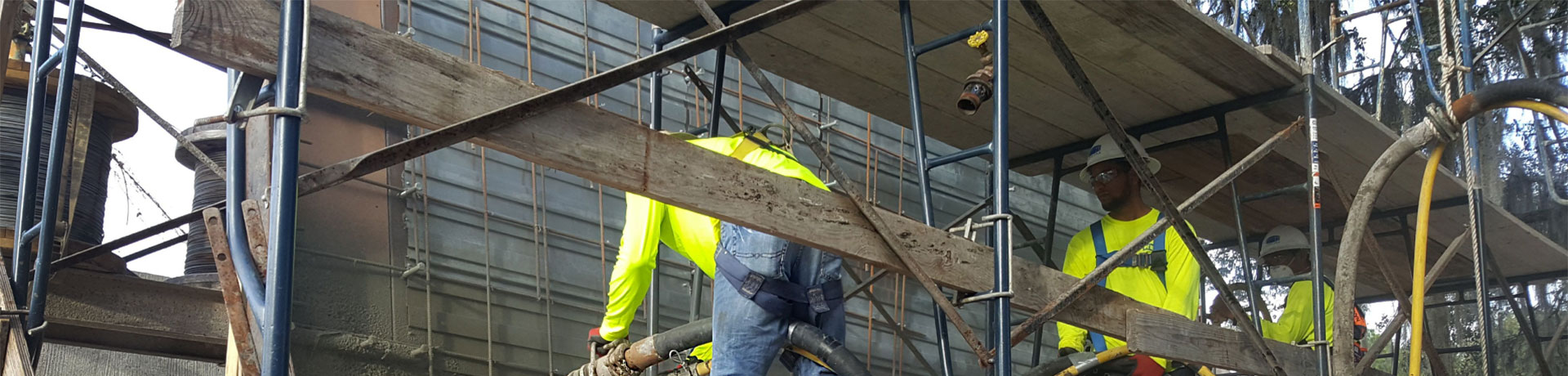
Shotcrete is a method of placing concrete. Thus, testing for selenium appropriate for concrete is suitable for shotcrete. The Portland Cement Association (PCA) has published a paper on testing of cement for various constituent components, including selenium, to meet NSF 61 requirements. Their testing showed “Values for arsenic, cadmium, selenium, and silver were all below detection limits.” The paper can be found at PCA’s website.
We are building a pool using shotcrete, and our pool design team has been asked to use the Aquron pool shell protector. The info from Aquron says for best results, spray the CPSP the morning after the shotcrete has been applied. However, our shotcrete company told us to keep the shell damp for a minimum of 7 days. Could you weigh in on this?
The ICC (International Code Council) Building Code requires a 7-day wet cure, which is good practice for concrete or shotcrete. The Aquron Technical Data Sheet mentions prewetting the surface prior to application, but we do not see the direction on the timing. You may want to question the product representative regarding how to accomplish the ICC curing requirements and also get the best results from their product.
I have a project in Fort Worth, TX, where we will be placing shotcrete on some interior walls that will have steel embeds for other structural supports. Do you have an article or literature regarding good practices of shotcrete placement around steel embeds?
Shooting around embeds can be very challenging. The most important factor is to have the work done by a shotcrete subcontractor who has done this successfully in the past and has ACI Certified Nozzlemen who are also experienced in this type of work. It has been done successfully on many projects in the past, but we do not have a published procedure to do this work.
We are in the process of renovating a commercial pool with a gutter system. The plaster surface has been removed along with some of the concrete. The wall of the gutter on the water side is tiled and is crumbling away. Our plan is to shotcrete the walls and gutter. When we shoot the walls back we will be adding 1 to 2 in. (25 to 51 mm) of shotcrete at a maximum. Is this too thin for shotcrete? Also, the gutter edge will be 2 in. (51 mm) thick and 4 in. (102 mm) in height without any reinforcing bar—will this have much strength?
Shotcrete can be placed as thin as 1 to 2 in. (25 to 51 mm), but will do little more than to provide a new surface to apply the plaster. To do a proper job you need to remove all loose and deteriorated existing shotcrete and should likely add in a layer of reinforcement or use structural fibers (either steel or synthetic) in the shotcrete mixture. The surface preparation should be done to the standards outlined by the International Concrete Repair Institute (ICRI).
I own a home on a very busy street and the house placement borders the street, approximately 75 ft (23 m) from the curb. Traffic flow has increased over the past year, and I have tried all suggested and approved soundproofing wall systems with varied results. It would seem that a shotcrete product sprayed within a wall cavity would work great. My assumption is that I would need to insulate the outward face of the cavity enough to prevent excessive condensation and moisture buildup. This would certainly solve the sound problem (depending on the mass sprayed). Are there any suggestions or references you might be able direct me to?
A properly designed shotcrete composite wall system would certainly create a quiet atmosphere in the interior of the house. There are 3-D shotcrete wall systems on the market which use shotcrete on both the interior and exterior surfaces with a foam material in the center for insulation and vapor barrier. Attempting to do something like this to an existing structure would require a lot of analysis. Shotcrete is a method of placing concrete and adding shotcrete to an existing wall would significantly increase the weight of the wall and could overload the footings or impact other parts of the system. A structural engineer well-versed in residential construction should be consulted before attempting such a modification.
I need to know about use of carbon fiber in shotcrete. Would you please inform me about some resources? Is carbon fiber suitable for shotcrete?
We would suggest that you refer to an ACI document, ACI 506.1R, “Guide to Fiber-Reinforced Shotcrete.” Carbon fibers are suitable for use in shotcrete in suitably designed mixtures.
We have a client who is looking to make a relatively deep cut in a mixture of soils and rock (approximately. 50 ft [15.2 m] high, maximum; the structures will be placed on a pad at the bottom of the cut). We are looking to provide a shotcrete facing for the entire cut area. The upper portion of the cut will be in soil; therefore, the design of a soil nail wall with temporary and permanent facing in the soil region seems to be relatively straightforward using design guidance in FHWA publications, Geotechnical Engineering Circular #7, and some software programs. Significant portions of the exposed cut face, however, consist of nondurable bedrock (claystone). We want to stabilize this area with shotcrete to prevent weathering and the generation of overhang conditions where the claystone is overlain by a more durable sandstone. I have been unable to find design procedures or guidance on specifying shotcrete (thickness, reinforcement type, etc.) and whether or not rock bolts should be used. If so, how do you select the size, spacing, resin type, etc.?
Soil and rock stabilization is an excellent application for shotcrete. However, ASA as an association does not provide engineering design. We recommend consulting with a geotechnical engineer familiar with the local geology and soil conditions to evaluate potential lateral earth forces from the claystone. Once potential loads are established, a consulting engineer experienced with shotcrete in soil nailing applications will be able to design the soil nail facing. You can check our online Buyers Guide to find a consulting engineer experienced with shotcrete.
An inspection report on our home indicated there was evidence of past rodent infiltration. An engineering consulting firm recommended that, to prevent rodents from burrowing underneath the foundation, we have a contractor apply shotcrete across the entire crawlspace bottom, then have a 2 oz. (60 mL) vapor barrier installed on top of it. The barrier would be glued or taped up the sides of the crawlspace. As there is some shrinkage of the concrete during the curing process, I would expect creatures could later emerge between the shotcrete and crawlspace sides. Have you heard this type of shotcrete application in a crawlspace as a structural pest barrier? What thickness should the shotcrete be? Is this use of shotcrete effective? Are there any potential drawbacks to using shotcrete in this way, such as possible problems with the house later on?
Shotcrete is a method of placing concrete and the properties of shotcrete are equivalent to those of cast concrete. The type of work you are describing is done in many cases with the shotcrete process and is commonly called “ratproofing.” As you have engaged an engineer, we would suggest you follow his advice and he should determine the thickness required. Providing a row of dowels around the stem wall to tie the shotcrete to the wall should eliminate any significant separation between the shotcrete and the stem wall. Shrinkage of concrete between the walls may cause some minor hairline cracking, but nothing to allow ingress of rodents or insects.
I am searching for criteria/guidelines or ratings on what different profiles are achieved by shotcrete. I am hoping there are installed shotcrete profile requirements with respect to final surface roughness. We manufacture a waterproofing system and are often asked to be installed over shotcrete, to which we have no objections. However, I am hoping there are criteria/guidelines/ratings on achieved profile of the finished surface. For example: The concrete industry often talks about roughness achieved by shotblasting and the surfaces getting to various degrees between CSP-1 to CSP-9. Is there a criteria/guideline/rating system, or something similar with shotcrete? Here is the link to some such guidelines.
Shotcrete is a method of placing concrete. The surface texture of roughness varies considerably depending on the application and the abilities of the installer. The surface can vary from a rough nozzle finish to a smooth trowel finish and many variations between these two extremes. In buildings, the typical finishes are wood float, rubber float, or trowel finish. The owner and the architect determine what finish will be required and generally specify the finish in the construction documents. The documents which might be of help to you are ACI 506R, “Guide to Shotcrete,” ACI 301, “Specifications for Structural Concrete,” and ACI 117, “Specification for Tolerances for Concrete Construction and Materials.”
I have a 24 in. (610 mm) thick concrete dome that serves as an enclosure to protect extremely sensitive and important equipment that needs to withstand high impact demands such as tornados or missiles. The contractor is proposing to use the shotcrete method with the following sequence: shoot approximately 1 in. (25 mm) (to achieve reinforcing bar cover); let stand for 8 hours; then place a reinforcing mat; then shoot the majority of the dome thickness; let stand for 8 hours; then place the other mat of reinforcing; then shoot the remaining concrete cover. I am concerned that, with an 8-hour duration between concrete placements, the three layers of concrete will not be adequately bonded such that they behave monolithically. In particular, I would be concerned that the aggregate of the concrete that is shot onto a mat of reinforcement will not be able to make its way “behind” the bar’s deformation, thus causing voids. Please let me know your thoughts on the aforementioned concerns, whether it would be reasonable to shoot a 24 in. (610 mm) dome with a minimum of two layers of reinforcement all at once, and whether any of the ACI codes or standards speak to shotcrete joints parallel to reinforcement.
Multi-layer buildout of shotcrete sections is very common and has decades of successful performance in existing structures. Shotcrete applied to a properly prepared, existing hardened concrete substrate (such as a previously shot shotcrete layer) develops an excellent bond. The high-velocity impact of shotcrete on the surface is in effect like sandblasting, and opens up the receiving surface immediately before exposing it to the fresh cementitious paste. Cores taken through multiple layered shotcrete sections exhibit no signs of reduced bond. Often it is nearly impossible to identify where one layer stops and the next starts.
Incremental placement of reinforcing bars in layered application is also common. Proper shotcrete consistency, nozzleman technique, and air velocity will force fresh cement paste around the back of the bar and fully encase the reinforcing bar, even when in contact with the previous hardened concrete surface.
Shooting a 24 in. (610 mm) thickness at one time with two layers of reinforcement in the mostly overhead orientation of a dome would require use of special concrete mixture designs with chemical accelerators, and would be very difficult to execute with consistent quality. Also, depending on the formwork design, unbalanced loading on the dome by shooting very thick sections adjacent to sections not yet shot would be a potential concern.
For more information on the performance of shotcrete in layers, you can review this article from Shotcrete magazine, “Shotcrete Placed in Multiple Layers does NOT Create Cold Joints.”