
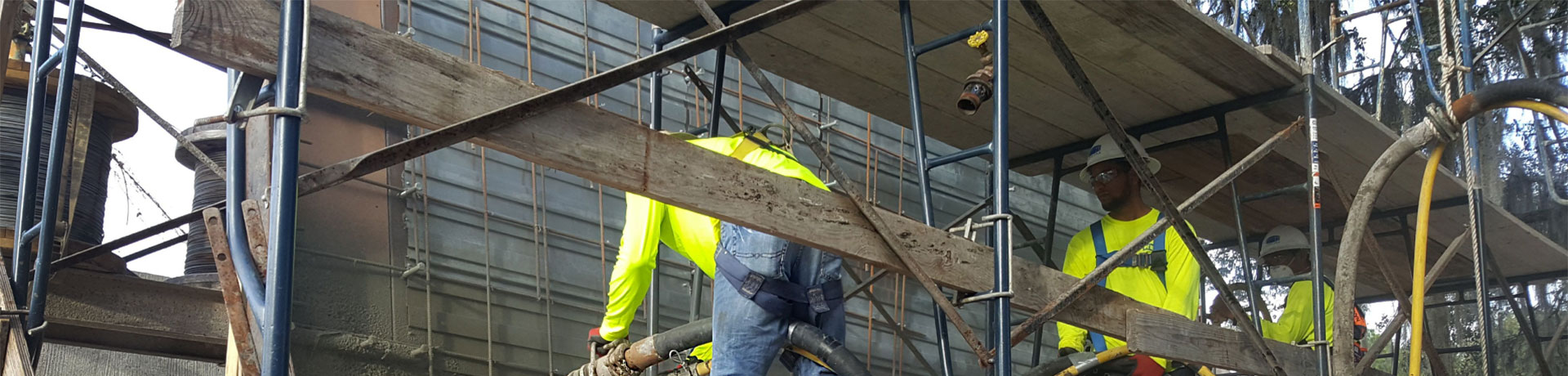
At the point at which concrete/shotcrete temperature is starting to rise and the mixture is stiffening up, adding water should not be allowed. Water should only be added when the mixture is stable and only up to the water specified in the approved mixture design. In warm or hot conditions, retarders, set stabilizing admixtures, or ice may be needed to keep the mixture stable for the period of time to transport and pump the load.
We would like to place 4 in. (100 mm) thick shotcrete reinforced with welded wire reinforcement and anchoring bolts in a water pressure tunnel. The water velocity would be between 10 and 16.4 ft/s (3 and 5 m/s). We would like to know if there is a possibility of erosion or cavitation of the shotcrete at this range of velocity. It is mentioned in our concrete manual that cavitation and destructive erosion begin when water velocities reach about 40 ft/s (12 m/s). Because the roughness of the shotcrete surface is higher than the concrete surface, is erosion more likely to occur? Do you know what may be the maximum water velocity acceptable for reinforced shotcrete?
Shotcrete is a method of placing concrete and the surface finish can be as smooth as that of cast concrete. Even with a nozzle finish, shotcrete erosion or cavitation should not be an issue at the stated velocities. Examples of smooth shotcrete surfaces can be found in many Shotcrete magazine articles and in particular (“Restoring the Century-Old Wachusett Aqueduct”).
I know that there are many factors that affect the distance that shotcrete can be pumped. For a dry-mix process, is there a rule of thumb for a maximum recommended horizontal pumping distance?
The best information on this subject can be found in ACI 506R-05, “Guide to Shotcrete,” and likely in past articles in Shotcrete magazine. The distance that can be pumped is a function of too many parameters to fit a rule of thumb. The distance that can be pumped is influenced by the equipment being used, the vertical lift, the available compressed air, and other factors. We would suggest that you consult with one of our corporate members (shotcrete.org/BuyersGuide) in the area of the project and get their input.
We have a vertical shaft that is (right now) 70 ft (21.3 m) deep and we do blasting every 5 ft (1.5 m) after applying shotcrete to the vertical surface for protection. My concern is that if we have less than 48 hours between successive blasting, is it allowable? How does one measure if the shotcrete reaches the required percentage of strength?
The best guidance on this subject can be found in ACI 506.5, “Guide for Specifying Underground Shotcrete” (available through the ASA Bookstore), and some articles from past issues of Shotcrete magazine might be of interest:
- “Shotcrete Spraying Machines for Immediate Support in Tunnels”
- “Slope Stabilization in an Open Pit Mine”
- “Where Are We Now with Sprayed Concrete Lining in Tunnels?”
- “The Danger of Fallouts in Overhead Shooting”
- “Incline Tunnel—S&S Quarries, Inc.”
- “Reaching 20 MPa (2900 psi) in 2 Hours is Possible”
- “Rapid-Setting Cement in Shotcrete”
With properly qualified nozzlemen, a good shotcrete mixture, and high-quality accelerator added at the nozzle, the re-entry time can be minimal—normally 24 hours.
I am interested in any information or suggestions you may have regarding practical working space requirements for shotcrete applications. Shotcrete is a common approach for sewer pipeline and storm-water culvert rehabilitation projects. My concern relates to the space requirements necessary to best ensure a quality installation—for pipelines, this boils down to the question: What is the smallest diameter pipe that can be used for this method? Technical specifications that I have come across call for a minimum of 3 ft (1 m) between the surface being covered and the application nozzle. To me, this means that pipes that are much smaller than 6 ft (1.8 m) would create some difficulty. Similarly, for applications between vertical walls, how much room does a nozzleman need between the wall receiving the shotcrete and the wall at his/her back? Are there robotic means or other methods in use that would allow shotcrete applications without a hands-on nozzleman? Are there any other workspace limitations or controls that should be considered when determining feasibility of shotcrete application methods?
In the case of installing a lining inside of an existing pipe, there are robotic methods available, such as spin lining, where the cementitious material is cast from a rotating head as the carrier is moved along the pipe. For pipe smaller than 42 in. (1067 mm) diameter, the spin lining is likely the best method.
For pipe larger than 42 in. (1067 mm) and up to 6 or 8 ft (1.8 or 2.4 m) diameter, either hand shotcrete nozzling or spin lining are applicable. For pipes much larger than 6 to 8 ft (1.8 to 2.4 m), hand nozzling is likely the best solution.
In the case of clearance between a wall to be shotcreted and an obstruction, 3 ft (1 m) is a good rule of thumb, but a qualified and experienced shotcrete contractor can use modified equipment to place quality shotcrete in tighter spaces. A recent article on shotcreting in confined spaces can be found here.
I had wallpapered over a cement interior basement wall years ago. Recently, When I removed the wallpaper and the liner beneath it, the shotcrete came off with the paper. Is there any way I can repair these spots? Can the shotcrete process cover a garage floor that is heavily pitted, has a few cracks, and has some dirt and road salt marks? Will it hold up to road salt and prevent further deterioration?
You mention that you had originally wallpapered over a cement interior basement wall. It is not clear that the cement interior wall was placed using the shotcrete process. If it was installed with the shotcrete process, then the application was flawed due to improper surface preparation or application. There are many concrete repair products on the market which could be used to repair the surface. Many of these are troweled on by hand or sprayed. Check with a local building supply company or on the Internet.
With respect to the garage floor, we would not recommend the shotcrete process for a thin overlay on a horizontal surface. Again, there are many products on the market that are designed for resurfacing floor slabs. Check with a local building supply company or on the Internet for potential products.
Our company is carrying out a tunnel project in rather poor geological conditions, including water seepage and poor rock, with wire mesh and two layers of steel mat. What is the reasonable rebound percentage in such conditions?
Shotcrete rebound varies for many different reasons, many of which you mention in your question. The water seepage must be controlled or the shotcrete will likely not adhere to the surface and will slough off as the water saturates the fresh shotcrete. Accelerator will help, but it is difficult, if not impossible, to achieve good results against a seeping surface. ACI 506R-05, “Guide to Shotcrete,” estimates approximate range of shotcrete losses from 10 to 30%. Some other factors affecting the percentage of rebound are:
Mixture design
- Shotcrete process (wet- or dry-mix)
- Concrete mixture design and materials (for example, microsilica will tend to create less rebound; more than 30% coarse aggregate can cause more rebound)
- Plastic concrete properties (air content, slump)
- Nozzleman competence
- Vertical placement generally has less rebound than overhead
- Thickness of buildup per layer
Reinforcing grid
- Size and spacing of reinforcing
- Stability of reinforcing grid
We are working on an historical renovation project where the existing structure has been reinforced with shotcrete. We need to attach structural studs/furring members to the face of this shotcrete. Is there any difference between standard concrete and shotcrete when it comes to fastener embed depth? We are considering powder-actuated fasteners (Hilti-type) or Tapcons.
The embedment depth of anchors in shotcrete would be the same as it would be for conventionally formed and placed concrete. Shotcrete is essentially a method of placing concrete and the same rules would apply. As with any anchoring system, it is important to make sure that you are anchoring to sound material.
I have been experiencing slow curing times (early set times). Every year during the wet season, my shotcrete curing times go from 1 MPa (145 psi) in 2 hours to 1 MPa (145 psi) in 8 hours. I believe that there is a change in the materials when the groundwater comes up. I have had water tests done, but I’m not sure what to be looking at. The recycled water that was being used had a pH of 5.7. We changed water, the problem was still there, and the pH is now 9.7. What effects does the pH level have?
A pH of 5.7 is slightly acidic, while 9.7 is quite alkaline. According to PCA’s “Design and Control of Concrete Mixtures,” most inorganic acids have no adverse effect on concrete. Organic acids (such as tannic acid) can significantly reduce strength when present in higher concentrations. Some alkaline materials, such as sodium hydroxide, in higher concentrations may cause a quick set. However, because this occurs in the rainy season, another factor that may have an impact is an increase in dissolved solids. PCA states that solid contents exceeding 50,000 ppm can increase water demand, accelerate set, lower compressive strength, and increase permeability of the hardened concrete. The appropriate test for acceptable non-potable concrete mixing water is ASTM C1602/C1602M, “Standard Specification for Mixing Water Used in the Production of Hydraulic Cement Concrete.”
We are, and have been, designing and constructing permanent soil nail and shotcrete retaining walls. Typically, our designs consist of a primary nozzle-finished shotcrete facing to shore during our top-down construction, followed by a secondary shotcrete facing that is shot and sculpted once the full height of the wall has been excavated, drilled, and shot with the primary facing. We had a comment recently that only the secondary facing thickness can be used in our design for the wall’s flexural capacity because the shotcrete layers may delaminate. Our general practice is to pressure-wash the primary nozzle-finished shotcrete facing before our approved and experienced nozzlemen place the secondary layer. From our experience, this procedure has been very effective and we have not experienced any delamination between shotcrete layers on any of the millions of square feet of shotcrete we have placed this way. If installed correctly with our general practice, is there any reason the shotcrete layers would delaminate? If not, have any studies been done to prove this to our reviewer?
All of your points are valid, but the Engineer of Record or the owner makes the final decision on recognizing a composite system or ignoring the value of the initial layer. As your experience shows, shotcrete provides an excellent bond between freshly placed layers and properly prepared concrete or shotcrete substrates. There are many articles available in the Shotcrete magazine archives—found on our website, —that may provide the designer or owner more information to allow them to make their design decision.