
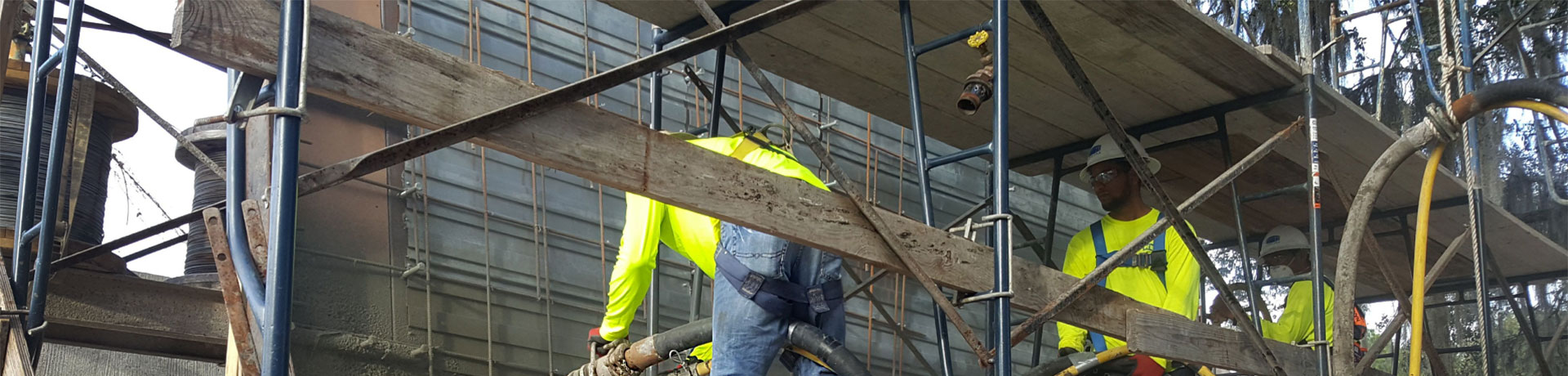
This type of application is very common. Either wet- or dry-process shotcrete can be used successfully. The mixture should contain a minimal amount of coarse aggregate and be rich in cementitious material to minimize rebound. Generally either 2 x 2 in. (50 x 50 mm) 14 gauge or 2 x 4 in. (50 x 100 mm) 12 or 14 gauge welded wire fabric is used. The wire fabric needs to be spaced off the surface of the steel pipe to allow the shotcrete to encase the wire properly. This can be accomplished by welding studs or nuts on the pipe surface and securing the wire to them.
We have a 6 in. (152 mm) thick tilt-up concrete wall that needs to be upgraded to achieve a 4-hour fire rating. We would like to add shotcrete to achieve that rating. What is the hourly rating per inch of shotcrete? We were hoping that 2 in. (51 mm) of shotcrete would provide the desired rating.
Shotcrete is a method of concrete placement, not a special type of concrete. The fire-rating of a concrete wall constructed by shotcreting or pouring will be the same. The important consideration is the requirements of the Underwriters Laboratory (UL) Fire Resistance Directory. The directory will provide guidance. UL ratings provide the most widely accepted criteria.
We are currently designing a retaining wall, sloped at 1H:0.5V, 18 ft (5.5 m) high. We want to use shotcrete for this 12 in. (300 mm) thick structural wall. For strength requirements, we are able to use a 0.4 in. (10 mm) mesh; however, this does not satisfy for crack control requirements. For crack control, it is required that 1/2 in. (12 mm) individual reinforcing bars are used. Obviously, for cost and ease of construction, the mesh is the favorable choice of reinforcing. Is there a typical section for this type of application? Will shotcrete shrink less than placed concrete?
Each retaining wall needs to be engineered for the specific job conditions. It is fairly common, however, to see two layers of reinforcing bars in a wall of this thickness. In addition to reinforcing the wall, the steel would help support the shotcrete during placement. If drying shrinkage crack control is an issue, synthetic fibers may be added. Shrinkage in shotcrete mixtures may be higher than placed concrete with a 1 in. (25 mm) maximum-sized coarse aggregate due to smaller coarse aggregate size in shotcrete mixtures, higher fine aggregate content, and higher cement/cementitious material content. This may be partially offset by a slightly lower water-cementitious material ratio in a shotcrete mixture.
We are looking at lining an existing 20 ft (6.1 m) diameter brick sewer with shotcrete that is 15 in. (0.4 m) or more thick and fairly heavily reinforced. Can this be done? The existing sewer is about 3 mi (4.8 km) long and 100 years old. Would shotcrete be a suitable method of rehabilitation? The rehabilitation is not just a liner, but the owner wants the shotcrete designed as a replacement pipe inside the existing brick sewer, designed for all earth and other superimposed loads as though the brick sewer were not there.
Yes, this can and should be done in shotcrete. Shotcrete has been used to successfully line brick sewers for 75 years. Shotcrete has been used to line over $40 million worth of brick sewers in Atlanta alone. Large brick sewers have been lined with shotcrete in most of the major midwestern cities. All of them were designed using the existing sewer as a one-sided form. Properly designed and constructed, shotcrete will provide the owner with a new concrete pipe or permanent tunnel lining and the associated expected longevity.
We are currently designing a retaining wall, sloped at 1H:0.5V, 5.5 high. We want to use shotcrete for this 12 inch (300mm) thick structural wall. For strength requirements, we are able to use a 10mm mesh, however this does not satisfy for crack control requirements. For crack control, it is required that we us 1/2 inch (12mm) individual rebars. Obviously for cost and ease of construction, the mesh is a favorable choice for reinforcing. Is there a typical section for this type of application? Will shotcrete shrink less than poured concrete?
Each retaining wall needs to be engineered for the specific job conditions. However it is fairly common to see two layers of reinforcing bars in a wall of this thickness. In addition to reinforcing the wall, the steel would help support the shotcrete during placement. If drying shrinkage crack control is an issue, synthetic fibers may be added. Shrinkage in shotcrete mixes may be higher than a poured concrete with a 1″ (25mm) maximum sized coarse aggregate content, and higher cement/cementitious material content. This may be partially offset by a slightly lower water/cementitious material ratio in a shotcrete mixture.
I am in the process of designing a 6″ shotcrete overlay for an existing wall that is approximately 1,250 square feet. The shotcrete subcontractor has proposed to use a dry-mix shotcrete. What are the advantages and disadvantages to the dry-mix process? The design includes dowels on 24″ centers and 4×4 W4xW4 wire mesh. Can the entire 6 inch thickness be placed at one or will it require a number of different lifts to build up to the 6 inch thickness?
The overlay can be placed successfully with either a dry-mix or wet-mix shotcrete process. The preference of the shotcrete subcontractor is likely related to his/her past experience and what they are best suited doing. The advantages of dry-mix process are beyond the scope of a simple answer. The process is well described in ACI 506R Guide to Shotcrete. The entire 6 inch thickness can be placed in one layer using the bench gunning technique. The number of vertical lifts would depend upon the height of the wall and the nature of the surface that the shotcrete is being placed against.
We are concerned about the compressive strengths of shotcrete recently placed on one of our projects. The specification calls for 8000 psi (55 MPa). Test results indicate we are only at 5200 psi (36 MPa) at 28 days. Ambient temperatures are constant at about 45 °F (7 °C) at the point of placement. Should we be considering removal of the shotcrete?
Shotcrete, like any other concrete mixture, will continue to gain strength as long as there are unhydrated cement particles present along with sufficient temperature and moisture. Strength development will generally be quite slow at the ambient temperature reported. The inclusion of supplementary cementitious materials in this mixture is a benefit in this instance as strength will increase as long as calcium hydroxide is available from the hydration of the cement. The specified strength should eventually be attained as long as the ambient temperature does decrease further and some form of moisture is available to the shotcrete.
I am a project engineer. Recently I received a mixture design for a shotcrete project that included limestone coarse aggregate. This is a first for me. All other shotcrete mixtures I have seen have had pea gravel as a coarse aggregate or no coarse aggregate at all. Is limestone commonly used in shotcrete?
A limestone coarse aggregate will generally be harder and more angular than what you are used to seeing in shotcrete mixtures. It really shouldn’t be a problem to use. In dry-process gunning, it is considerably more abrasive so there is more wear and tear on equipment, such as hoses, bowls, and wear plates, but it generally guns fine. In wet-process gunning, a sharper aggregate may not flow as easily through the hoses as smoother sand and pea gravel aggregates would. These are issues that the shotcrete contractor will have to address. They should have no effect on the quality of the in-place shotcrete.
Is there any specified finish for shotcrete?
There are several different finishes that are specified for shotcrete. One is a natural gun finish, which is the natural finish as sprayed (often used in slope protection). Another is a cut-down finish, which is cut-to-grade with the edge of a trowel or cutting rod (this finish is often flashed and sealed with a light gun finish to seal and texture the surface). Often in concrete repair, a trowel finish is specified where the shotcrete is cut down with the edge of a trowel or cutting rod to grade after the initial set of the material, and the surface is lightly flashed and toweled. Several different finishes can be achieved with shotcrete, but it should not be pushed or floated with the flat part of the trowel, as is done with poured concrete. It is important to wait for the initial set of the material and to use the edge of the trowel to cut the high points or shave the surface to achieve the grade or effect desired. Several excellent articles describing shotcrete finishes and finishing techniques are available as free downloads from the ASA website: shotcrete.org. One article, Technical Tip: Technical Tips on Shotcrete Finishes, written by Denis Beaupre, describes the different finishes that can be applied to shotcrete. Another article of interest would be Finishes for Retaining Walls by Marcus H. von der Hofen. Go the Publications section of the ASA website, click on “Click here to search the archive of Shotcrete Publications” and type “Shotcrete Finish” in the search window.
We have a large pond (12,000 ft2 [1115 m2]) 12 ft (4 m) deep with 2-to-1 sloped sides. It currently has an old PVC liner that is ripped and cannot be repaired. We have no shotcrete experience and wonder if shotcrete would be a better option than installing a new PVC liner?
Shotcrete is used extensively for zooscapes, water parks, museum exhibits, swimming pools, and spas. A shotcrete water feature, although more expensive than PVC liner, would provide a long-term, more aesthetically pleasing alternative to a new PVC pond liner. Shotcrete is very versatile and can be shaped to replicate natural rock ledges or boulders. A properly designed and built water feature would provide a low-maintenance, durable solution.