
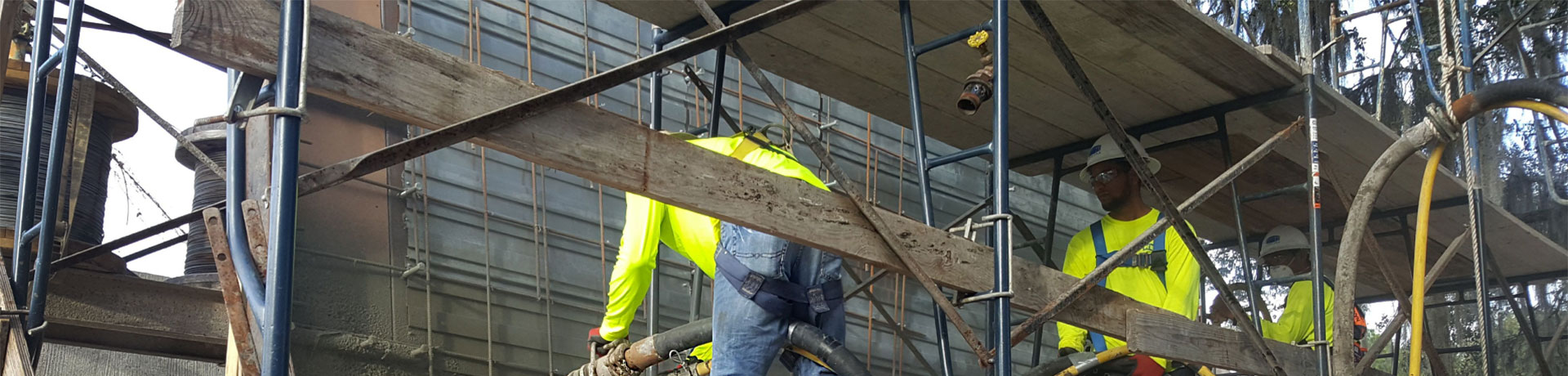
Shotcrete is concrete, and therefore if designing structures based on the ACI 318 Code, cover for conventional reinforcing steel should be those suggested in ACI 318 for concrete against ground. If the shotcrete is a “temporary” support, with further placement of “final” support, then these requirements do not apply.
We will be tiling a pool. The pool’s shotcrete walls and floor were placed approximately 10 days ago. What is the earliest we can begin gauging the pool walls and floors?
It is generally good practice to let the shotcrete cure for the full 28 days before attempting to apply coatings or overlays. We would recommend you get a recommendation on the cure time from the manufacturer of the gauging product before doing the work.
I have a seawall with a gunite (dry-mix shotcrete) outer layer. The gunite layer has cracked in multiple locations on the seawall resulting from years of exposure to the harsh environment. The original gunite was not part of a soil nail system. I am considering a re-coat of shotcrete probably 3 to 4 in. (76 to 100 mm) thick with wire mesh and L-anchors on a 2 to 3 ft (0.6 to 0.9 m) grid. I know the importance of surface treatment for bonding, etc., but I am not sure if I should remove the original gunite layer (which is still sound in some places) or apply the re-coat. The new overlay needs to be structurally effective. I know that a soil nail system is the most dependable solution, but cost is a major concern. Do you have any suggestions?
The new shotcrete layer can be added to the existing shotcrete or installed after the existing shotcrete is removed. The decision to remove or not remove the existing shotcrete is beyond the scope of what we can comment on. If the existing shotcrete is left in place and overlayed, it should be thoroughly cleaned and roughened to create a good bonding surface. Because this is in a marine environment and you are considering the use of wire mesh, you need to make the new layer thick enough to have sufficient cover on the reinforcing steel. Alternately you could consider the use of fiber-reinforced shotcrete and silica-fume-enhanced fibrous shotcrete. Please note that there are many types of fibers on the market. We recommend that you review some of the Shotcrete magazine articles on fibrous shotcrete and on shotcrete in a marine environment on the ASA Web site. We suggested two papers for reference. The first is by Gilbride, Bremner, and Morgan on the Port of Saint John, and the other is by Morgan on the use of fibers that cover marine repairs. You mentioned using “L-anchors” at 2 to 3 ft (0.6 to 0.9 m) spacing. The use of grouted anchors with a reasonable embedment is quite common, but the design of such anchors is again beyond the scope of what we can advise.
We recently stained a shotcrete wall. After we placed the staining on the wall, the stain came out in different shades across the wall, in effect bring out the different curing of the concrete. What can be done to eliminate this inconsistency?
It is not unusual to have variations in the tone of color for shotcrete or concrete walls that have been stained due to variation of the texture or density of the surface being stained. An acid-based stain typically results in more consistent shading. When anticipating that a wall will be stained, extra care needs to be taken in the curing process. It is generally recommended that walls to be stained should be water-cured to avoid any interaction between a curing compound and the stain material. If a curing compound is used, it must be completely removed prior to applying the stain material. Consult the stain supplier for more information.
Our client has a retaining wall that has experienced movement in the precast concrete panels and has asked us to research a product that could be applied to give a smooth look to the retaining wall. Is shotcrete a possible option? I would also like information on the recycled content of shotcrete.
Shotcrete is basically concrete that is pneumatically applied. Shotcrete can be used as an overlay for an existing wall to provide structural strengthening and a smooth look. Again, we suggest that you visit ASA’s Web site and search previous Shotcrete magazine articles for finishes. Before the shotcrete is applied, the wall must be stabilized from any anticipated future movement. Relatively thin layers of shotcrete or concrete will not withstand future wall movements without distress and cracking. The recycled content of most shotcrete mixtures is limited to the substitution of fly ash or other pozzolans for a percentage of the cement in the mixture. To properly place shotcrete, this substitution is generally limited to approximately 25% of the cement content.
I am a pool builder who favors dry-mix shotcrete. I have a project requiring: a) cast-in-place concrete retaining walls, where there will be exposed downhill faces (that are not necessarily meant to be seen). Should my shotcrete contractor be able to finish the exposed face in some sort of reasonable finished appearance? and b) placing a pool house foundation (about 4 ft [1.2 m] high). Would I be able to shoot these? I am thinking not because there is no place for the rebound to go.
a) Shotcrete can be finished in a wide variety of ways. It can be left with anywhere from a very rough to a very smooth finish and a huge variety of other finishes. We suggest you visit ASA’s Web site, click on the tab for Shotcrete magazine, and search the previous articles for finishes and swimming pools. You will find a lot of photos of great-looking walls. Not all shotcrete contractors are proficient in providing these attractive finishes. You need to discuss this with your current shotcrete contractor and/or interview other shotcrete contractors to make sure the chosen contractor can provide what you are looking for. We also suggest you look at work these contractors have previously completed. You can also locate contractors online at ASA’s Buyers Guide, www.Shotcrete.org\BuyersGuide.
b) If the pool house foundation is a footing trenched into the ground 4 ft (1.2 m) deep, dry-mix shotcrete would not be a good solution. If the foundation is 4 ft (1.2 m) above grade, then it could be done with shotcrete against a one-sided form. This would be considered structural shotcrete and not all shotcrete contractors are qualified to place shotcrete for structural walls. Again, we suggest you ensure the chosen contractor is qualified to do the work.
Is it feasible and economical to construct floodwalls approximately 5 ft (1.5 m) high with shotcrete?
Yes, it is feasible and economical to construct structural walls such as a 5 ft (1.5 m) high floodwall. Shotcrete is a method of placing concrete and has similar, if not identical, properties after placement. As you can imagine, shotcrete needs to be shot against something such as a one-sided form, gabion baskets, earth, expanded metal lath, or just about any structurally sound thing you can think of. The economy of the system is dependent upon the site conditions and the ingenuity of the contractor. An example of a similar structure is on the east side of I-880, south of Dixon Landing Road in Milpitas, CA. This project, a flood control channel, involved trapezoidal channel sections, vertical wall sections, and a combination of sloped walls with a vertical extension. If you have further interest, you should contact an organization with experience in this area. An excellent source is the directory of Corporate Members in the ASA Buyers Guide.
I am a civil engineer looking to use shotcrete in a culvert rehabilitation project. Due to flow constraints, we are forced to have a maximum wall thickness of 3 in. (76 mm). For the typical 96 in. (2438 mm) precast concrete culvert, the walls are approximately 9 in. (228 mm). What can I do to obtain a near similar product with only 3 in. (76 mm) of wall thickness? Can shotcrete be applied at higher compressive strengths, 10 psi (0.07 MPa), or is it better to use fiber-reinforced shotcrete? The intent of the retrofit is to at least obtain a 10-year service life to this temporary solution.
This is an engineering question, not an application question. Precast pipe is sized for multiple uses and services. Depending on this service (depth of cover or loads), creative reinforcing bar placement and higher compressive strengths can reduce the wall thickness significantly. For example, success has been realized using elliptical steel to reduce concrete section thickness. Fiber reinforcement is secondary reinforcing and is not a suitable replacement for reinforcing steel. Given the short life required of the culvert, and assuming fairly equal loading on the circumference, a 3 to 4 in. (76 to 101 mm) section with judiciously placed reinforcing bar, and silica fume (8 to 10% of cement for higher strength up to 10,000 psi (69 MPa)]) would be sufficient. The resulting culvert’s life would probably be much longer than 10 years. In the end, an engineering call should be made, but the material will perform.
I am reconfiguring the interior of a spa and am wondering if drains and jets can be relocated without compromising the overall structure and getting cold cracks. Can the entire interior be re-shot to maintain the monolithic form and guarantee against failure? Is there an independent professional who could conduct an on-site inspection and recommend a next step?
We are not able to advise you on the structural integrity of a remodel of a spa or any other structure and would suggest you consult with a local engineer who is familiar with pools and spas. Shotcrete is often used to overlay or patch structures and the success of such overlays and patches is highly dependent upon the quality of the surface preparation prior to the application of the shotcrete. With respect to referrals of independent professionals, we would suggest that you use the directory of Corporate Members in the ASA Buyers Guide.
I am lining a below-ground conical shaped excavation with shotcrete. Dimensions are approximately 90 ft (27.4 m) diameter by 45 ft (13.7 m) depth. Sand will be moved in and out of the container daily. Temperature range is 590 to 740 °F (310 to 393 °C). Can you tell me if a mixture is available that can meet the following specific conditions: Withstand the temperature ranges noted above without spalling, cracking, etc.; and Resist abrasion assuming hot sand is flowing over the surface area daily?
You certainly have adverse conditions to work with! There are products on the market based on calcium aluminate cements that will tolerate the temperatures you mention and are durable. These products can be placed using the shotcrete process. A list of companies who supply this product can be found at www.shotcreteweb.wpengine.com/pages/products-services-information/buyers-guide/.