
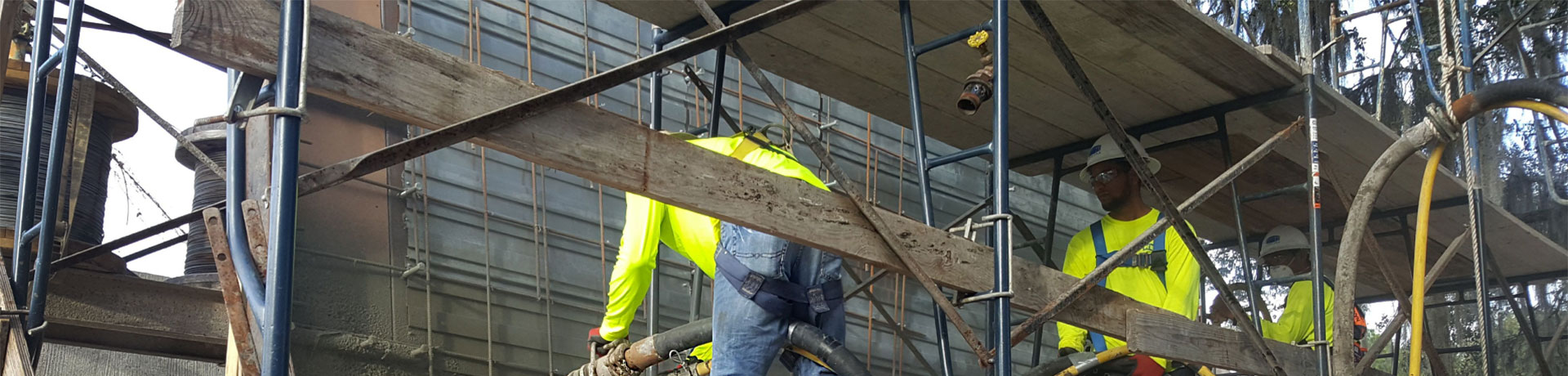
Shotcrete would work well for the overlay of the walls. In most cases, floors are placed by a conventional cast-in-place method. Either the wet- or dry-mix procedure would work well for the walls. To ensure good bond of the shotcrete to the walls, the walls should be cleaned and prepared to assure that the shotcrete is bonding to sound material rather than contaminates such as dirt or weathered material. You might also want to consider reinforcing the walls, but you should consult with an engineer on how to do this and with what material. If you were to use the wet-mix process, you could use the same equipment to place the floor as you are using for the walls.
I am repairing a concrete masonry unit (CMU) block wall that was partially damaged when a portion of the roof collapsed. The engineer on the project is proposing to apply shotcrete to one side of the wall to help structurally reinforce the wall. I would like to know if there is a way to finish the wall so it is cosmetically pleasing, especially since this is on the inside of an existing building with the other walls being a painted CMU. Also, were can I get some conceptual pricing for applying the shotcrete?
Shotcrete can, and often is, finished to provide nice printable wall surfaces. To be the same general texture of the concrete block wall, you should specify a wood or rubber float finish. You can access the ASA Buyers Guide at https://shotcrete.org/products-services-information/buyers-guide/ to locate organizations regarding budget or conceptual pricing.
We would like to get approval to use shotcrete on the perimeter walls of an existing laboratory building. We would be shooting against a waterproofing membrane and shoring lagging. The project engineer is concerned that the shotcrete will damage the membrane, resulting in leaking into the occupied space. Are there any examples where this type of shotcrete placement has been used?
This is a commonly used technique in the Western U.S. and Canada, and has been used successfully from Stanley Hall at the University of California at Berkeley, Berkeley, CA, to the Baltimore Hilton Convention Center near Camden Yards, Baltimore, MD. There are a number of suppliers of waterproofing materials to choose from for this application. In selecting a supplier, be sure there is field service available to inspect the project before placement of the shotcrete.
What is the maximum thickness for shotcrete used for shear walls? Can we use more than 12 ft (3.7 m) if we use a double layer of reinforcing?
There is no stated maximum thickness for shotcrete used in shear walls or any other type of wall. Walls have been successfully placed to a thickness of 36 in. (914 mm) for some time. The two main concerns are the heat of hydration and proper encapsulation of the reinforcing steel. Because shotcrete mixtures typically contain more cement per cubic yard or cubic meter than formed and poured placements, there will be more heat generated by the shotcrete mixture. The ability of the nozzleman to encapsulate the reinforcing will be a function of proper mixture design, proper selection of shotcrete equipment, and the skill level of the nozzleman and the crew.
We are having a swimming pool constructed. The pool consultant is concerned about cold joints during construction if walls and the floor are shotcreted on different days. The shotcrete subcontractor states that there is no problem as the next layer of shotcrete will knit itself to the previous placement and form a solid bond. Is the shotcrete subcontractor correct?
Yes, if care is taken to prepare the receiving surface properly. The receiving shotcrete edge must be sound (no loose or unconsolidated material), clean (no traces of laitance or gloss), rough, and dampened to a saturated surface-dry condition. If these steps are followed, there should be no concern about the soundness of the joint.
Can shotcrete be applied to a slope to act as a retaining wall without a moisture barrier? If a moisture barrier is recommended, what type should we use?
Most shotcrete slopes are placed without moisture barriers and are constructed to ensure that water pressure does not build up behind the slope and create hydrostatic pressure on the backside of the shotcrete. This is generally done with drainage material and weep holes or vents near the base of the shotcrete slope. Please bear in mind that shotcrete slope paving alone is not generally considered as a retaining wall. If shotcrete slope paving is to be used as a retaining structure, it is generally done in conjunction with soil nailing, tie backs, or some type of structural footing. If the shotcrete is intended to be used as a structural wall, a structural engineer must be consulted to be sure all structural issues are addressed.
How can I maintain a 2 in. (50 mm) thickness of shotcrete in a rock excavated tunnel?
There are many ways of maintaining the thickness of shotcrete. When placing shotcrete over a rough rock excavation, the thickness will vary with more material filling in the voids than covering the high points. Some methods of checking or maintaining the thickness are as follows: stabbing the plastic shotcrete with a depth gauge; preinstalling pins to the desired thickness; and using groundwires or shooting wires that would create an even plane over the length of the wires.
What can we add to dry-process shotcrete mixtures for cold weather operations?
Successful cold weather placements require more than just modifying a mixture. The mixture temperature, condition of the substrate, and the placing and curing environment are also important considerations. Generally, one is discouraged from trying to apply shotcrete if substrate temperatures are too cold and the ambient temperature is at 40 °F (5 °C) and falling. There are, however, exceptions for extreme situations such as shotcreting in permafrost ground conditions, where it is not possible (or advisable) to heat up the substrate. In such conditions, special accelerated dry-mix shotcretes (in conjunction with the use of heated materials) have been successfully used. This type of work is highly specialized and not recommended for the novice.
Accelerators can be added to shotcrete mixtures to help overcome cold weather conditions. The accelerator can be either a liquid accelerator added with the mixing water at the nozzle or a dry-powdered accelerator in prebagged dry-mix shotcrete. Caution is advised when using accelerators containing calcium chloride, as the use of these materials may accelerate corrosion of reinforcing steel. More information can be found in ACI 306R, “Cold Weather Concreting,” available from the American Concrete Institute, www.concrete.org.
We are constructing a canopy for a mine entrance. We need to attach some type of wire mesh to the wood fillers to give the shotcrete some surface to bond to. What type of wire would be the best for this application? The mine canopy is self-supporting and the shotcrete is strictly to be used as a sealant.
AA typical wire mesh for such applications is 2 x 2 in. (51 x 51 mm) by 12 or 14 gauge; 3 x 3 in. (76 x 76 mm) by 11 gauge; or 4 x 4 in. (102 x 102 mm) by 10 gauge. It is important that the mesh be secured such that it does not move during the shotcrete placement. The mesh will tend to be pushed away from the back surface by the pressure of the shotcrete application.
Can brackish or salt water be used to make shotcrete for a pool and will it have any negative effect on the quality of a shotcrete pool?
As a general rule of thumb, brackish or salt water should not be used as shotcrete mixing water. High chloride ion contents can cause rapid setting of the shotcrete (which can make finishing difficult) and longer-term reinforcing steel corrosion-induced cracking, delamination, and spalling. Other components of brackish water can also be damaging to the fresh and hardened shotcrete. For a detailed statement on what constitutes acceptable contents of various dissolved chemicals for concrete/shotcrete mixing water, refer to the Portland Cement Association publication Design and Control of Concrete Mixtures, Chapter 4, “Mixing Water for Concrete.” One could also consult ASTM C1602/C1602M for limits on the composition of nonpotable water for use in the production of shotcrete.