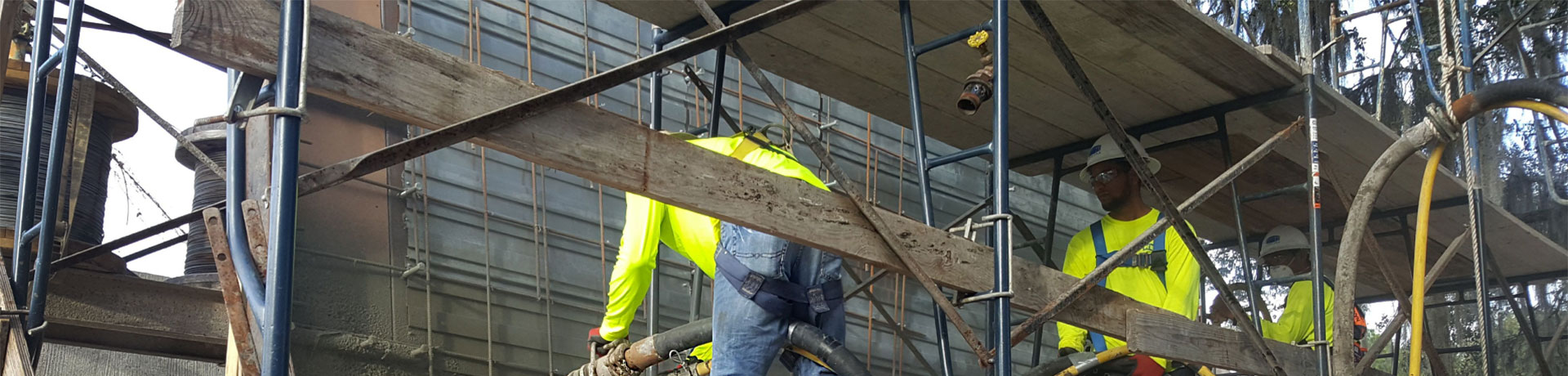
There are four basic reasons to require preconstruction qualification testing:
- To prove the suitability of the fresh shotcrete mixture design for the intended use;
- To verify the proposed mixture will produce the required strength and any other specified hardened shotcrete properties;
- To prove the ability of the nozzleman (and blowpipe operator, if required) to place dense, homogeneous shotcrete completely encasing the reinforcing steel under field conditions; and
- To prove the desired surface finish can be achieved.
This testing must be discussed in detail with the shotcrete contractor in advance with a clear understanding of the expected outcomes and the process for any required adjustments. Requiring ACI Nozzleman certification is an important requirement in screening for qualified nozzle operators. However, it is not a guarantee that the nozzleman has applied shotcrete under the same conditions to be encountered on your project. Therefore, a preconstruction plan is an important part of critical projects. Other prequalification testing may be necessary depending on the nature of the work.
There are a number of ways to treat these stains. Successful treatment will depend on the specific material in the stain and the depth of the stain. The first step would be to try to draw out the material from the surface by applying a poultice of finely ground kitty litter, cement powder, or talc and allow the surface to dry. Repeat this application if necessary.
Next, try a scrubbing a nominally dry detergent powder into the surface. Allow the powder to dry and rinse off the surface. Follow this treatment with a liquid detergent scrubbed with a bristle brush into the surface. Allow the liquid to remain in the surface for 1 to 2 days, then rinse thoroughly. Should the staining persist, you may want to try a proprietary stain remover specifically intended for use on concrete.
Muratic acid is also an option. However, muratic acid can have deleterious affects on the concrete if not thoroughly removed. Because of its potential to attack concrete aggregates and mortar, along with the hazards inherent with applying and removing acid, muratic acid should only be used with the guidance of an experienced consultant. Following a thorough power washing, the surface should be mechanically roughened to ensure proper bond with the shotcrete.
Shotcrete needs to be protected from rain until it obtains its final set, usually 4 or 5 hours. Following final set, it should be wet cured for at least 4 days, preferably 7 days if possible. The exposure to rain would prove beneficial as the rain would assure the presence of moisture for continued curing.
ASTM C 33 contains a variety of aggregate gradations. Gradations recommended for shotcrete applications can be found in ASTM C 1436, Standard Specification for Materials for Shotcrete, or ACI 506, Guide to Shotcrete. Note that ACI 506 includes the caveat that “aggregates failing to comply with gradations shown in Table 2.1 may be used if preconstruction testing proves that they give satisfactory results or if acceptable service records are available.”
Shotcrete is a method of concrete placement, not a product. Therefore, concrete placed by the shotcrete method will exhibit the same characteristics as concrete placed by other methods. Mixture designs and proportions for shotcrete are modified for high-velocity placement. The high velocity provides some performance improvements over conventional cast-in-place methods when properly placed.
There are areas that have no problem getting values lower than the most stringent ACI requirement of 0.06% for prestressed concrete with no special adjustments. It would be prudent to test each of the proposed shotcrete constituents to determine their soluble chloride ion content. The most likely suspects are the aggregate and water sources. Typically portland cement and silica fume would contribute little, if any, detectable chloride ions. Assuming this would be a dry-process application, the only admixture other than the silica fume might be an air entraining agent, which would not provide any chloride ions. This leaves only the aggregates and water as the sources. At a minimum, the aggregates and water should be tested by a qualified laboratory for soluble chloride ion content. Alternate sources of aggregates and water may be required based on the laboratory results.
If this statement was true, there would be a lot more shotcrete projects! The truth is that shotcrete is a method of concrete placement, not a special material. The materials, mix designs, and mix proportions may vary between the shotcrete method and the conventional concrete form and pour method, but the thickness and reinforcing of the structure will be very similar.
There is a subtle difference between the two methods that might affect thickness requirements. Shotcrete is generally placed directly onto the undisturbed soil, joining with the soil to provide the shell for the pool. To use the form and pour method, over-excavation would be required to accommodate two-sided forming. The walls would then have to withstand the forces of backfilling. This may result in a thicker wall requirement. The final decision regarding wall thickness, however, should be made by a structural engineer.
Shotcrete is widely used for swimming pool construction. In some areas it is virtually the only method used. Successful shotcrete swimming pool construction is a result of having an appropriate design, selecting a qualified contractor with certified nozzlemen, selecting appropriate materials and shotcrete mixture design, and following industry recommendations for placing, finishing, and curing.
Shotcrete containing silica fume will tend to be more adhesive (sticking to substrate surfaces) and cohesive (adhesion to itself). This will result in quicker build-up (greater thicknesses per pass) and possibly reduced need for accelerators. Silica fume additions also result in dramatic reductions in rebound, particularly with the dry-mix process.
Shotcrete made with normalweight aggregates will have a density of approximately 145 lb/ft3 (2323 kg/m3).
No. Shotcrete is a method of placing concrete. Therefore, any applicable certifications would apply to concrete regardless of the method of placement.