
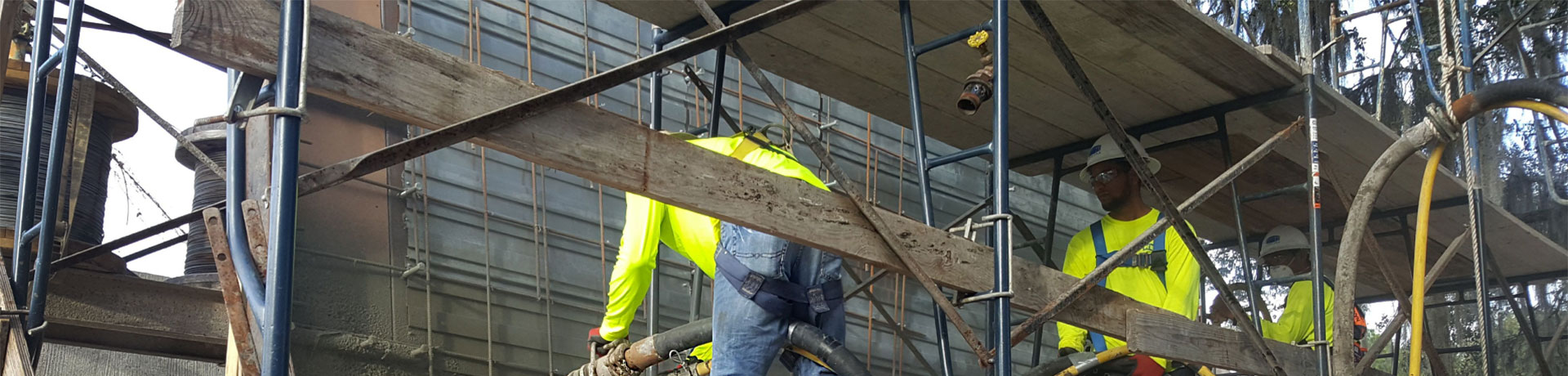
There are many ways of maintaining the thickness of shotcrete. When placing shotcrete over a rough rock excavation, the thickness will vary with more material filling in the voids than covering the high points. Some methods of checking or maintaining the thickness are as follows: stabbing the plastic shotcrete with a depth gauge; preinstalling pins to the desired thickness; and using groundwires or shooting wires that would create an even plane over the length of the wires.
What can we add to dry-process shotcrete mixtures for cold weather operations?
Successful cold weather placements require more than just modifying a mixture. The mixture temperature, condition of the substrate, and the placing and curing environment are also important considerations. Generally, one is discouraged from trying to apply shotcrete if substrate temperatures are too cold and the ambient temperature is at 40 °F (5 °C) and falling. There are, however, exceptions for extreme situations such as shotcreting in permafrost ground conditions, where it is not possible (or advisable) to heat up the substrate. In such conditions, special accelerated dry-mix shotcretes (in conjunction with the use of heated materials) have been successfully used. This type of work is highly specialized and not recommended for the novice.
Accelerators can be added to shotcrete mixtures to help overcome cold weather conditions. The accelerator can be either a liquid accelerator added with the mixing water at the nozzle or a dry-powdered accelerator in prebagged dry-mix shotcrete. Caution is advised when using accelerators containing calcium chloride, as the use of these materials may accelerate corrosion of reinforcing steel. More information can be found in ACI 306R, “Cold Weather Concreting,” available from the American Concrete Institute, www.concrete.org.
We are constructing a canopy for a mine entrance. We need to attach some type of wire mesh to the wood fillers to give the shotcrete some surface to bond to. What type of wire would be the best for this application? The mine canopy is self-supporting and the shotcrete is strictly to be used as a sealant.
AA typical wire mesh for such applications is 2 x 2 in. (51 x 51 mm) by 12 or 14 gauge; 3 x 3 in. (76 x 76 mm) by 11 gauge; or 4 x 4 in. (102 x 102 mm) by 10 gauge. It is important that the mesh be secured such that it does not move during the shotcrete placement. The mesh will tend to be pushed away from the back surface by the pressure of the shotcrete application.
Can brackish or salt water be used to make shotcrete for a pool and will it have any negative effect on the quality of a shotcrete pool?
As a general rule of thumb, brackish or salt water should not be used as shotcrete mixing water. High chloride ion contents can cause rapid setting of the shotcrete (which can make finishing difficult) and longer-term reinforcing steel corrosion-induced cracking, delamination, and spalling. Other components of brackish water can also be damaging to the fresh and hardened shotcrete. For a detailed statement on what constitutes acceptable contents of various dissolved chemicals for concrete/shotcrete mixing water, refer to the Portland Cement Association publication Design and Control of Concrete Mixtures, Chapter 4, “Mixing Water for Concrete.” One could also consult ASTM C1602/C1602M for limits on the composition of nonpotable water for use in the production of shotcrete.
We would like to apply a 2 in. (50 mm) layer of shotcrete on 10 ft (3 m) diameter steel pipes including wire mesh. Is this practical? If so, how do we do this successfully?
This type of application is very common. Either wet- or dry-process shotcrete can be used successfully. The mixture should contain a minimal amount of coarse aggregate and be rich in cementitious material to minimize rebound. Generally either 2 x 2 in. (50 x 50 mm) 14 gauge or 2 x 4 in. (50 x 100 mm) 12 or 14 gauge welded wire fabric is used. The wire fabric needs to be spaced off the surface of the steel pipe to allow the shotcrete to encase the wire properly. This can be accomplished by welding studs or nuts on the pipe surface and securing the wire to them.
We have a 6 in. (152 mm) thick tilt-up concrete wall that needs to be upgraded to achieve a 4-hour fire rating. We would like to add shotcrete to achieve that rating. What is the hourly rating per inch of shotcrete? We were hoping that 2 in. (51 mm) of shotcrete would provide the desired rating.
Shotcrete is a method of concrete placement, not a special type of concrete. The fire-rating of a concrete wall constructed by shotcreting or pouring will be the same. The important consideration is the requirements of the Underwriters Laboratory (UL) Fire Resistance Directory. The directory will provide guidance. UL ratings provide the most widely accepted criteria.
We are currently designing a retaining wall, sloped at 1H:0.5V, 18 ft (5.5 m) high. We want to use shotcrete for this 12 in. (300 mm) thick structural wall. For strength requirements, we are able to use a 0.4 in. (10 mm) mesh; however, this does not satisfy for crack control requirements. For crack control, it is required that 1/2 in. (12 mm) individual reinforcing bars are used. Obviously, for cost and ease of construction, the mesh is the favorable choice of reinforcing. Is there a typical section for this type of application? Will shotcrete shrink less than placed concrete?
Each retaining wall needs to be engineered for the specific job conditions. It is fairly common, however, to see two layers of reinforcing bars in a wall of this thickness. In addition to reinforcing the wall, the steel would help support the shotcrete during placement. If drying shrinkage crack control is an issue, synthetic fibers may be added. Shrinkage in shotcrete mixtures may be higher than placed concrete with a 1 in. (25 mm) maximum-sized coarse aggregate due to smaller coarse aggregate size in shotcrete mixtures, higher fine aggregate content, and higher cement/cementitious material content. This may be partially offset by a slightly lower water-cementitious material ratio in a shotcrete mixture.
We are looking at lining an existing 20 ft (6.1 m) diameter brick sewer with shotcrete that is 15 in. (0.4 m) or more thick and fairly heavily reinforced. Can this be done? The existing sewer is about 3 mi (4.8 km) long and 100 years old. Would shotcrete be a suitable method of rehabilitation? The rehabilitation is not just a liner, but the owner wants the shotcrete designed as a replacement pipe inside the existing brick sewer, designed for all earth and other superimposed loads as though the brick sewer were not there.
Yes, this can and should be done in shotcrete. Shotcrete has been used to successfully line brick sewers for 75 years. Shotcrete has been used to line over $40 million worth of brick sewers in Atlanta alone. Large brick sewers have been lined with shotcrete in most of the major midwestern cities. All of them were designed using the existing sewer as a one-sided form. Properly designed and constructed, shotcrete will provide the owner with a new concrete pipe or permanent tunnel lining and the associated expected longevity.
We are currently designing a retaining wall, sloped at 1H:0.5V, 5.5 high. We want to use shotcrete for this 12 inch (300mm) thick structural wall. For strength requirements, we are able to use a 10mm mesh, however this does not satisfy for crack control requirements. For crack control, it is required that we us 1/2 inch (12mm) individual rebars. Obviously for cost and ease of construction, the mesh is a favorable choice for reinforcing. Is there a typical section for this type of application? Will shotcrete shrink less than poured concrete?
Each retaining wall needs to be engineered for the specific job conditions. However it is fairly common to see two layers of reinforcing bars in a wall of this thickness. In addition to reinforcing the wall, the steel would help support the shotcrete during placement. If drying shrinkage crack control is an issue, synthetic fibers may be added. Shrinkage in shotcrete mixes may be higher than a poured concrete with a 1″ (25mm) maximum sized coarse aggregate content, and higher cement/cementitious material content. This may be partially offset by a slightly lower water/cementitious material ratio in a shotcrete mixture.
I am in the process of designing a 6″ shotcrete overlay for an existing wall that is approximately 1,250 square feet. The shotcrete subcontractor has proposed to use a dry-mix shotcrete. What are the advantages and disadvantages to the dry-mix process? The design includes dowels on 24″ centers and 4×4 W4xW4 wire mesh. Can the entire 6 inch thickness be placed at one or will it require a number of different lifts to build up to the 6 inch thickness?
The overlay can be placed successfully with either a dry-mix or wet-mix shotcrete process. The preference of the shotcrete subcontractor is likely related to his/her past experience and what they are best suited doing. The advantages of dry-mix process are beyond the scope of a simple answer. The process is well described in ACI 506R Guide to Shotcrete. The entire 6 inch thickness can be placed in one layer using the bench gunning technique. The number of vertical lifts would depend upon the height of the wall and the nature of the surface that the shotcrete is being placed against.