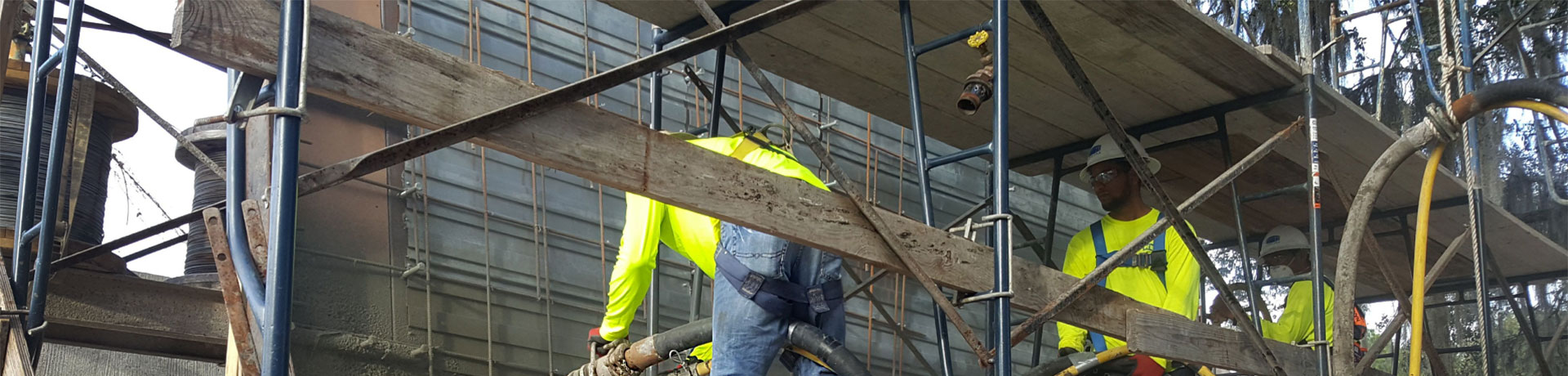
Vertical formwork can generally be removed the day following the shotcrete installation. If the formwork is supporting a load like a soffit form, the form should not be removed until the shotcrete has attained full strength such that it can support the weight of the member.
Your question regarding the installation of the tile should be directed to a professional who installs tile.
Type FA shotcrete uses a fine aggregate meeting the requirements of ASTM C1436 Gradation #1. Type CA shotcrete uses a combined aggregate gradation meeting the requirements of ASTM C1436 Gradation #2. The decision on which type to use depends on the application, shotcrete thickness, specification requirements, and perhaps the shotcrete equipment to be used, that is, wet- or dry-process. For example, one may want to use Type FA if using dry-process equipment and placing thin sections, or when a smooth finished surface texture is required. For thicker sections, Type CA shotcrete may provide the best properties for the application. The choice of which to use depends on the application, equipment, and experience of the contractor.
Shotcrete is well suited to the application you have described. You need to determine the characteristics that you want from the shotcrete (strength, toughness, freeze-thaw durability) and include these in the specification. The 1 in. (25 mm) seems very thin for a long-term installation. Please be aware that the material costs (in most cases) will be a small part of the total cost of the installation. You should also make sure that you have a good specification for surface preparation. If the existing surface is not properly prepared, the added shotcrete will not bond well and the installation will not last very long.
The ASA Online Buyers Guide (www.Shotcrete/BuyersGuide) is an excellent source to locate members within the field of shotcrete whom are listed as shotcrete consultants.
Shotcrete is concrete and the same rules apply with respect to cold weather applications. Cold weather is defined in ACI 306R, “Cold Weather Concreting” as “a period when, for more than 3 consecutive days, the following conditions exist: 1) the average daily air temperature is less than 40°F (4.4°C) and 2) the air temperature is not greater than 50°F (10°C) for more than one-half of any 24-hour period.” ACI 306R is an excellent reference that provides recommendations for cold weather concrete placement and protection. A copy of ACI 306R can be purchased online at ACI’s Web site, www.concrete.org, from the Bookstore and Publications tab. You can also download articles regarding cold weather placement from ASA’s Web site, shotcrete.org—click on “Shotcrete magazine,” go to the article search page, and type in “cold weather.”
Shotcrete is concrete, and therefore if designing structures based on the ACI 318 Code, cover for conventional reinforcing steel should be those suggested in ACI 318 for concrete against ground. If the shotcrete is a “temporary” support, with further placement of “final” support, then these requirements do not apply.
It is generally good practice to let the shotcrete cure for the full 28 days before attempting to apply coatings or overlays. We would recommend you get a recommendation on the cure time from the manufacturer of the gauging product before doing the work.
The new shotcrete layer can be added to the existing shotcrete or installed after the existing shotcrete is removed. The decision to remove or not remove the existing shotcrete is beyond the scope of what we can comment on. If the existing shotcrete is left in place and overlayed, it should be thoroughly cleaned and roughened to create a good bonding surface. Because this is in a marine environment and you are considering the use of wire mesh, you need to make the new layer thick enough to have sufficient cover on the reinforcing steel. Alternately you could consider the use of fiber-reinforced shotcrete and silica-fume-enhanced fibrous shotcrete. Please note that there are many types of fibers on the market. We recommend that you review some of the Shotcrete magazine articles on fibrous shotcrete and on shotcrete in a marine environment on the ASA Web site. We suggested two papers for reference. The first is by Gilbride, Bremner, and Morgan on the Port of Saint John, and the other is by Morgan on the use of fibers that cover marine repairs. You mentioned using “L-anchors” at 2 to 3 ft (0.6 to 0.9 m) spacing. The use of grouted anchors with a reasonable embedment is quite common, but the design of such anchors is again beyond the scope of what we can advise.
It is not unusual to have variations in the tone of color for shotcrete or concrete walls that have been stained due to variation of the texture or density of the surface being stained. An acid-based stain typically results in more consistent shading. When anticipating that a wall will be stained, extra care needs to be taken in the curing process. It is generally recommended that walls to be stained should be water-cured to avoid any interaction between a curing compound and the stain material. If a curing compound is used, it must be completely removed prior to applying the stain material. Consult the stain supplier for more information.
Shotcrete is basically concrete that is pneumatically applied. Shotcrete can be used as an overlay for an existing wall to provide structural strengthening and a smooth look. Again, we suggest that you visit ASA’s Web site and search previous Shotcrete magazine articles for finishes. Before the shotcrete is applied, the wall must be stabilized from any anticipated future movement. Relatively thin layers of shotcrete or concrete will not withstand future wall movements without distress and cracking. The recycled content of most shotcrete mixtures is limited to the substitution of fly ash or other pozzolans for a percentage of the cement in the mixture. To properly place shotcrete, this substitution is generally limited to approximately 25% of the cement content.
a) Shotcrete can be finished in a wide variety of ways. It can be left with anywhere from a very rough to a very smooth finish and a huge variety of other finishes. We suggest you visit ASA’s Web site, click on the tab for Shotcrete magazine, and search the previous articles for finishes and swimming pools. You will find a lot of photos of great-looking walls. Not all shotcrete contractors are proficient in providing these attractive finishes. You need to discuss this with your current shotcrete contractor and/or interview other shotcrete contractors to make sure the chosen contractor can provide what you are looking for. We also suggest you look at work these contractors have previously completed. You can also locate contractors online at ASA’s Buyers Guide, www.Shotcrete.org\BuyersGuide.
b) If the pool house foundation is a footing trenched into the ground 4 ft (1.2 m) deep, dry-mix shotcrete would not be a good solution. If the foundation is 4 ft (1.2 m) above grade, then it could be done with shotcrete against a one-sided form. This would be considered structural shotcrete and not all shotcrete contractors are qualified to place shotcrete for structural walls. Again, we suggest you ensure the chosen contractor is qualified to do the work.