
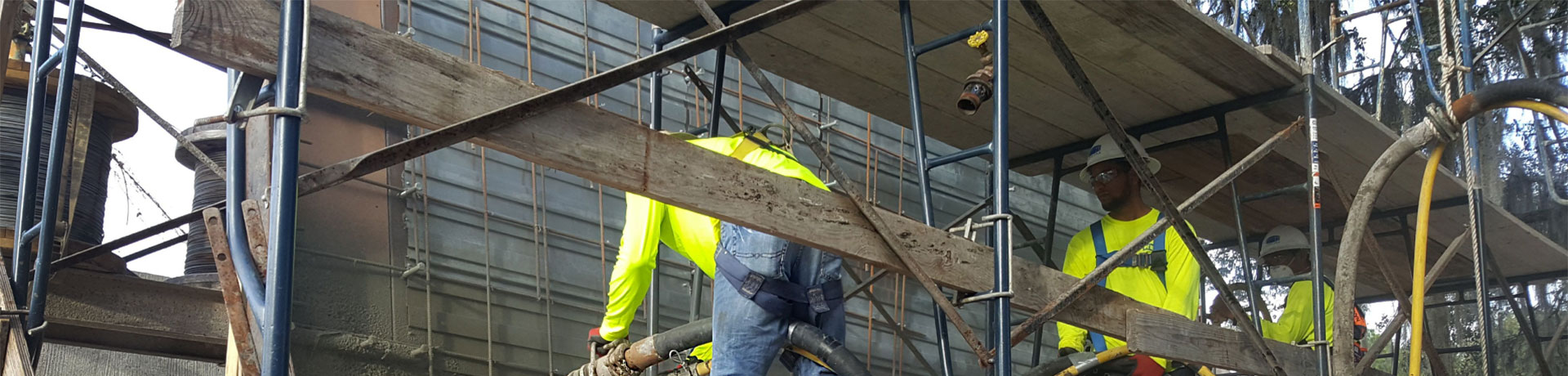
Shotcrete will adhere to properly prepared asphalt concrete. Shotcrete bond is generally related to the preparation of the surface that you want to bond with. If the surface is dirty, the shotcrete will not bond very well.
We are proposing a project that will use shotcrete on an existing metal bin wall to match recently constructed soil nail walls with shotcrete facing. What is the proper way to prepare the bin-wall surface? Also, what type of reinforcement would you recommend and what is the suggested method of attaching the reinforcement to the bin wall?
The surface should be cleaned using a high-pressure water blaster or sandblasting to remove any loose material and rust. If the metal bin material is thick enough, you might want to consider welding metal studs or nuts to the bin to secure the reinforcing steel or mesh. The amount and type of reinforcement is beyond the scope of our organization and we suggest getting guidance from a qualified engineer. You may gain some insight from the design of the reinforcing used in the soil nail walls.
Can a shotcrete mixture be designed using crushed washed sand instead of natural washed sand?
The grading of fine aggregates, natural or manufactured, should be in compliance with the combined aggregate gradations in ACI 506R or ASTM C1436. Using crushed washed sand will be more difficult than using natural washed sand due to the more angular particle shapes. Due to the more angular particles, crushed sand will likely require a higher paste content to successfully convey it through the shotcrete hose.
I am working on a water feature formed out of cast-in-place reinforced concrete with a hot-fluid-applied waterproofing system over the concrete. To protect the waterproofing, we plan to install shotcrete over it. What minimum thickness of shotcrete is required? Would welded wire fabric or fiber mesh be required as well?
In general, we would recommend a minimum of 2 in. (50 mm) of shotcrete. Either fibers or wire mesh or both should be used in this application. Please note that there are different types of synthetic fibers (microsynthetic and macrosynthetic). Refer to ACI 506.1R for information on fiber-reinforced shotcrete.
If the surfaces are steep or vertical, wire mesh should be used, but provisions need to be included to stabilize the wire mesh. This would likely require attachment points through the waterproofing system.
We’re looking at adding approximately 4 in. (100 mm) of shotcrete to an existing 8 in. (200 mm) wall to meet new load requirements. What’s the minimum cover between the reinforcement and existing wall for proper encapsulation of the reinforcement?
A minimum clearance for the reinforcment off the existing surface should be 0.75 in. (19 mm) or one bar diameter, whichever is greater, to allow a good flow of material around the reinforcing steel.
We are repairing a culvert in Dallas, TX. The concrete wall of the structure is prematurely disintegrating. We are considering a process to temporarily support the ceiling, remove the wall, place a form on one side, and use shotcrete to replace the wall. Does this sound like a reasonable use for shotcrete? What kind of specifications should be used?
Yes, this sounds like a good use of the shotcrete process. Your sequence sounds like a good plan. A sample Structural Shotcrete Specification is available from the Shotcrete magazine archive on the ASA Web site (www.shotcreteweb.wpengine.com/).
We are designing underground support for a hydropower tunnel. I want to know whether wire mesh-reinforced shotcrete or steel fiber-reinforced shotcrete will be better and more economical. What are the advantages and disadvantages of both of these types of reinforcement if used for supporting a tunnel for hydropower? Also, for slope protection work, which type of shotcrete is better in terms of reliability, durability, and cost?
There are really two questions here: 1) Underground fiber-reinforced versus mesh reinforced; and 2) slope protection fiber reinforced versus mesh reinforced.
- Underground fiber reinforced versus mesh reinforced: it is not clear what the alternatives are that you are considering, but sprayed concrete has a good, solid track record for ground support. If it is a simple comparison of steel mesh versus steel fiber reinforcement, then the issue is one of a design approach.
Wire mesh and bolts have a longer history and are simple to design as a rigid structure. To install mesh and bolts, however, requires working under unsupported ground. Mechanized spraying of concrete is done with the operator under supported ground and therefore is intrinsically safer.The design of fiber-reinforced sprayed concrete as ground support is approached differently. The sprayed concrete is allowed to deform to a certain extent before coming to rest with the ground forces finding a new equilibrium. The extent of this deformation depends on the energy absorption of the sprayed concrete structure, which is provided for by the fibers.Steel fiber-reinforced sprayed concrete is by far faster to place and therefore has economic benefits. As the fibers are discontinuous, there is merit in considering this structure less susceptible to corrosion and consequential durability issues. We recommend consulting ACI 506.1R and ACI 506.5R. - Slope protection fiber reinforced versus mesh reinforced: for slope protection, both fiber-reinforced and wire-mesh-reinforced shotcrete work well and are durable, reliable, and cost effective if done properly. Care must be taken with wire mesh reinforcing to ensure that it is maintained in the middle of the section and not on the ground where it is not effective. Wire mesh can also be difficult to install on an irregular surface and require more shotcrete material to cover the area and the mesh. The wire mesh can be an asset to the installer in providing a grid to support a scaffold system. In many applications, the choice of wire mesh or fibers should be left to the installer with the engineer specifying the minimum requirement for each.
What is the recommended cure time for shotcrete pools and spas so that shrinkage cracks in finished tile work can be avoided?
Concrete, when applied using the shotcrete process, or cast-in-place, needs to cure for 7 days. Water is the best curing method (7 continuous days). Curing compound can be applied, but the membrane film that is formed will have to be removed by sand or water blasting (5000 psi [34.5 MPa] is recommended) before the plaster or tile can be set (it will create a bond breaker if not removed). There are curing compounds with a dissipating resin, which means after about 30 days in the sun, the material will break down. In either case, it is a good practice to pressure wash the concrete surface to remove the grit and dust out of the pours so that the plaster and tile will have a good bond. This is normal, everyday concrete curing practice that helps to prevent shrinkage cracks. The concrete being applied should have a water-cement ratio (w/c) of 0.35 to 0.45. Having the w/c at 0.40 at a 2 to 3 in. (50 to 75 mm) slump will keep the water demand low to help minimize the shrinkage. Wet-fogging freshly placed concrete before the curing process begins will also help prevent shrinkage cracks.
We have demolished two radioactively contaminated buildings down to their concrete slabs. One of the slabs has a concrete pit that is 26 ft (8 m) deep. The slabs have not been removed because the soil beneath the slabs is contaminated and we’re using the slabs as a cover to protect the spread of contamination in the soil until the soil remediation begins. We’d like to use shotcrete to temporarily (up to 5 years) fix the contamination on the slabs and the 5 ft (1.5 m) area surrounding them. The questions we have are: 1) Will shotcrete adhere to the concrete slabs and pit walls for up to 5 years without special preparations? (Portions of the radioactively contaminated concrete are painted and it is dirty from demolition activities); and 2) What is the minimum thickness of shotcrete needed to last for 5 years in this type of application? We do not want to use any wire or fabric mesh as it would require personnel to work in a radiologically controlled environment to install the material.
Shotcrete, like concrete, likely will not adhere to surfaces that are painted and dirty from the demolition activities. There should be no issue to the time durability. Shotcrete is pneumatically placed concrete and has great long-term durability characteristics if placed properly.Shotcrete has been installed in many adverse environments at a thickness of 2 in. (50 mm) with fibrous reinforcement and provided a long service life. Many irrigation districts line their canals with shotcrete and it has provided decades of great service in freeze-thaw exposures.
We have an approximately 9500 ft2 (882.6 m2) pool that was built and finished in midsummer. Four weeks later, the pool has developed “spider web” cracking in the bottom. We need to have a compressive strength test done. Our crew is on site now and is going to pull a 4 in. (101.6 mm) core sample for testing. I need to know what procedure to follow and where to send the sample for testing.
Consult with a local engineering firm that is qualified to develop a coring plan, obtain cores, and perform testing in accordance with ASTM C42/C42M or ASTM C1604/C1604M. Please refer to ASTM C42/C42M for further guidance.