
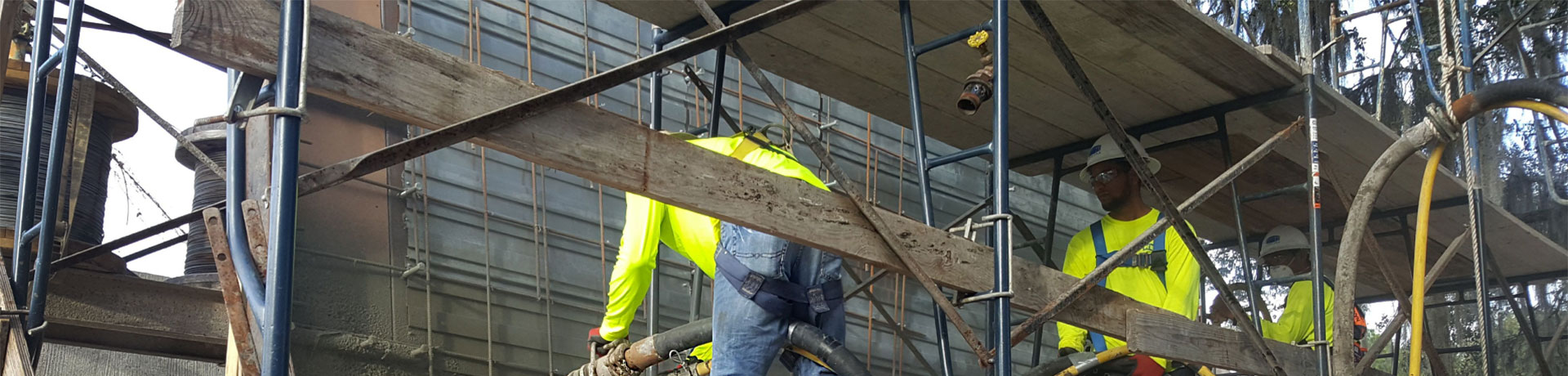
Yes, it is feasible and economical to construct structural walls such as a 5 ft (1.5 m) high floodwall. Shotcrete is a method of placing concrete and has similar, if not identical, properties after placement. As you can imagine, shotcrete needs to be shot against something such as a one-sided form, gabion baskets, earth, expanded metal lath, or just about any structurally sound thing you can think of. The economy of the system is dependent upon the site conditions and the ingenuity of the contractor. An example of a similar structure is on the east side of I-880, south of Dixon Landing Road in Milpitas, CA. This project, a flood control channel, involved trapezoidal channel sections, vertical wall sections, and a combination of sloped walls with a vertical extension. If you have further interest, you should contact an organization with experience in this area. An excellent source is the directory of Corporate Members in the ASA Buyers Guide.
I am a civil engineer looking to use shotcrete in a culvert rehabilitation project. Due to flow constraints, we are forced to have a maximum wall thickness of 3 in. (76 mm). For the typical 96 in. (2438 mm) precast concrete culvert, the walls are approximately 9 in. (228 mm). What can I do to obtain a near similar product with only 3 in. (76 mm) of wall thickness? Can shotcrete be applied at higher compressive strengths, 10 psi (0.07 MPa), or is it better to use fiber-reinforced shotcrete? The intent of the retrofit is to at least obtain a 10-year service life to this temporary solution.
This is an engineering question, not an application question. Precast pipe is sized for multiple uses and services. Depending on this service (depth of cover or loads), creative reinforcing bar placement and higher compressive strengths can reduce the wall thickness significantly. For example, success has been realized using elliptical steel to reduce concrete section thickness. Fiber reinforcement is secondary reinforcing and is not a suitable replacement for reinforcing steel. Given the short life required of the culvert, and assuming fairly equal loading on the circumference, a 3 to 4 in. (76 to 101 mm) section with judiciously placed reinforcing bar, and silica fume (8 to 10% of cement for higher strength up to 10,000 psi (69 MPa)]) would be sufficient. The resulting culvert’s life would probably be much longer than 10 years. In the end, an engineering call should be made, but the material will perform.
I am reconfiguring the interior of a spa and am wondering if drains and jets can be relocated without compromising the overall structure and getting cold cracks. Can the entire interior be re-shot to maintain the monolithic form and guarantee against failure? Is there an independent professional who could conduct an on-site inspection and recommend a next step?
We are not able to advise you on the structural integrity of a remodel of a spa or any other structure and would suggest you consult with a local engineer who is familiar with pools and spas. Shotcrete is often used to overlay or patch structures and the success of such overlays and patches is highly dependent upon the quality of the surface preparation prior to the application of the shotcrete. With respect to referrals of independent professionals, we would suggest that you use the directory of Corporate Members in the ASA Buyers Guide.
I am lining a below-ground conical shaped excavation with shotcrete. Dimensions are approximately 90 ft (27.4 m) diameter by 45 ft (13.7 m) depth. Sand will be moved in and out of the container daily. Temperature range is 590 to 740 °F (310 to 393 °C). Can you tell me if a mixture is available that can meet the following specific conditions: Withstand the temperature ranges noted above without spalling, cracking, etc.; and Resist abrasion assuming hot sand is flowing over the surface area daily?
You certainly have adverse conditions to work with! There are products on the market based on calcium aluminate cements that will tolerate the temperatures you mention and are durable. These products can be placed using the shotcrete process. A list of companies who supply this product can be found at www.shotcreteweb.wpengine.com/pages/products-services-information/buyers-guide/.
I have an unfinished (dirt) basement with a stacked stone and mortar foundation. Can I shotcrete the existing dirt walls and floor with shotcrete MS (micro silica enhanced) and have it adhere to the dirt portion of the basement? If so, what method would be best?
Shotcrete would work well for the overlay of the walls. In most cases, floors are placed by a conventional cast-in-place method. Either the wet- or dry-mix procedure would work well for the walls. To ensure good bond of the shotcrete to the walls, the walls should be cleaned and prepared to assure that the shotcrete is bonding to sound material rather than contaminates such as dirt or weathered material. You might also want to consider reinforcing the walls, but you should consult with an engineer on how to do this and with what material. If you were to use the wet-mix process, you could use the same equipment to place the floor as you are using for the walls.
I am repairing a concrete masonry unit (CMU) block wall that was partially damaged when a portion of the roof collapsed. The engineer on the project is proposing to apply shotcrete to one side of the wall to help structurally reinforce the wall. I would like to know if there is a way to finish the wall so it is cosmetically pleasing, especially since this is on the inside of an existing building with the other walls being a painted CMU. Also, were can I get some conceptual pricing for applying the shotcrete?
Shotcrete can, and often is, finished to provide nice printable wall surfaces. To be the same general texture of the concrete block wall, you should specify a wood or rubber float finish. You can access the ASA Buyers Guide at https://shotcrete.org/products-services-information/buyers-guide/ to locate organizations regarding budget or conceptual pricing.
We would like to get approval to use shotcrete on the perimeter walls of an existing laboratory building. We would be shooting against a waterproofing membrane and shoring lagging. The project engineer is concerned that the shotcrete will damage the membrane, resulting in leaking into the occupied space. Are there any examples where this type of shotcrete placement has been used?
This is a commonly used technique in the Western U.S. and Canada, and has been used successfully from Stanley Hall at the University of California at Berkeley, Berkeley, CA, to the Baltimore Hilton Convention Center near Camden Yards, Baltimore, MD. There are a number of suppliers of waterproofing materials to choose from for this application. In selecting a supplier, be sure there is field service available to inspect the project before placement of the shotcrete.
What is the maximum thickness for shotcrete used for shear walls? Can we use more than 12 ft (3.7 m) if we use a double layer of reinforcing?
There is no stated maximum thickness for shotcrete used in shear walls or any other type of wall. Walls have been successfully placed to a thickness of 36 in. (914 mm) for some time. The two main concerns are the heat of hydration and proper encapsulation of the reinforcing steel. Because shotcrete mixtures typically contain more cement per cubic yard or cubic meter than formed and poured placements, there will be more heat generated by the shotcrete mixture. The ability of the nozzleman to encapsulate the reinforcing will be a function of proper mixture design, proper selection of shotcrete equipment, and the skill level of the nozzleman and the crew.
We are having a swimming pool constructed. The pool consultant is concerned about cold joints during construction if walls and the floor are shotcreted on different days. The shotcrete subcontractor states that there is no problem as the next layer of shotcrete will knit itself to the previous placement and form a solid bond. Is the shotcrete subcontractor correct?
Yes, if care is taken to prepare the receiving surface properly. The receiving shotcrete edge must be sound (no loose or unconsolidated material), clean (no traces of laitance or gloss), rough, and dampened to a saturated surface-dry condition. If these steps are followed, there should be no concern about the soundness of the joint.
Can shotcrete be applied to a slope to act as a retaining wall without a moisture barrier? If a moisture barrier is recommended, what type should we use?
Most shotcrete slopes are placed without moisture barriers and are constructed to ensure that water pressure does not build up behind the slope and create hydrostatic pressure on the backside of the shotcrete. This is generally done with drainage material and weep holes or vents near the base of the shotcrete slope. Please bear in mind that shotcrete slope paving alone is not generally considered as a retaining wall. If shotcrete slope paving is to be used as a retaining structure, it is generally done in conjunction with soil nailing, tie backs, or some type of structural footing. If the shotcrete is intended to be used as a structural wall, a structural engineer must be consulted to be sure all structural issues are addressed.