
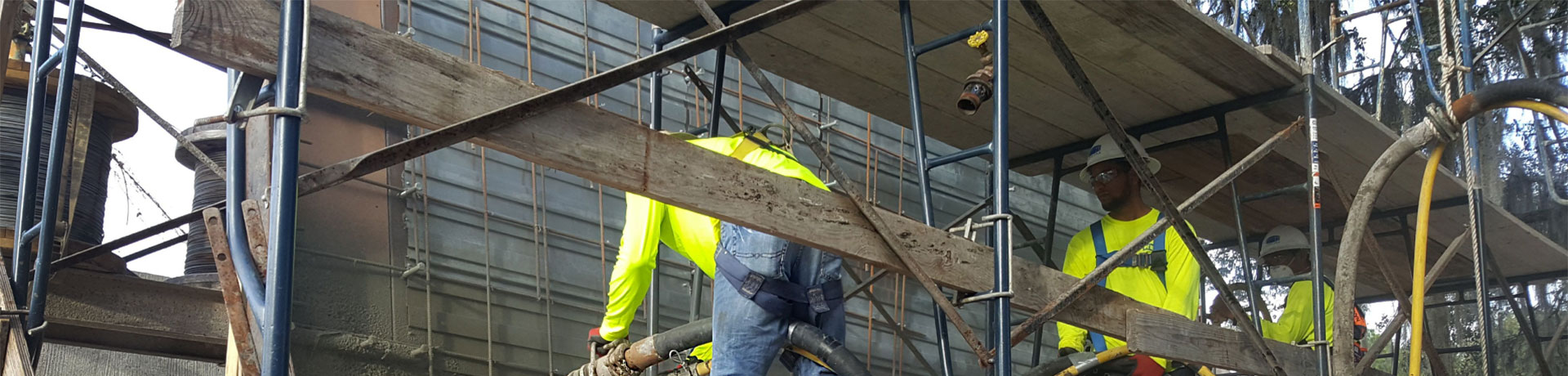
Shotcrete is a method of placing concrete and therefore the material has the same basic characteristics of concrete. Shotcrete is often used for canal, channel, and ditch lining. It is important with shotcrete (concrete) that the subgrade the material is placed over be compacted and stable. The thickness, strength, and reinforcing needs to be designed and specified by a professional engineer familiar with this type of structure or pavement. For budget numbers, you should contact one of our contractor members, who can be found in the Buyers Guide on the Web site at shotcrete.org.
We are currently working on a tunnel that will cross through a drinking water protection zone in the alluvial aquifer. Do shotcrete technology and materials exist that can be used on groundwater-sensitive areas?
Shotcrete is the same as concrete when evaluated as a material and its exposure to potable water. In the U.S., many admixtures and cements for concrete have been tested and certified to meet the NSF 61 standards for materials exposed to potable water. In my experience, potable water stored in concrete tanks with direct exposure to the concrete (no coatings) has not exhibited any significant rise in alkalinity. Exposure of a tunnel in a groundwater aquifer would seem to have much less contact area per volume of water contained in the aquifer, such that any rise in alkalinity would be miniscule. Because concrete in the U.S. is universally accepted for the storage and transport of potable water, I’d assume that the use of shotcrete in your tunnel would be perfectly acceptable.
Often, steel fiber-reinforced shotcrete (SFRS) linings are applied in underground construction. In some areas of high tensile stresses, it is necessary to use additional ordinary reinforcement (reinforcing bar/mesh). It may be inefficient to switch to non-fibrous shotcrete for these regions. Are the shadowing problems to be expected in that case (SFRS with additional ordinary reinforcement) more severe and how can they be resolved?
It is not uncommon to encapsulate lattice girders or steel sets in fibrous shotcrete. The skill of the nozzleman, the size and density of the reinforcing, and the characteristics of the mixture and the accelerator are the most important factors in achieving good encapsulation of reinforcing bar or these more complicated applications around lattice girders or steel sets. With welded-wire reinforcement, you should have a 4 x 4 in. (100 x 100 mm) or greater spacing. With reinforcing bar, you should use the minimum diameter possible at a minimum spacing of around 6 in. (150 mm). Preconstruction mockups should be considered to prove the competency of the nozzleman and the mixture. Please note that the best nozzleman cannot succeed without a good, workable mixture.
Is it possible to use a penetrating sealer, such as those used on driveways, to make shotcrete repel moisture? If so, will the sealer improve the shotcrete’s freezing-and-thawing performance?
It is possible to use a penetrating sealer on shotcrete in the same manner as cast-in-place concrete. We are not aware of research on the durability of such a sealer and do not know if it would enhance the freezing-and-thawing characteristics. A high-quality shotcrete mixture that is properly placed will exhibit excellent freezing-and-thawing characteristics with or without a sealer.
We are rehabilitating a limestone-brick masonry storm sewer by lining it with shotcrete. The sewer is approximately 7 ft (2.1 m) tall with an arch ceiling and walls that are 8 ft (2.4 m) apart. The limestone surface is fairly rough, but the brick portions are not. While the existing structure shows no signs of needing to be reinforced for structural support, we are reinforcing to prolong the service life of the culvert. Is there a recommended minimum shotcrete thickness and reinforcement?
Shotcrete has been used to successfully rehabilitate sewers for over 50 years.
The thickness to be used is an engineering issue and beyond the scope of our association. We would recommend a 2 in. (50 mm) minimum thickness reinforced with either polypropylene fibers or a light-gauge welded wire reinforcement. The surfaces must be cleaned thoroughly to remove grease, oils, and other substances deleterious to good bond. Bonding to brick is not a problem.
Finish is another consideration. The added liner thickness will reduce the size of the culvert. If capacity is not an issue, it is recommended to leave the new shotcrete lining with a nozzle finish. If capacity might be a problem, then a float or trowel-smooth finish may be necessary.
Can you provide any information or research on the sound absorption performance of shotcrete?
We are not aware of any testing done specifically for the sound absorption performance of shotcrete. Shotcrete is a method of placing concrete and, once hardened, it should have similar parameters as cast concrete. With shotcrete, one has the ability to use many different finishes, which might influence the sound absorption characteristics. A smooth troweled shotcrete wall would be the most similar to a formed cast-in-place wall. On the other end of the spectrum, a nozzle-finished wall would likely absorb far more sound. A recent design of a concert hall at a major university was to be built with oval concrete or shotcrete perimeter walls covered with fabric curtains for sound purposes. The ceiling was to be suspended nozzle-finished shotcrete.
We want to shotcrete a porous rock wall to stop water leakage out of a small pool that is home to an endangered fish. The wall is quite rough and uneven. The pool will be drained to do the work. How long should we allow the concrete to cure before refilling the pool with water? Does this sound like a good application for shotcrete?
This is a great application for shotcrete. Once drained, the existing surfaces should be cleaned by water blasting or sandblasting to provide a good bonding surface. The shotcrete can be submerged within a few hours or upon reaching the final set (hardened). One factor to be concerned about is the chemical reaction and alkalinity of the area around the shotcrete during the curing period. A good solution would be to submerge the pool for a period of at least a week, drain and waste the water, flush the shotcrete surfaces, refill the pool, and test the pH before reintroducing the fish. This should eliminate the danger of the alkalinity to the fish.
What are the requirements for selection of the shotcrete lift height and delay between successive layers? ACI 506R describes only a general approach.
Although some have tried, there are not and should not be specific recommendations for lift height or time between lifts of layers. Shotcrete is a method of placing concrete, and concrete properties vary with many parameters, such as admixtures, ambient temperature, concrete temperature, slump, and age of concrete, to name a few. The lift height is also influenced by the surface on which you are shooting (rough, porous, smooth, dense, and so on); the orientation being applied (vertical, sloped, or overhead); and the size and density of the reinforcing steel, if it is present. Regardless of the period of time between lifts or layers, the receiving surface must be clean and moisture-conditioned to create a good bond between lifts or layers. As you can see, there are too many variables to spell out recommended guidelines or rules of thumb for lift heights or time between lifts or layers. The goal is to place the lifts or layers in heights or thicknesses that do not slough or sag. The time between lifts or layers is the time required for the initial lift or layer to support the subsequent lift of layer. These decisions must be made on the job on a daily and hourly basis by a properly trained and experienced nozzleman and shotcrete foreman. These decisions may vary during the day to meet the current situation. It is critical that the shotcrete is placed by a shotcrete contractor with trained and experienced crews who is experienced and successful in the type of work being installed.
I would like advice about spraying shotcrete on the exterior walls of a house I am building. In constructing the exterior walls of the house, I plan to shoot approximately 0.75 in. (19 mm) on Day 1 and shoot 1.25 in. (31 mm) on Day 2 for 2 in. (50 mm) thick walls. I have hung 14-gauge wire mesh spaced at 1 in. (25 mm) over all the walls and am planning to use a 3000 psi (20.7 MPa) mixture. I am greatly concerned about cracking. Is my planned technique a good way to mitigate cracking or are there better approaches? Should I consider upping the strength of the concrete?
In structural applications, most of the impact force from nozzling shotcrete is directed toward compacting the shotcrete in place rather than against the formwork. This was the subject of a study conducted by Marc Jolin of Laval University, Quebec City, QC, Canada, and reported in the Fall 2008 issue of Shotcrete magazine. There is virtually no hydrostatic pressure on the forms from the application using the shotcrete process. A copy of this study can be viewed on the ASA WebIt is fine to place shotcrete in two layers on 2 consecutive days, although simply placing two layers on 2 consecutive days won’t prevent long-term drying shrinkage cracking. For the best bond, the surface of the shotcrete on Day 1 should be given a rough broom finish to provide a rough texture for the Day 2 shotcrete to bond to. On Day 2, before shooting, wet the surface of the Day 1 shotcrete to prevent a hot, dry surface from absorbing water from the fresh shotcrete. Please note that the surface needs to be dampened but allowed to dry to an SSD condition. A surface that is too wet can inhibit good bonding. It is essential to moist-cure the shotcrete as soon as it has finally set to help reduce early-age shrinkage cracking. On a hot, windy day, you may need to fog the surface soon after placement with a pressure washer using a fogging nozzle to reduce the rapid evaporation of water from the surface of the shotcrete. Wet curing with a wetted burlap overlay or drip system for at least 3 days (preferably 7 days) is recommended to help reduce the potential for longer-term drying shrinkage cracking. Using macrosynthetic fibers in the shotcrete mixture will also help reduce early-age shrinkage cracking. Because you are in Florida, unless you are shooting in the dead of winter, you may also want to consider using a concrete mixture with up to 20 to 25% fly ash. This will slow down the hydration of the cement and resultant set time to give you some more time to finish the surface and get proper curing started. Fly ash also helps reduce the concrete permeability and increases the long-term strength and is generally less expensive than portland cement. If you use a concrete mixture with silica fume (also called microsilica), it will increase the water demand of the mixture during hydration and has a greater tendency for early-age plastic shrinkage cracks. Thus, if you use silica fume, you will need to pay close attention to keep the surface wet through fogging and then wet curing as soon as it is practical. As previously mentioned, a 2 x 2 or 3 x 3 in. (50 x 50 or 75 x 75 mm) wire mesh would be preferred to reduce congestion of the reinforcement. Stay away from rolled mesh, as it is very difficult (even nearly impossible) to get to lay flat. Sheets of welded wire mesh are recommended. ASA recommends a minimum 28-day compressive strength for shotcrete of 4000 psi (27.6 MPa). A 3000 psi (20.7 MPa) mixture will have a higher water-cement ratio (w/c); therefore, there is more water in the mixture, which will significantly increase the potential for drying shrinkage cracking in the final surface. A 4000 psi (27.6 MPa) mixture is easily achieved with current portland cements and normal supplemental cementitious products such as fly ash. Finally, you mentioned that you will be shooting the surface of a house. You haven’t provided any details about what you are shooting the shotcrete on, but the substrate must be rigid enough to not vibrate when shotcrete hits the surface. If it is not rigid enough, the vibration of adjacent areas of freshly shot plastic shotcrete could cause cracking. This would be more of a problem in the Day 1 coat of shotcrete, but cracks that form in the Day 1 shotcrete would create a weaker section and increase the likelihood of mirrored cracking in the Day 2 layer. Again, please note: While it is appropriate to wet down the Day 1 shotcrete prior to application of the Day 2 shotcrete, it is important to let the wetted Day 1 shotcrete dry back to an SSD condition before application of the Day 2 shotcrete. If the Day 2 shotcrete is applied to a wet substrate (with liquid water on the surface), it will fail to meet the specified 150 psi (1 MPa) bond pulloff strength requirements for the project.
We are removing up to 0.75 in. (19 mm) of the existing scaled concrete on a fire-damaged concrete wall. The architect has asked if shotcrete is applicable for a vertical 0.75 in. (19 mm) application. Also, the walls are circular and the working distance from the wall is no more than 36 in. (0.9 m). Is this enough room to apply shotcrete?
Yes, shotcrete can be applied in a 36 in. (0.9 m) area. Keep in mind, however, that it’s difficult to get as nice a gunning pattern as you would like when you are that close to the receiving surface. When you cannot back off from the wall, there is a tendency for a more irregular gunning surface, which would require more cutting and screeding to get an aesthetically pleasing result.