
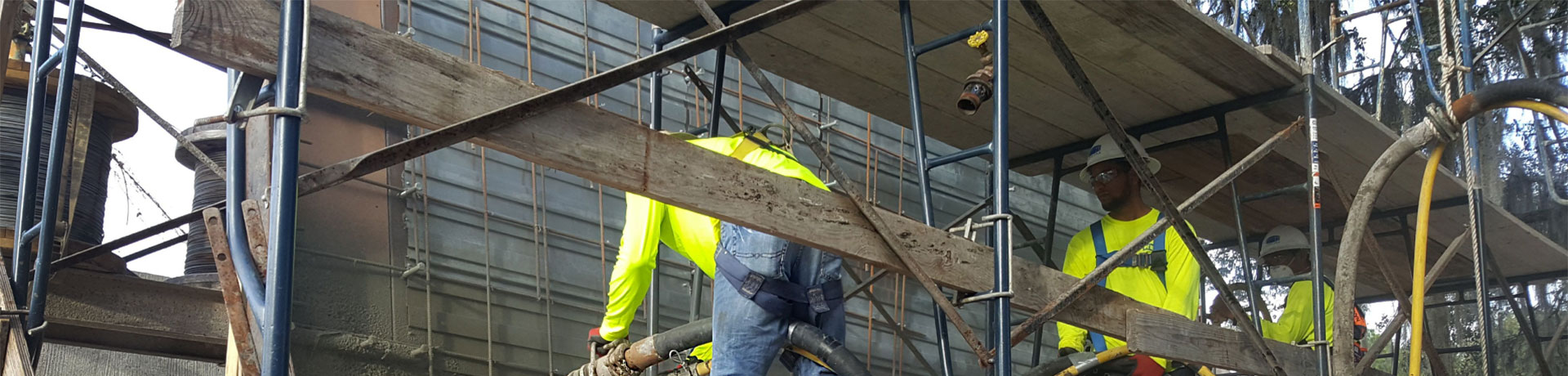
Shotcrete would be an excellent process to repair or overlay your wall. You are correct in saying that it could not only repair but also reinforce and enhance the strength of the wall system. It is important to remove all deteriorated brick and sandblast or water-blast the surface if you are looking for a good bond between the shotcrete and the existing brick. Dowels epoxied or grouted into the existing brick are often used to mechanically tie the shotcrete overlay to the brick wall and also stabilize the new reinforcing steel in the shotcrete overlay.
We are a local agency considering the repair of a number of older culverts with shotcrete. Like most agencies, we are trying to be creative about maximizing our funds. We work with a federal agency when it is determined that a “new” culvert is needed. In other words, the agency will not pay for maintenance repairs but will pay for “new” culverts. We are wondering if the shotcrete method has ever been viewed as a means of creating a “new” culvert. Could the existing culvert be considered as merely a form for the new culvert? Could you also speak to the life expectancy of shotcrete (life cycle) versus a new concrete culvert?
Shotcrete has been used extensively for the purpose of relining existing culverts. You are correct to visualize the existing culvert as a form for building a new structure. Because it is a stay-in-place form, it may actually act as a composite structure. Shotcrete is a method of placing concrete and will have similar, if not better, durability and life span if installed professionally with good mixtures. You can locate numerous past articles on durability of shotcrete that have appeared in Shotcrete magazine in the magazine’s archive on the ASA website, shotcrete.org. Similar work has been done in California, Colorado, and other states. This approach is currently being used as permanent tunnel lining in many places, including many of the current New York Transit projects.
A knowledgeable contractor will develop a mixture and procedures to ensure that the timing of the subsequent blast is compatible with the set time of the shotcrete. Preconstruction testing should be required to establish the set time (both early and final set) to assist in developing the sequence of operations. The set time will also be impacted by the site conditions, such as temperature.
We are considering a shotcrete lining of a new corrugated metal pipe to improve the smoothness and hydraulic capacity. What is the minimum thickness over the corrugations and should we be looking at any reinforcement or studs to support the shotcrete?
This has been done in the past to improve hydraulic capacity and provide better wear resistance in the invert. Typically, the minimum cover over the corrugation is 2 to 3 in. (51 to 76 mm) with a welded-wire fabric either welded or otherwise attached to the corrugated pipe. The cover could likely be reduced with the use of structural fibers of either steel or synthetic material. Steel fibers and wire mesh should not be used together. Care must be taken to specify the required finish. This application would likely benefit from a smooth trowel or light broom finish. A light broom finish is preferable from a safety standpoint, as a trowel finish creates a very slippery surface both during construction and for the maintenance at a later date. In addition to the hydraulic and wear characteristics, once shotcreted, the entire pipe will become a composite section with improved structural characteristics. It should be noted that the pipe must be large enough for workers to work in safely and productively. This would mean an absolute minimum of 48 in. (1219 mm) and preferably larger.
A knowledgeable contractor will develop a mixture and procedures to ensure that the timing of the subsequent blast is compatible with the set time of the shotcrete. Preconstruction testing should be required to establish the set time (both early and final set) to assist in developing the sequence of operations. The set time will also be impacted by the site conditions, such as temperature.
We will be blasting close to a shotcrete wall. Can you suggest any precautionary measures or offer lessons learned when blasting next to a recently shotcrete wall?
It is very common in drill and blast operations to blast shortly after the application of shotcrete. There are certainly risks involved, but a knowledgeable and experienced mining crew working with or for a knowledgeable, experienced contractor would not have any problem with this type of application.
A knowledgeable contractor will develop a mixture and procedures to ensure that the timing of the subsequent blast is compatible with the set time of the shotcrete. Preconstruction testing should be required to establish the set time (both early and final set) to assist in developing the sequence of operations. The set time will also be impacted by the site conditions, such as temperature.
I have a question regarding the oscillator on a shotcrete rig. When applying shotcrete, does the oscillator serve any purpose other than uniform application? I’m searching for the main reason to use an oscillator and am wondering if the integrity of the shotcrete would be compromised if it were disabled?
Assuming this is an oscillator on a robotic arm, it should not be disabled. Good nozzling technique, for either wet or dry, requires the nozzle to be moved in a constant overlapping circular pattern. This allows for better encapsulation of reinforcing bar and produces a more uniform surface; and, particularly for dry process, it is required for final mixing of materials that occurs on the surface.
Without proper nozzle technique, which requires oscillation, you will not get uniform, homogeneous shotcrete.
We are building 6 and 8 in. (150 and 200 mm) thick cast-in-place concrete retaining walls with No. 4 (No. 13M) reinforcing bar at 18 in. (450 mm) on center each way. We would like to change to shotcrete as an alternate method of construction. Does the reinforcing bar design have to change for shotcrete application?
Shotcrete would be a great substitute for the retaining wall. Design-wise, the shotcrete is equivalent to concrete because shotcrete is really just a way of placing concrete.
The No. 4 (No. 13M) at 18 in. (450 mm) on-center spacing is not a problem. A No. 4 (No. 13M) bar can be easily encased by a qualified, experienced nozzlemen using either wet- or dry-mix shotcrete. In longer walls, or anywhere where reinforcing bars are lap spliced, the lap splice bars should be spaced apart. ACI 506R-05, “Guide to Shotcrete,” Section 5.4, provides some good guidance on optimizing reinforcing bar layouts for shotcreting. On the issue of lap splices, it says: “If the design allows, direct contact of the reinforcing splices should be avoided. Non-contact lapped bars should have a minimum spacing of at least three times the diameter of the largest bar at the splice.”
Thus, with No. 4 (No. 13M) bars in a lap splice, you should have the reinforcing bars spaced 1.5 in. (38 mm) apart at the splice to allow the shotcrete material to flow around the bar during shooting.
Chapter 8 of ACI 506R-05, “Guide to Shotcrete,” also provides a lot of guidance on proper shooting techniques for a variety of applications, including walls.
We will be shotcreting the inside of a tunnel entrance. The plan is to apply 3 ft (0.9 m) of shotcrete on the walls and ceiling to support a large section of limestone rock 22 ft (6.7 m) high, 30 ft (9.1 m) wide, and 20 ft (6.1 m) deep above the tunnel at the entrance that has moved and is wedged and supported with an existing steel structure. We would like to test the shotcrete and are wondering what type and quantity of tests you recommend and which testing labs are in our area that would be able to conduct the testing?
The article “Shotcrete Testing—Who, Why, When, and How” in ASA’s Summer 2011 issue of Shotcrete magazine should help answer most of your questions on testing of shotcrete. ACI 506R, “Guide to Shotcrete,” and ACI 506.2, “Specification for Shotcrete,” also have helpful information on shotcrete testing. Most competent testing labs should be able to test the compressive strength of cores extracted from shotcrete panels or sections, as they are very similar to concrete cylinder tests. If conducting more advanced testing, you may want to consider selecting a lab experienced with shotcrete.
Can shotcrete be recycled?
Shotcrete is concrete applied using the shotcrete process. Therefore, any recycling potential that applies to concrete would apply to shotcrete.
In placing shotcrete in layers, what is the recommended thickness of each layer?
Appropriate thickness of the shotcrete layers is impossible to generalize because it depends on many factors, including:
- The type of shotcrete (wet- or dry-mix);
- The texture and stiffness of the receiving surface;
- The physical properties of the fresh concrete used, including a) w/cm ratio; b) slump; c) use of accelerator; d) type of supplementary cementitious materials used in the mixture (microsilica, fly ash, and slag); e) fibers used in the mixture; and f) mixture temperature;
- Weather conditions—Is it hot or cold, dry or wet, and/or windy or calm?;
- The shotcrete equipment used: a) type of nozzle; b) distance from the receiving surface; and c) air pressure and air volume;
- The orientation of the shotcreting (vertical/sloped/overhead)
Experienced shotcrete contracting firms using ACI Certified Nozzlemen have a wealth of experience in evaluating all these factors to achieve the proper results. You may consider subcontracting the shotcrete work to an ASA member contractor with experience in this type of work. You can submit your project details for bids from our ASA Corporate Members using the Web form at shotcrete.org. For further reference, ACI 506R-05, “Guide to Shotcrete,” provides some general discussion of the shooting techniques that may be appropriate. Retaining an engineer or shotcrete consultant experienced in shotcrete application may be of value to assist in evaluating your specific factors and recommend the best solution.
An artist we have commissioned will be using gunite for the creation of a large-scale geode-inspired sculpture. There is some concern from the community about vandalism, specifically graffiti. Do you recommend sealing or applying anti-graffiti coating to gunite? If so, what brand of sealant or coating do you recommend?
The ability to clean graffiti from the surface will, to some extent, depend on the finish texture. A rough texture will be difficult to coat successfully with a sealer or paint. Commercially available anti-graffiti paints have been used very successfully on shotcrete tanks with relatively smooth float finishes. We do not have any recommendations on the brand of sealer or coating.