
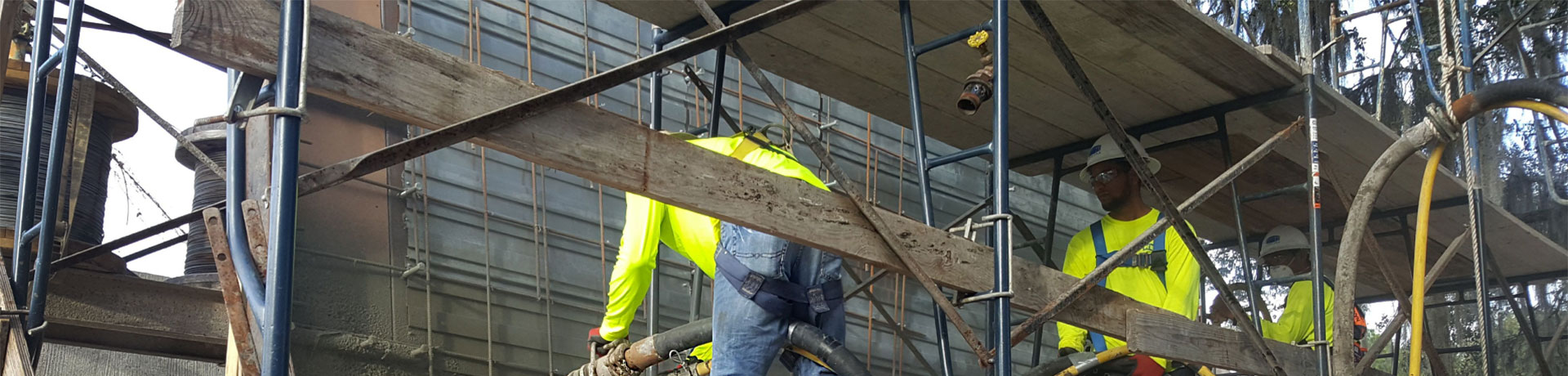
Yes, it is possible to shoot 24 in. (600 mm) thick tunnel linings. There are various ways of doing this, depending on the reinforcing steel configuration. One method we have successfully used for shooting tunnel linings this thick with a double mat of reinforcing bar (1 in. [20 mm] diameter bars at 6 in. [150 mm] on center, vertically and horizontally) is to bench gun shoot the walls up to the spring line with a wet-mix silica-fume-modified shotcrete (without accelerator) and then ribbon-shoot (2 ft [0.5 m] wide strips) overhead using the same mixture but with the option of using an alkali-free accelerator added at the nozzle.
If the shotcrete requires a smooth finish (equivalent to a cast-in-place concrete finish), then the initial shotcrete is shot to within about 1 in. (30 mm) of the final shotcrete thickness and allowed to set and harden. Following that, a final non-accelerated finish coat can be applied that can be trimmed to shooting wires with a cutting rod, closed up with a darby, and then trowelled with either a magnesium or steel trowel, depending on the required finished surface texture.
Such work can be done with a remote-control manipulator arm (robot) or, for more precision, with hand nozzling out of a basket on a manlift (provided the tunnel floor is sufficiently smooth for operation of a manlift). The bottom line: hire a contractor who has experience in conducting such work.
I would appreciate if you could comment on a city of Los Angeles shotcrete code that requires that shotcrete lifts not exceed 3 ft (1 m) and that 3 hours must pass before the second lift can be applied. First of all, if you waited 3 hours between lifts, you would have full-length cold joints along the whole length of the wall. You’d also have to wash out the pump after every lift or the concrete would harden in the pump and hoses. Second, you can’t leave a 4000 to 5000 psi (28 to 34 MPa) mixture sitting in the truck for 3 hours! Does it make any sense to you?
This provision has been an issue for shotcrete contractors in the region for many years. ASA and ACI Committee 506, Shotcrete, do not endorse the concept stated in the “Los Angeles Bulletin.” Unfortunately, this provision has shown up in other areas around the country.
A good shotcrete practice is to limit lift height to that which can be placed without sloughing or sagging and to place subsequent lifts at such a time that the previous lift is sufficiently firm to support the subsequent lift. ACI 506R-05, “Guide to Shotcrete,” Section 8.5.8, specifically addresses this point. The following is a link to ASA’s bookstore: https://shotcrete.org/bookstore
Can you send me a document with ASA specifications for gunite coverage of reinforcing bar for swimming pools, please?
ASA does not have such a document. The concrete cover for embedded reinforcing steel is subject to the local Building Codes and may be increased by the structural plans and specifications produced by an Engineer or Architect for a specific project. ACI 350-06, “Code Requirements for Environmental Engineering Concrete Structures and Commentary,” covers concrete structures intended for water containment and would be applicable to pools. The following is a link to ACI’s bookstore: www.concrete.org/bookstore/ProductDetail.aspx?itemid=35006.
Is it critical for the early and intermediate compressive strength at 3 and 7 days, respectively, to be met for shotcrete applications for a rock fall face if the 28-day compressive strength is met?
Compressive strength at 1, 3, and 7 days can be important to all for subsequent operations. In general, 7-day strengths are a good indicator of the ultimate 28-day strength. The need for early strength is an engineering and construction sequence issue, not a normal or typical shotcrete requirement.
I need to specify a shotcrete cover to some structural steel in a coal dump hopper. The idea is to provide abrasion and impact protection to the steel beams. However, the client cannot afford to have the hopper out of service for an extended period. Is there a “high-early-” strength option for shotcrete as there is for cast-in-place concrete?
There are prepackaged materials commercially available for impact and abrasion resistance. Please contact material suppliers from “ASA’s Buyers Guide” for product information: shotcrete.org/Buyers Guide.
We have a unique situation where we need to apply shotcrete around a steel plate that is surrounding a beam supporting a floor. Can you provide any UL listings for applying shotcrete to a steel beam, column, or plate?
UL designs are typically for the hourly fire proofing ratings on structural steel members such as I-beams, wide flange beams, and vessel skirts. The beams and columns are tested for specific fireproofing products, beam sizes, and configurations. The thickness of the steel and other considerations factor in the evaluation; therefore, there is no blanket UL design number that you can use for steel plate. You can get guidance on the cover needed for different fire ratings in ACI 216.1-97/TMS 0216.1-97, “Standard Method for Determining Fire Resistance of Concrete and Masonry, Construction Assemblies.”
Remember that shotcrete is a process for applying concrete. You may also consider looking for a similar concrete UL design and submit it for consideration. Applying the shotcrete at a greater thickness to compensate for any variances should be proposed and presented to engineer or the owner for consideration.
When was the 4000 psi (28 MPa) standard set for shotcrete?
ASA has taken the position that structural shotcrete is shotcrete that meets or exceeds a compressive strength of 4000 psi (28 MPa). Looking at pertinent ACI Codes related to watertight concrete, as we would expect in a pool, we find ACI 318-95, “Building Code Requirements for Structural Concrete,” introduced a provision in 1995 that required: “Concrete intended to have low permeability when exposed to water shall have a Minimum f´c of 4000 psi (28 MPa)”. Similarly, ACI 350-01, “Code Requirements for Environmental Concrete Structures,” first issued in 2001 required: “Concrete intended to have low permeability when exposed to water, wastewater, and corrosive gases shall have a Minimum f´c of 4000 psi (28 MPa)”. Since ACI 350 is more directly applicable to water-containing structures, the 2001 date is probably the most relevant, though ACI 318 introduced the concept in 1991. We do, however, see shotcrete specified at lesser levels for different types of uses.
I’m planning to add 6 in. (152 mm) of shotcrete to an existing 12 in. (305 mm) wall of a below-surface concrete tank to accommodate the removal of an existing middle support slab. The soil grade is approximately near the top of the existing tank wall. I’ve been told that since the existing wall is preloaded with soil, adding shotcrete will not increase the strength of the thickened wall and that the only way the wall will act as a whole (based on 18 in. [457 mm] thickness) is if the retained soil load is removed, then the shotcrete is added, and then soil is put back in place. Is this assessment accurate? Is there a way make this wall work as 18 in. (457 mm) without removing the existing soil?
Stress distribution from external loads through the tank wall with the shotcrete lining will depend on the geometry of the tank and the structural function of sections to be removed. A professional engineer experienced in shotcrete and concrete tank design should be consulted to ascertain the structural capacity of the completed wall. It would certainly be important to create a good bond plane by roughening the surface and removing any loose or fractured materials and using sufficient drilled dowels to make the existing 12 in. (305 mm) wall and new 6 in. (152 mm) overlay work well together. Also, it might help to specify the use of a shrinkage reducing admixture.
We are working on a geotechnical project in the northwest to repair an existing rockery retaining wall. The wall is around 750 ft (229 m) in length and up to 12 ft (4 m) in height. The issue is that some of the basalt boulders within the wall are weathered soft and falling apart. The total weathered rocks that are falling apart comprise approximately 7% of the wall. Can we use shotcrete on the weathered rocks to give them more stability as a repair process? If not, is there a process we can use with shotcrete to repair the wall without having to rebuild the entire wall?
Shotcrete has been used in the Northwest to strengthen and overlay existing rockery walls. The need to remove the weathered material is dependent upon the need for the overlay to bond with the existing wall, which is an engineering issue and not a shotcrete issue. Shotcrete can and is shot successfully against soil and other weathered surfaces.
Is shotcrete a viable option to encase galvanized steel beams at a coal unloading facility to protect them from impact and abrasion? Will the galvanizing on the steel inhibit bonding?
Yes, shotcrete would be suitable for this application. A well-installed shotcrete lining will be durable and protect the steel from impact, abrasion, and from the acid attack that occurs from sulfur in the coal. Shotcrete is used to cover both the steel hopper walls and to encase the steel beams. Calcium aluminate cement is typically recommended for coal bunkers because of the mild acid condition that occurs that can attack the steel. Whether or not the steel beams are galvanized or not is irrelevant because the shotcrete will not bond well enough to any steel surface without welded studs and mesh to hold it in place. The beams will need to have studs welded and mesh installed around the beams for the shotcrete placement. With galvanized steel it is often necessary to grind off a spot of the galvanized coating at the spot of each stud weld location to properly weld the studs.