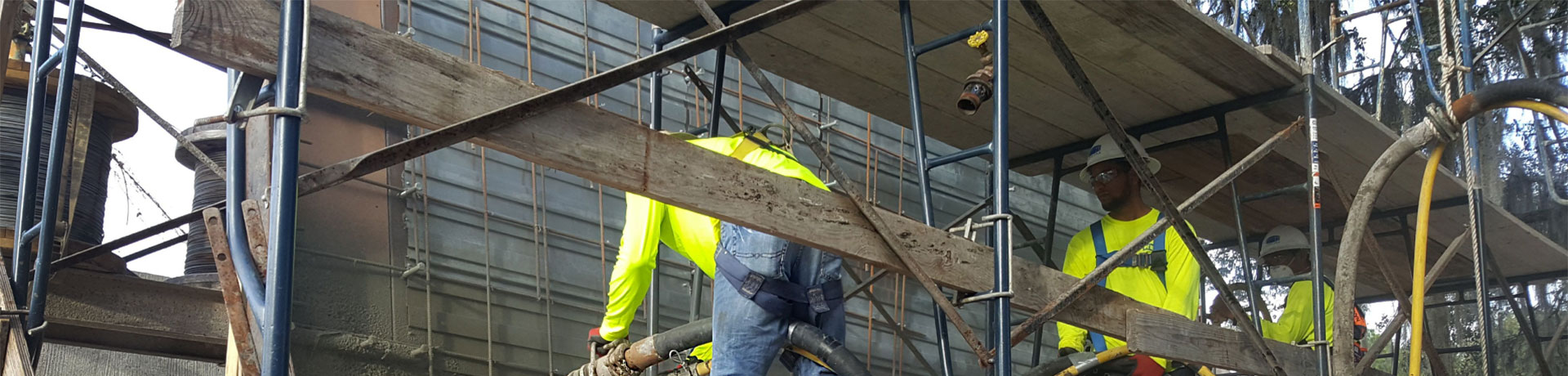
Design of a concrete mixture to be placed by the wet-mix shotcrete method is essentially the same as normal cast-in-place concrete mix design. The major differences with shotcrete mixtures are:
- The maximum coarse aggregate size is generally limited to about 3/8 in. (9.5 mm);
- They use a fairly low water-cementitious material ratio (w/cm) and slump to allow shooting on vertical surfaces without sloughing;
- The potential to use an accelerator that can be added at the nozzle; and
- The pumpability is an important workability characteristic.
Since you desire a high-early-strength mixture, using fly ash as a supplemental cementitious material (SCM) wouldn’t be recommended because it slows set and strength gain at early ages. Microsilica may be beneficial for early strength gain. Consideration should be given to using accelerator added at the nozzle. There is some guidance on concrete mixture design in ACI 506R-05, “Guide to Shotcrete”; however, because local materials (aggregates, cements, SCMs) can vary significantly, you should consult with an engineer or concrete testing laboratory familiar with shotcrete to produce and test a mixture design to meet your requirements.
Long expanses of concrete canal lining exposed to the sun and weather would experience significant internal tensile drying shrinkage stresses. Regular contraction joints help to relieve the internal tension created by concrete shrinkage. If no contraction joints are provided, shrinkage will still occur and the concrete lining will produce its own contraction joints, better known as “cracks.” Unfortunately, the resulting cracking will be random and can vary significantly in size and length. Thus, contraction joints are a good approach to help induce cracking at regular, controlled locations. If the client doesn’t want contraction joints, they need to understand that cracking will be much more extensive and likely more noticeable.
Theoretically, with the same percentage of embedded reinforcement, cracking between a 2 or 4 in. (51 or 102 mm) should not be substantially different. Of course, the 4 in. (102 mm) thick shotcrete section would require twice the concrete material and twice the embedded reinforcement to maintain the same percentage of reinforcement. A 2 in. (51 mm) thick section could have some difficulty in maintaining adequate cover over embedded reinforcing bars. The designers could also consider using fiber-reinforced shotcrete to help control shrinkage and temperature stresses, although fairly high dosages are needed for effective elimination of reinforcing bars. More guidance on fiber-reinforced shotcrete is available in ACI 506.1R-08, “Guide to Fiber-Reinforced Shotcrete”. A 2 in. (51 mm) overlay is absolutely the least possible and 3 or 4 in. (76 or 102 mm) is far more normal in practice.
Canals are generally specified to have a natural gun finish, a rough broom finish, or a light broom finish.
Shotcrete is a method for placing concrete. Thus, the concrete placed by the shotcrete method has the same physical properties as cast concrete with the same mixture proportions. Either working stress or ultimate strength methods used for concrete design are applicable. Local building codes may require a particular design approach.
Shotcrete can and has been used to overlay previously installed shotcrete or concrete that has cracked over time. It would be advisable that you engage an engineer knowledgeable in geotechnical engineering and concrete properties to formalize a solution. It is important that the cause of the cracks be determined and adequate reinforcing be designed to ensure that the cracks do not propagate through the overlaid shotcrete.
Shotcrete can be applied with many different textures. The nozzle finish shown is very rough, even for a natural gun finish. Nozzle finishes can be done smoother than this. Another technique would be to use a broom to make it smoother after it is shot. Other finishes include wood float, rubber or sponge float, broom, and smooth trowel finishes. There are many examples of finishes shown in articles in Shotcrete magazine.
Many of our members add them by hand at the mixer and have had good success when using an adequate mix time. Another method is to have the mix blended at a bag mix plant with the fibers.
There are many products in the marketplace for repairing cracks. Because shotcrete is simply a method for placing concrete, any method for concrete crack repair would be applicable. It would be wise to use a product that filled the cracks and is able to tolerate thermal movement in the future (not a brittle product). Many injectable polyurethane grouts can accomplish this. Surface-applied coatings would need an adequate thickness and elasticity to tolerate moving cracks. We suggest that you contact one of our corporate members who is familiar with your area and get their specific advice. Please refer to “ASA’s Buyers Guide”.
Phosphate-bonded refractory materials were routinely shot in cyclone boilers in the 1970s. These phosphate-bonded materials don’t have a cement bond, but achieve a chemical bond when heat is applied. Without knowing the precise formulation of the mixture and grain sizes involved, we cannot tell you definitively that your specific material can be shotcreted. However, there is a long history of successful past experience with phosphate-bonded refractory materials being shot with the dry-mix process. You may want to consider a field trial before construction to verify your specific mixture works with your dry-mix shotcrete equipment.
The proposed overlay will be similar to any repair where shotcrete is placed over existing concrete. Proper surface preparation is essential for allowing good bond. Guidance on surface preparation can be found in ACI 506R-05, “Guide to Shotcrete”. It also appears you are suggesting tapering the thickness from 15 to 0 in. (381 to 0 mm). Feathering thickness down to 0 in. (0 mm) is not encouraged, and a minimum thickness should be established. Because the overlay section will be quite thick and experience differential shrinkage from the previously shot material, the overlay will require additional reinforcement to accommodate temperature and shrinkage stresses. You should consult with an engineer experienced in shotcrete design to establish the proper amount of reinforcement. The required reinforcement and cover over the reinforcement will control your minimum overlay thickness.
Shotcrete can and has been used to increase the size of columns and thicken overhead slabs while providing great-looking linear or curvilinear finishes. Examples of curvilinear finishes can be found in past Shotcrete magazine articles. You can search the Shotcrete magazine archives.