
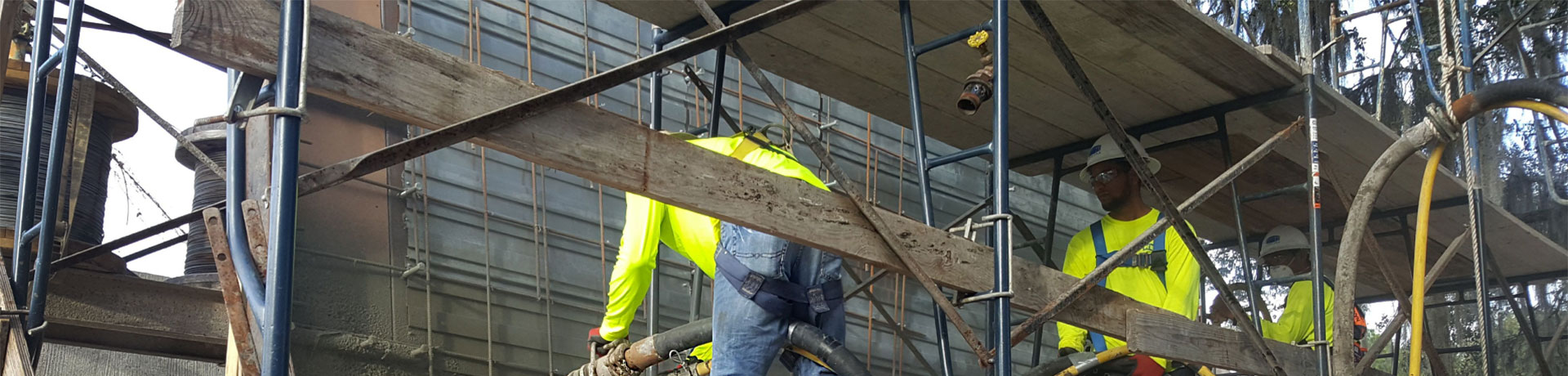
Shotcrete is routinely used to seal shale after excavations. It is typically done as soon as possible after the excavation because the shale will deteriorate when exposed to the air. When shotcreting, it is considered good practice to wet the receiving surface prior to gunning to create a saturated surface-dry (SSD) condition so the substrate will not draw moisture from the newly placed shotcrete. A good SSD condition is where the surface is wet without any standing water on it. Gunning over wet shale should not be a problem unless the water seeping from the shale is moving. If that is the case, we would recommend installing weep holes with plastic pipe at the locations where the water is seeping from and using an accelerator to flash-set the material immediately around the weep-hole pipe. It is also a good idea to install weep holes at regular intervals along the excavation or exposed hillside. It is important to use a qualified shotcrete subcontractor for this or any high-quality shotcrete installation. A qualified shotcrete contractor will use ACI-certified nozzlemen and should provide you with a résumé of similar, successfully installed projects, along with the up-to-date contact information of representatives from the owners or engineers involved in those projects. The ASA Buyers Guide (www.shotcreteweb.wpengine.com/pages/products-services-information/buyers-guide/) is an excellent source of shotcrete contractors.
What is the impact force on formwork resulting from a shotcrete application? I am designing the formwork for a wall to be placed via shotcrete and need to know the forces imposed on the wall forms.
In structural applications, most of the impact force from nozzling shotcrete is directed toward compacting the shotcrete in place rather than against the formwork. This was the subject of a study conducted by Marc Jolin of Laval University, Quebec City, QC, Canada, and reported in the Fall 2007 issue of Shotcrete magazine. There is virtually no hydrostatic pressure on the forms from the application using the shotcrete process. A copy of this study can be viewed on the ASA Web site at www.shotcreteweb.wpengine.com/archivesearch/ArchiveSearch.asp.
We recently contracted with a shotcrete company to install a shotcrete structure for a swimming pool. After the pool was completed and filled with water, rust stains began emerging through the plaster surface. When we broke out a section of the pool structure, we found that there was little to no coverage of shotcrete over the steel reinforcement. The shotcrete company’s excuse is that they shot the pool to maintain the desired finished depths and widths and there was little to no coverage because the steel was set too high (even if that were the case, they never alerted anyone during the installation). This sounds like an excuse to me. Shouldn’t the shotcrete company we hired make sure that the concrete coverage met or exceeded what the structural engineer called for? Is there any credibility to their explanation of why they didn’t cover the reinforcing bar enough? What is the standard practice for shotcrete installation?
In short, the shotcrete contractor is responsible for maintaining proper cover over the reinforcing steel. The reinforcing bar installer should set the steel in the proper location for achieving the required cover corresponding to the final desired shape. If the shotcrete contractor finds that he cannot maintain proper cover with the reinforcing as placed, however, he needs to communicate to the designer/owner/general contractor that the reinforcing needs to be fixed before he shoots the section in place. There is no excuse for placing shotcrete with less than the specified cover, as shooting it with reduced cover will obviously create a section that has much less durability than intended by the designer.
I have been in the swimming pool industry for 30 years and I deal with a lot of different engineers on my commercial projects who want a wet test to verify water tightness before the finish is applied to the pool. In my experience, air-entrained shotcrete tends to be porous and leak. Are there any engineering specifications that state that air-entrained shotcrete is porous and will leak if the surface is not trowel-finished?
Properly added and mixed air-entraining admixture in concrete will actually reduce the permeability of concrete. This is because the small, well-formed air bubbles from air-entraining admixtures are not interconnected as larger, entrapped air bubbles may be in non-air-entrained concrete. Thus, the reported higher permeability of the air-entrained shotcrete is not a material flaw but must be from poor shotcrete application. Air entraining from 4 to 7% air is advantageous for enhanced resistance to the freezing-and-thawing cycles of saturated concrete and should be specified by the designer in areas subject to significant numbers of freezing-and-thawing cycles annually. The reported high permeability and resultant failure to pass a water-tightness test could be investigated by taking cores of the “porous” material and conducting a petrographic analysis of the core. Based on the reported results, I strongly suspect that the in-place shotcrete has major issues with sand pockets, overspray, and rebound.
I would like to add fibers to a shotcrete mixture. Many research articles discuss steel fibers and sometimes synthetic. I’d like to consider glass or synthetic fibers because the exterior wall will be visible and I don’t want to see the corroding steel fibers toward the surface of the concrete. What are the pros/cons of glass fibers versus steel fibers and how much should I add to the mixture design to achieve a product that can be submerged in water and experience as few cracks as possible? Is there reference material for these questions?
Refer to ACI 506.1R-08, “Guide to Fiber-Reinforced Shotcrete,” at www.concrete.org for guidance on fiber types and dosages. Glass fibers are seldom (if ever) used in shotcrete because they tend to break under the high velocity required for shotcrete. Steel or macrosynthetic fibers should be used at about 0.4 to 0.5 volume percent to control hardened shotcrete cracking, 50 to 66 lb/yd3 (30 to 39 kg/m3) for steel (specific gravity (SG) of 7.85), and 6 to 7.5 lb/yd3 (3.6 to 4.5 kg/m3) for macrosynthetic polypropylene (SG of 0.91). Fiber suppliers can provide more technical guidance for their products. You can locate fiber suppliers by visiting the ASA Online Buyers Guide at www.shotcreteweb.wpengine.com/pages/products-services-information/buyers-guide/.
Are there any guidelines/regulations as to how close in proximity the installer/nozzle person can be to the receiving surface? I have a chimney job (existing chimney repair) that has an opening of 3.5 x 3.5 ft (1.1 x 1.1 m) and the interior is calling for a gunite (dry-mix) liner to be installed. Is there an issue with splash-back or any other concern with using gunite in such a confined space?
When gunning in tight areas, you have to allow for the bend in the hose and the length of the nozzle, which will require at least 2 to 2.5 ft (0.6 to 0.8 m). An area 3.5 ft (1.1 m) wide is a very tight area to gun in, but it can be done. In areas that restricted, it’s not possible to always maintain a 90-degree shooting angle, so you will get much more rebound from the deflection when shooting at less than desirable angles. Also, with the dry process, you have to reduce the air pressure and volume to keep from blowing the material off the walls. Ideally, you would like the nozzle to be at least 3.5 to 5 ft (1.1 to 1.5 m) from the receiving surface, depending on the nozzle you use. For a tight area like you are proposing, in addition to reducing the air pressure and running it slowly, we would recommend using a double-bubble nozzle, as it has a wider spray pattern, allowing the nozzleman to be closer to the receiving surface and still get an adequate spray pattern. A double-bubble nozzle is also flexible, which will help in extremely tight areas. You can locate organizations that sell a range of nozzles by visiting the ASA Online Buyers Guide at www.shotcreteweb.wpengine.com/pages/products-services-information/buyers-guide/.
I am searching for a sample specification that calls for the use of a polymer-modified cement mortar in lieu of one that does not have the polymer additive. My thought is that this material would be more durable. I am also wondering if it would have greater bond to the old substrate.
Most of the industry does not endorse the use of polymer-modified additive in shotcrete. Please refer to ACI RAP Bulletin 12 and ACI 506R for further information and insight from the American Concrete Institute (ACI) at www.concrete.org. Shotcrete applied by competent contractors to properly prepared surfaces exhibits excellent bond characteristics to the substrate. Additionally, a good shotcrete mixture that is properly applied will yield a durability equal to or superior to cast concrete. There are many examples discussed in various articles of Shotcrete magazine at shotcrete.org/archivesearch/ArchiveSearch.asp.
I will be placing a large amount of concrete via the shotcreting process onto a river bed. There are minimal forces and the only reason I need reinforcing is for temperature and shrinkage. If I add fibers to the mixture design, what percent of steel will I still need (if any) or, in other words, how much fiber do I need to include so that any other form of mesh or reinforcing bar is not required to meet temperature and shrinkage requirements? In addition, will too much fiber have any unwanted effects?
Fibers are typically added to shotcrete linings for canals, channels, and other water structures in lieu of conventional reinforcing, such as welded wire reinforcement (WWR). For your “large amount of concrete via the shotcreting process,” we assume that you are using the wet-mix shotcrete process.
Temperature/shrinkage reinforcement is typically placed in thin sections governed by the structural concrete provisions of ACI 318 at a rate of 0.15 to 0.18%. Please be aware that if the lining is intended to be liquid-tight and has movement joints spaced at greater than 40 ft (12 m) apart, a reinforcement ratio of at least 0.50% is recommended by ACI 350 for concrete liquid-containing structures. Assuming that the section does not need to be liquid-tight and using the ACI 318 requirements, let’s consider the tensile capacity of a conventionally reinforced section and provide an equal or greater tensile capacity with fibers. Assuming a 3 in. (75 mm) thick lining with an assumed 28-day compressive strength of 4000 psi (28 MPa), using a WWR of 6 x 6 x W2.9/W2.9 in this section provides a percentage of steel of 0.161% and a tensile capacity of 3770 lb/ft (5610 kg/m). (Asfy = 0.058 in.2/ft [0.12 mm] x 65,000 psi [448 MPa] = 3770 lb/ft [5610 kg/m].)
Then, we assume that the direct tensile strength is 75% of the flexural strength (modulus of rupture [MOR]). For 3770 lb/ft (5610 kg/m) in a section 3 x 12 in. (75 x 300 mm), we have 3770/(12 × 3) = 105 psi (0.72 MPa). Then, we need an average residual strength (ARS) (ASTM C1399) of 105/0.75 = 139.6 psi (0.963 MPa) = 140 psi (0.965 MPa).
Using a macrosynthetic fiber, one can achieve these results using 4 to 5 lb/yd3 (2.4 to 3.0 kg/m3) in wet-process shotcrete. Fiber manufacturers will provide exact dosages to meet the ARS requirements.
Using steel fibers, approximately 43 lb/yd3 (25.5 kg/m3) will provide an equivalent area of steel to the WWR of 6 x 6 x W2.9/W2.9 in a 3 in. (75 mm) thick concrete section. Using steel fibers, however, may require a flash coat to cover the fibers that will protrude and rust over time. The corrosion of the fibers will only reach a carbonation depth of 0.05 to 0.10 in. (1 to 2 mm) but may result in staining the lining.
These calculations assume a thickness and strength. You must adjust for your conditions.
We are currently working on a Request for Deviation to use shotcrete in lieu of cast-in-place concrete. The engineer is requesting additional information/confirmation. The application locations are structural, using No. 6 and No. 8 reinforcing bars on 1.5 ft (0.5 m) thick walls approximately 40 ft (12.2 m) high. The engineer’s comments refer to detailing construction joints, curing, and plastic shrinkage gaps (work done in July). We have also requested a slump to be reduced to 2 ± 1 in. (51 ± 25 mm) and the use of 3/8 in. (9.5 mm) aggregate. What methods would you suggest to address each issue?
The project as described sounds very feasible for a structural shotcrete application. As we understand, the concerns are:
- Detailing construction joints—Please refer to ACI 506R, “Guide to Shotcrete,” Paragraph 5.7, Joints. Typically, shotcrete joints are beveled to increase the surface area of the bonding surface and reduce the likelihood of trapping rebound. Other considerations for construction joints should follow the principles of cast-in-place concrete. Shotcrete is a method of placing concrete.
- Curing—Shotcrete is concrete consisting of smaller aggregates and generally higher cement content. Good curing practices should be followed as they should be with cast-in-place concrete. Considerations should include the temperature and humidity when evaluating a curing program. High temperatures with low humidity will require significantly more effort than high temperature with high humidity. The key is to ensure that sufficient moisture is available to hydrate the cement during the curing period.
- Plastic shrinkage gaps or cracking—The shrinkage characteristics of shotcrete are similar to cast-in-place concrete. Shotcrete is composed of smaller particles and higher cement but generally places at a low water-cement ratio (w/c) or less than 0.45. Shotcrete is somewhat more prone to plastic shrinkage cracking due to the surface not being protected by a form in its early stages. If the finished surface is subjected to high ambient temperatures, low humidity, or high winds, it will tend to dry quickly on the surface and exhibit more plastic shrinkage cracking. In these environmental conditions, fogging of the exposed shotcrete surfaces soon after shotcreting may help to reduce or eliminate the plastic shrinkage cracks. Plastic shrinkage cracks are generally superficial in nature and can be repaired if necessary.
- Slump to be reduced to 2 ± 1 in. (51 ± 25 mm)—This is a good range if measured and treated properly. It is important to ensure that the shotcrete material has enough slump at the nozzle to properly encapsulate the reinforcing steel and is stiff enough to stay in place without sloughing or sagging. The slump at the nozzle is far more relevant than the slump at the pump.
The important factors influenced by slump are maintaining the proper water-cementitious material ratio (w/cm) and consistency at the nozzle to ensure good placement. The most important consideration is to ensure that you have an experienced shotcrete contractor who has a history of success with similar projects with respect to the size and complexity of the installation. You can locate shotcrete contractors on the ASA online Buyers Guide at shotcrete.org.
Our current project is a pier with severe corrosion of reinforcement and obvious spalls. The work will all be overhead with the surface 18 in. (457 mm) above the mean tide level and, for a variety of reasons, dry-mix is not an option. We are looking for a good, dense, wet-mix design for saltwater marine exposure. Compressive strengths need to be in the mid-range of 7000 to 8000 psi (48.3 to 55.2 MPa).
For a potentially suitable wet-mix shotcrete mixture design for marine structure repair, go to the ASA Web site (shotcrete.org). Click on Shotcrete magazine and search for “Shotcrete Classics: Deterioration and Rehabilitation of Berth Faces in Tidal Zones at the Port of Saint John.” This mixture design worked well for over 1.2 miles (2 km) of ship berth face repair over a 10-year period. Note: Because of high freezing-and-thawing exposure, the shotcrete was required to be air entrained. While the original mixture design called for 7% air content as shot, it was subsequently modified to require an air content of 7 to 10% as batched (at the point of discharge into the shotcrete pump) and an air content of 5 ± 1.5% as shot (into an air pressure meter base). Such shotcrete has provided good freezing-and-thawing resistance. You should be aware that your local materials (coarse and fine aggregates and cement) may have different properties in the concrete mixture, however, as compared to the mixture discussed in the article. It is recommended that a local engineer, testing laboratory, or concrete supplier be retained to develop a concrete mixture using local materials that meets the performance requirements of the mixture design mentioned in the article. Also, test panels constructed with the mixture, nozzlemen, and equipment to be used in the shotcreting are highly recommended to verify the strength performance of the shotcrete.