
A nozzleman who has made a transition from hand-nozzling to using a robotic arm knows the value that mechanical technology has brought to our industry. Far beyond just saving human backs and arms during a shift of spraying concrete, robotic arms (booms, lances, etc.) have taken the application of shotcrete to the next level, facilitating rapid deployment of material to signiï¬cant thicknesses, in hard-to-reach areas, particularly in underground construction environments (tunnels or mines).
This quantum leap in technology, while requiring training and skill to operate, makes shotcreting easier.
But what if those human factors that detract from the quality of in-place shotcrete could be controlled or eliminated? With the use of emerging technology, human error can be reduced or even eliminated.
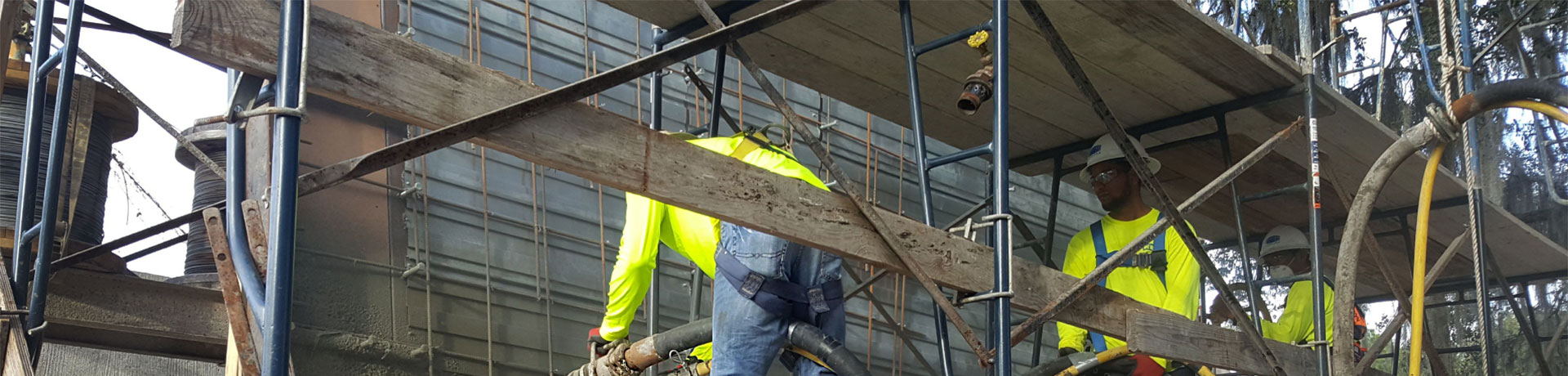
Scaffolding is Serious Business
According to the Occupational by Joe Vierra of Safety and Health Admini-Concrete Structures stration, 2.3 million construction workers work on scaffolding on
a frequent basis. Every year, approximately 4500 injuries and 50 deaths occur in scaffold-related accidents with an estimated $90 million in lost workdays in addition to the medical, workers compensation, and other costs resulting from these incidents.
Technical Tips on Shotcrete Finishing
In this section of the fall issue of ASA™s Shotcrete, I introduced some aspects of pool finishing. I receive many calls, questions, and comments from people about the new finishing tools. Since this issue is on architec-tural shotcrete and finishing, I thought it would be interesting to further develop the topic of finishing techniques for shotcrete.
Shotcrete for Ground Support: Current Practices in Western Canada
Historically, in Western Canada, the stabilization of rock slopes and construction of excavations have been achieved using methods such as soldier piles and lagging or construction of cast-in-place concrete retaining walls. In the case of reinforced cast-in-place concrete, there is a requirement for erection of formwork, fixing of reinforcement, pouring the concrete mixture, and vibration to ensure good concrete consolidation and steel encapsulation. These methods have proven to be relatively ineffi-cient and costly in many cases. In recent decades, however, the use of shotcrete for ground support has seen increased use, as shotcrete has allowed
Spanish Terminology in the Shotcrete
For effective communication and interaction among groups in this industry, the knowledge and use of the Spanish language in the American construction industry has been increasingly recognized as a growing requirement, rather than an exception. According to U.S. Census Bureau reports for the year 2000, of the 281 million inhabitants in the United States, 35 million (12.5%) are Hispanic, which is actually slightly higher than the black population (12.3%). A large increase in the Hispanic population was observed in the last decade. This group has grown by almost 40% since 1990, with much of this growth being attributed to new jobs in construction. To date, it is estimated that Hispanic workers account for up to 15% of the workforce in the construction
Construction and Repair with Wet-Process Sprayed Concrete and Mortar
A technical report has just been published in the UK by the Concrete Society. This new the Department of Civil and Building Engineering at Loughborough University: Simon Austin, professor of structural engineering; Peter Robins, senior lecturer; and Chris Goodier, a former research associate at Loughborough University, now a senior consult-ant with BRE™s Centre for Concrete Construction.
Artistic Shotcrete for a Historic Auditorium
The Goetheanum (Fig. 1) in Dornach, near Basel, Switzerland, was constructed in the late 1920s from a design by Austrian social philosopher and œspiritual scientist Rudolf Steiner. This building represents the first use of reinforced concrete for monumental, sculptured forms.
Shotcrete Lions for Calgary’s Centre Street Bridge
The Goetheanum (Fig. 1) in Dornach, near Basel, Switzerland, was constructed in the late 1920s from a design by Austrian social philosopher and œspiritual scientist Rudolf Steiner. This building represents the first use of reinforced concrete for monumental, sculptured forms.
Safety Shooter: Daily Inspection Can Improve Safety
It’s 5:30 in the morning in our yard. All of the compressors, trucks, shot-crete pumps, and related equipment are on their way out of the yard for the day™s operations. It™s important that the equipment gets to the various jobsites, which could be anywhere from 10 to 150 miles away, on time and without incident. But what can be done to assure that everything is road-worthy?