
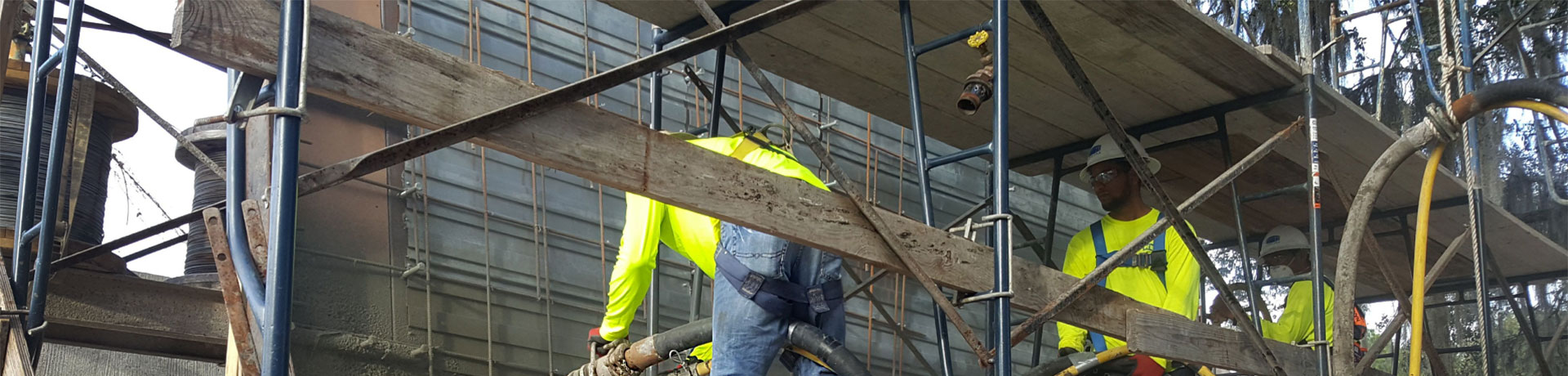
The purpose of this article is to examine the use of modern wet-mix shotcrete in under-ground environments. A critical review is provided of aspects such as mixture design, specificcations, and placement. More specifically, the intent of this article is to identify the limits of the wet-mix shotcrete process, examine actual mix designs, discuss the various methods of deter-mining (and specifying) the early-age properties of shotcrete (< 1 day), and review shotcrete placement properties, especially pumping the fresh concrete. The presentation treats various subjects taking into account actual ï¬eld practices as well as the results of on-going research at Laval University, QC, Canada.
How to Plan Your Safety Training Program
The subject of safety training necessarily starts with the question, œWhat do we need? A training-to answer this question. These answers will begin to deï¬ne the content, frequency, categories of employees to be trained, and documentation required.
Some training is required by law. Federal, state, and/or local laws detail required training for speciï¬c operations. A good ï¬rst step is to determine what is legally required by various government agencies. On the federal level, the Occupational Health and Safety Administration (OSHA) and the Environmental Protection Agency (EPA) are good examples
Steel Fibrous Shotcrete: A Summary of the State-of-the-Art
Steel fibrous shotcrete has been used for mine and tunnel linings, for rock slope stabilization, in dam construction, for repair deteriorated surfaces and arches, for fire protection coatings and in thin-shell dome construction.
Update on Standards for Shotcrete
There have been a number of articles on shotcrete speciï¬cations or guidelines since Shotcrete™s debut issue in 1999.1-5 Because this issue™s theme is Specitcations, I thought it timely to offer an article updating the state of current standards in North America and the ongoing work on shotcrete standards.
As you may know, there are three major groups concerned with shotcrete issues in the U.S.: ACI International, with Committee 506, Shotcreting, and Committee C 660, Shotcrete Nozzleman Certiï¬cation; ASTM International, with Subcommittee C 09.46, Shotcrete; and, of course, ASA. The first two publish speciï¬cations, guidelines, or standards; and, by agreement, ACI International deals with œhow to and design issues, while ASTM International deals with materials speciï¬cations, practices, and test methods. Two of the three committees mentioned previously are presently chaired by ASA members”we are working on the third person!”and are required to have a balance of interests of voting members, users, general interest, and suppliers. Documents published by these committees must be approved by oversight committees and sometimes by the entire memberships; thus, they are considered consensus documents in that anyone with an interest may provide input.
ACI International
ACI Committee 506 was organized in 1942 and now consists of approximately 62 members covering diversiï¬ed interests in shotcrete. Current Chair John H. Pye of the U.S. Nuclear Waste Technical Review Board has divided the committee into subcommittees. This committee has published and is working on the following:
Just Add Water…
Sufficient water supply is one of the most important variables in the application of good-quality dry-mix shotcrete. It is often overlooked, especially by people who are new to the industry. Although the flow required is relatively minimal (10 to 60 L/min [2.5 to 16 gal./min]), all too often the water pressure requirements are not given the attention they deserve. It is important for the water pressure to be at least 100 kPa (15 psi) greater than the pressure in your conveyance hose. Conveyance hose pressure will vary based on many factors such as length and inside diameter, material gradation, vertical ascents, rpm of the rotor or bowl, and the adjustment of the valves feeding the compressed air to the conveyance hose. Hose pressure will usually vary from as little as 200 kPa (30 psi) to as great as 480 kPa (70 psi). It is best not to rely on an onsite water source. A good-quality water tank and pressure booster pump will easily pay for themselves in the long run.
Release of New ASTM Round Panel Test
Following a 3-year development period, a new test for post-crack performance assessment of ï¬ber-reinforced shotcrete (FRS) and ï¬ber-reinforced concrete (FRC) based on round panels was passed by ASTM Committee C 09 in June 2002. The standard test method, known as C 1550-02, œStandard Test Method for Flexural Toughness of Fiber-Reinforced Concrete (Using Centrally-Loaded Round Panel), was published in the 2002 edition of the Annual Book of ASTM Standards V. 4.02.1 Publication of this standard test method is a major development in the fiber-reinforced shotcrete industry. It will, for the ï¬rst time, permit a both reliable and economical estimation of post-cracking performance for this material.
The use of ï¬bers in shotcrete has become an established form of reinforcement in many sectors of the underground construction industry over the last 20 years. The effective measurement of post-crack performance (toughness) in this material, however, is a problem that has plagued the industry and made the influence of parameters such as ï¬ber type, mixture design, and spraying technique difï¬cult to determine. Much of the difï¬culty is attributable to the high levels of within-batch variability obtained for even well-prepared sets of FRS samples when beams are used as the basis of toughness assessment. Typical levels of within-batch variability for toughness indices obtained using ASTM C 1018 beams range from 13 to 18%.2,3 More than18% is common for residual strength obtained using EFNARC beams.4 The imprecision associated with such high levels of variability has obscured trends in performance development and eroded conï¬dence in the material. Some improvement occurred with the introduction of EFNARC panels in the 1990s,5,6 but this test suffered its own difï¬culties associated with seating problems and high costs. Other types of specimens have seen occasional use,7-10 but the size and expense of these tests have limited their use to special applications.
The ï¬rst round panel test similar to the C 1550 conï¬guration was undertaken in 1997 as part of an investigation of the influence of support conditions on structural behavior in FRC panels.11 The potential of this test was recognized by the Roads and Traffic Authority of New South Wales in Australia, which immediately sponsored a comparative study of FRS performance for several commonly available ï¬bers.12 A speciï¬-cation based on this test13 was also introduced
Shotcreting in Australian Underground Mines: A Decade of Rapid Improvement
Over the last decade, dramatic improvements in spraying technology have allowed shot-crete to become the first-choice ground support in many underground mines in Australia. Before 1994, only a very small amount of dry spray shotcrete was used. Since then, the increased use of wet-mix ï¬ber-reinforced shotcrete has been extremely rapid, spurred along by improvements in machinery, admixtures, fibers, and under-standing the way shotcrete behaves as a ground support element.
Today, nearly 100,000 m3 (130,000 yd3) of shotcrete is applied annually in some 20 under-ground mines. While volumes have leveled off during a recent period of depressed metal prices, it is almost certain to boom again as metal prices improve and new mines come online. Australian mines are characterized by reasonably shallow ore bodies hosted in hard rock. This made under-ground mining initially fairly simple with little ground support needed beyond a few rock bolts. As surface deposits have become depleted, however, mine owners are increasingly spending their exploration dollars drilling beneath existing deposits to ï¬nd new resources. This has led to ever-deepening extraction depths and associated ground support difï¬culties.
Determination of Early-Age Ductility of Steel Fiber-Reinforced Shotcrete Lining System at INCO’s Stobie Mine
The state of technology in shotcrete materials has evolved steadily throughout the world and particularly in North America during the last 20 years. The use of supplementary cementing materials such as silica fume, fly ash and slag, the new generations of chemical admixtures, and the development of various types of ï¬bers (steel and synthetic) signiï¬cantly enhance the performance of shotcrete for a variety of applications.
These technological advancements have led the international mining industry to become a major user of shotcrete for underground support. Because the potential for instability in underground rock openings is a threat to the safety of miners, the support of permanent openings in underground mining is a critical area of shotcrete application. For over 20 years, mining companies have recog-nized the value of steel ï¬ber reinforcement in shotcrete. It has been proven that the performance of steel fiber-reinforced shotcrete compares favorably with steel-welded wire mesh reinforced shotcrete in various ground support applications.1
The introduction of steel ï¬bers in shotcrete increases its energy absorption or œtoughness, increases impact resistance, and provides increased ductility. Ductility is defined as the ability to continue to carry loads after the shotcrete micro-structure has cracked. These mechanical properties are considered extremely important parameters with respect to support linings designed for the underground environment.2 (The effects of addition rate, geometry, and property of ï¬bers are beyond the scope of this article.)
Although the ability of steel ï¬ber-reinforced shotcrete to carry loads in flexure beyond its flexural capacity can be assessed in laboratories using a variety of beam and panel test methods, the under-standing of how to relate it to ground support design guidelines for underground mine devel-opment is limited and subjective.3
Test methods evaluating the load-carrying capacity of steel ï¬ber-reinforced shotcrete (SFRS) performed after 7 and 28 days of curing do not assess
Freeze-Thaw Durability of Shotcrete
Shotcrete has been used in construction in North America for almost 80 years. Initially, all shotcrete was applied by the dry-mix shotcrete process, where the majority of the mixed water is added at or near the nozzle just before the shotcrete is pneumatically consolidated by the impact on the receiving surface.
Combining Shotcrete Mixes for Maximum Performance
Rebound is an essential element in the application of shotcrete. Rebound is deï¬ned as follows: œMainly large aggregate with some sand and cement that bounces or ricochets off the receiving surface and falls on to lower surfaces.1 There is a vital function that is achieved in the rebounding of shotcrete. The secret lies in knowing how much rebound is enough.
To paint a mental picture for the reader to understand rebound, consider a baseball. If you take a baseball and dip it into some fresh concrete and pull it out, it will be covered with mortar”a paste consisting of the cement and ï¬ne aggregate and water”that acts as the glue required to create an artiï¬cial rock called œconcrete. If you took this baseball covered with mortar and threw it at a high velocity against a solid block wall at a 90-degree angle to the wall, the ball would strike the surface and bounce off. Because the paste is also in motion at 95 miles per hour and the paste is not securely bonded to the ball, some paste will leave the surface of the baseball, contact the wall, and adhere to the surface. In layman™s terms, it would œsplat onto the wall. The harder the baseball is thrown, the more the paste would leave the surface of the