
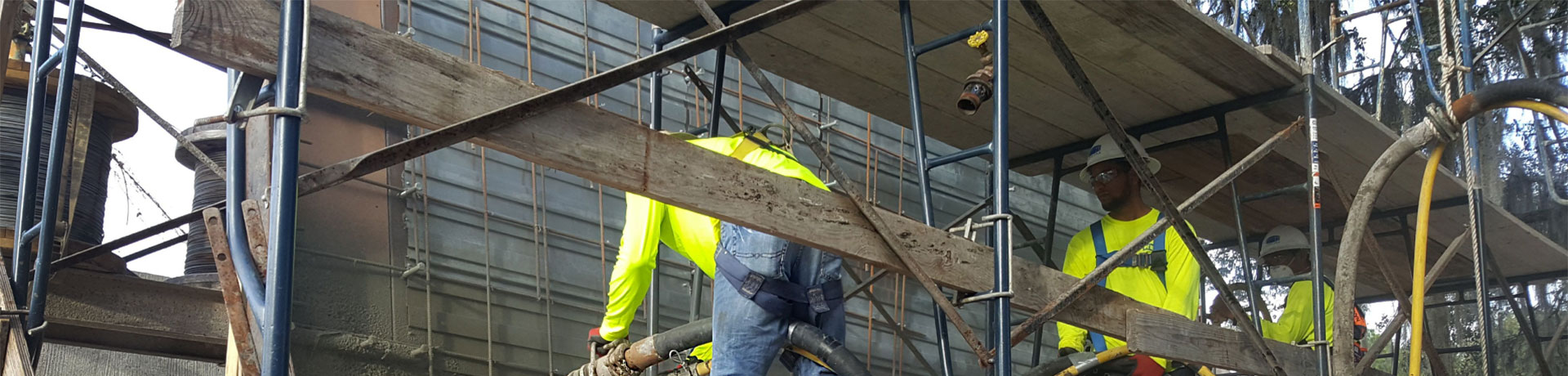
Here is an important safety tip: Reducers and pumping lines should be directed away from the operator, whenever pumping conditions allow. This means reverse the 90-degree reducers and run the pumping system away from the pump operator and the ready-mix truck driver (refer to Fig. 1).
What happens on one-way streets, such as in San Francisco, where you cannot change the way the system can be run? We also have found out that running the shotcrete line system per Fig. 1 can be difï¬cult when pumping shotcrete material that may tend to plug easily. The operator always seems to be going to the other side of the pump to unplug the lines, making it hard to access the ready-mix truck at the back of the pump.
After some serious brainstorming, we came up with a protective solution that would contain the concrete if a hose or reducer broke. We wanted to ï¬nd something that could be bought almost anywhere and was priced right. Some type of rubber mat seemed to make sense. Our idea was to use a rubber mat from the bed of a pickup truck. To test this idea, we dumped all the tools out of a foreman™s truck and used that mat. We cut it in half and used the special shotcrete attachment device (tie wire) and tied it off. It worked great. We now buy mats for approximately $75, install holes, and attach bungee cords (refer to Fig. 2).
Pump Clean Up
Protecting reducers and couplings is not only a safety concern but an environmental issue as well. We pump a lot of shotcrete
The Setenave Dry Docks Rehabilitation
Sentenave is ageneral designation for a shipyard built in the ninty seventies at the right end of Portugal
U.S. Shotcrete Standards Update
This is an attempt to keep you informed about the activities of various organizations and committees developing standards and recommendations related to the shotcrete industry. Readers are invited to provide supplemental information related to the initiatives of ACI, ASTM International, or any other organization active in shotcreting.
Matching Equipment to Process: The Predampener
As one who promotes choosing process before product, I believe that the success of any project also depends on matching the appropriate equipment to the process/product chosen. Specialty equipment offers several opportunities to achieve effective results. This article will discuss the predampener, a machine used in dry-mix shotcrete application.
In wet-mix shotcrete application, the water- cement ratio (w/c) is controlled prior to discharge into the mixer-pump apparatus. High-velocity air pressure propels the mixture to the receiving surface. In a dry-mix shotcrete application, the w/c is controlled by the nozzleman. Because it is not desirable for the nozzleman to introduce all the water at the water ring, a predampener must be used to ensure proper hydration of the cement.
The predampener facilitates the process as follows: the bagged product, or œsuper sack material, is dropped into the predampener™s front hopper and moved by an auger system through a ï¬ne mist of water that dampens the product prior to it being dropped into the shotcrete gun and propelled by compressed air up to the nozzle, where the appropriate amount of additional water is then added.
When shotcrete is delivered by a ready-mix concrete truck, the mixture is already predampened from the moisture in the sand. Avoid the use of
Restoring the Century-Old Wachusett Aqueduct
Every day, residents of Eastern Massachusetts quench their thirsts, bathe, flush toilets, do the dishes, and water their lawns with water drawn from the Massachusetts Water Resources Authority (MWRA) water system. Thanks to the Quabbin and Wachusett Watersheds and Reservoirs, 2.2 million people and 5500 industrial users have one of the most abundant and high-quality water supplies in the world.
The Wachusett system was constructed in 1897 to originally service the 29 municipalities within the 10 mile radius of the State House. At the time, the Wachusett Reservoir was the largest public water supply reservoir in the world. The Wachusett Aqueduct extends from the Wachusett Reservoir in Clinton, through Berlin to Northborough, MA. This 9 mile-long water system consists of 2 miles of hard rock tunnel and 7 miles of 11 ft-high horseshoe-shaped underground aqueduct constructed of nonreinforced concrete with a brick-lined invert.
From its completion in 1903 until the early 1960s, the Wachusett Aqueduct was the primary water transmission system from the Wachusett Reservoir to the City of Boston and surrounding communities. As Boston™s water demand steadily increased, a new system called the Cosgrove Tunnel was developed in the 1960s to provide increased capacity. The Cosgrove Tunnel is a deep rock tunnel running roughly parallel to and deeper than the Wachusett Aqueduct. Since its completion, the Cosgrove Tunnel has essentially replaced the Wachusett Aqueduct as the main delivery system of Boston™s water supply.
Today, a 10-year improvement program, initiated by MWRA with a series of projects to protect watersheds and build new water treatment and transmission facilities, is nearly complete. The Wachusett Watershed is just one
Rock Stabilization of Two Historically Sensitive Rock Slopes using Shotcrete
The need to stablize these rock slopes was driven by the construction of the Hudson-Bergen Light Rail Project, which was being extended into Weehawken, NJ. The location of the light rail was along the base of the Palisades in Hoboken and Weehawken. The need to stablize these rock slopes was driven by the construction of the Hudson-Bergen Light Rail Project, which was being extended into Weehawken, NJ. The location of the light rail was along the base of the Palisades in Hoboken and Weehawken.
ACI Shotcrete Certification: Our Aim is True
The Growing Market for Shotcrete in Skatepark Construction
How many times have we seen kids (including some our own) riding skateboards and BMX bikes around the neighborhood? Jumping off walls and homemade ramps is great fun.
Pump Safety – The Forgotten Screen
It seems like every time we take delivery of a new pump, everybody wants to climb all over it. They love to check out all controls and features, comparing them to the equipment they have been using.
Shotcrete Construction Joints
Shotcrete construction joints are required in situations such as the following. When the volume of shotcrete is greater than that which can be conveniently applied and finished in a single shift. In the construction of top-down shotcrete installations, such as soil-nailed walls, where the element is constructed in a series of horizontal lifts and in segmental shotcrete construction, such as used in the underpinning of buildings.