
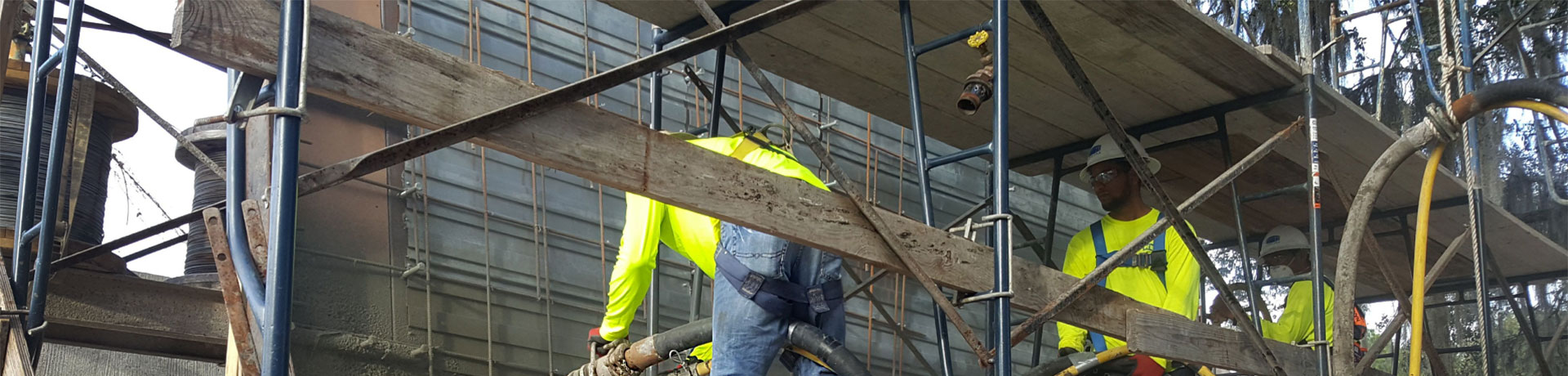
The face or surface of shotcrete walls as described are typically established with ground wires or screeds, which assist the person using the shotcrete rod in cutting the wall to the proper plane. The tools typically used to achieve a troweled surface are the shotcrete rod, wood floats, and steel trowels. Typically, shotcrete walls are a minimum of 4000 psi (27.6 MPa) 28-day compressive strength and the aggregate varies from sand only to a blend of sand and 0.375 to 0.5 in. (9.6 to 13 mm) aggregate. Consult our Shotcrete magazine archives for examples at www.shotcreteweb.wpengine.com.
A circular concrete tank built in the 1980s is to be resurfaced due to cracks in the exterior shotcrete lining. It has been proposed that the existing surface will be hydroblasted. Is there a concern that the shotcrete may contain asbestos?
No, there is no reason to assume that the shotcrete would contain asbestos. Shotcrete linings typically contain sand and cement. Asbestos was commonly used for pipe insulation and high-temperature industrial uses and not for shotcrete.
Can shotcrete be effectively used to repair holes in an old 8 ft (2.4 m) diameter storm sewer tunnel constructed of stone/brick/mortar? One of the holes is completely worn through to the earthen backfill material. The other two holes are missing the innermost layer of stone masonry, but the outer layer of masonry is still in place.
The friction coefficient n of well-finished shotcrete for use in Kutter’s equation (and, more streamlined, Manning’s equation) is generally used as 0.012. Shotcrete is used not only to improve flow characteristics of brick, corrugated metal, or any other pipe construction but can also be conventionally reinforced as a structural liner to eliminate the need for liner plates or other pipe-lining alternatives.
To keep shrinkage cracking sufficiently tight so as not to cause reflective cracking in the plaster layer, what is the proper depth of reinforcing steel from the shotcrete surface in swimming pool applications?
This question should be addressed by a qualified engineer with experience in designing swimming pools and well-versed in shotcrete technology. Shotcrete is a method of placing concrete and the parameters that work for concrete cover work for shotcrete.
Good practices for placing shotcrete or concrete include:
- Predampening the soil that the concrete/shotcrete is placed against;
- Ensuring that the reinforcing bar temperature is not too high; and
- Early curing of the shotcrete surface and maintenance of curing for the specified duration. If no duration is specified, a 7-day wet cure is recommended.
Using fibers in the shotcrete/concrete can also help control surface early-age plastic shrinkage cracking.
I have a swimming pool that appears to have shrinkage cracks in the floor. I have tried to inject an epoxy, but the cracks are too small. Do you have any suggestions?
There are a wide variety of epoxies and polyurethanes used for crack injection. Smaller crack widths would require a lower-viscosity material to penetrate the crack. You should contact an engineer or injection specialist experienced in shotcrete and cracking issues to evaluate the cracking and make a specific recommendation for repair. Proper concrete mixture design, placement techniques, and early water fogging and curing can help to reduce plastic shrinkage and drying shrinkage cracking in the future.
Which method of placing concrete provides a longer service life—traditional cast-in-place concrete with two-sided forms or shotcrete?
Shotcrete is a placing method for concrete. Wet-mix shotcrete will be very similar in density to fully consolidated concrete when the concrete mixture designs are similar. Properly mixed and shot, dry-mix shotcrete may have a slightly higher density. Properly designed, placed, and cured, both concrete and shotcrete will give an excellent service life.
I have been asked to recommend repairs to a fire-damaged brick wall. The wall is 12 in. (30.5 mm) thick and 14 to 16 ft (4.25 to 4.9 m) high. The fire caused spalled brick—3/8 in. (10 mm) deep—and soft mortar joints. The damaged side of the wall is exposed to weather. I plan to recommend tuck-pointing the mortar joints but am wondering if shotcrete is appropriate to repair the spalled brick. The brick could be cut out and replaced, but shotcrete would seem to offer the advantage of repairing and reinforcing the brick wall.
Shotcrete would be an excellent process to repair or overlay your wall. You are correct in saying that it could not only repair but also reinforce and enhance the strength of the wall system. It is important to remove all deteriorated brick and sandblast or water-blast the surface if you are looking for a good bond between the shotcrete and the existing brick. Dowels epoxied or grouted into the existing brick are often used to mechanically tie the shotcrete overlay to the brick wall and also stabilize the new reinforcing steel in the shotcrete overlay.
We are a local agency considering the repair of a number of older culverts with shotcrete. Like most agencies, we are trying to be creative about maximizing our funds. We work with a federal agency when it is determined that a “new” culvert is needed. In other words, the agency will not pay for maintenance repairs but will pay for “new” culverts. We are wondering if the shotcrete method has ever been viewed as a means of creating a “new” culvert. Could the existing culvert be considered as merely a form for the new culvert? Could you also speak to the life expectancy of shotcrete (life cycle) versus a new concrete culvert?
Shotcrete has been used extensively for the purpose of relining existing culverts. You are correct to visualize the existing culvert as a form for building a new structure. Because it is a stay-in-place form, it may actually act as a composite structure. Shotcrete is a method of placing concrete and will have similar, if not better, durability and life span if installed professionally with good mixtures. You can locate numerous past articles on durability of shotcrete that have appeared in Shotcrete magazine in the magazine’s archive on the ASA website, shotcrete.org. Similar work has been done in California, Colorado, and other states. This approach is currently being used as permanent tunnel lining in many places, including many of the current New York Transit projects.
A knowledgeable contractor will develop a mixture and procedures to ensure that the timing of the subsequent blast is compatible with the set time of the shotcrete. Preconstruction testing should be required to establish the set time (both early and final set) to assist in developing the sequence of operations. The set time will also be impacted by the site conditions, such as temperature.
We are considering a shotcrete lining of a new corrugated metal pipe to improve the smoothness and hydraulic capacity. What is the minimum thickness over the corrugations and should we be looking at any reinforcement or studs to support the shotcrete?
This has been done in the past to improve hydraulic capacity and provide better wear resistance in the invert. Typically, the minimum cover over the corrugation is 2 to 3 in. (51 to 76 mm) with a welded-wire fabric either welded or otherwise attached to the corrugated pipe. The cover could likely be reduced with the use of structural fibers of either steel or synthetic material. Steel fibers and wire mesh should not be used together. Care must be taken to specify the required finish. This application would likely benefit from a smooth trowel or light broom finish. A light broom finish is preferable from a safety standpoint, as a trowel finish creates a very slippery surface both during construction and for the maintenance at a later date. In addition to the hydraulic and wear characteristics, once shotcreted, the entire pipe will become a composite section with improved structural characteristics. It should be noted that the pipe must be large enough for workers to work in safely and productively. This would mean an absolute minimum of 48 in. (1219 mm) and preferably larger.
A knowledgeable contractor will develop a mixture and procedures to ensure that the timing of the subsequent blast is compatible with the set time of the shotcrete. Preconstruction testing should be required to establish the set time (both early and final set) to assist in developing the sequence of operations. The set time will also be impacted by the site conditions, such as temperature.
We will be blasting close to a shotcrete wall. Can you suggest any precautionary measures or offer lessons learned when blasting next to a recently shotcrete wall?
It is very common in drill and blast operations to blast shortly after the application of shotcrete. There are certainly risks involved, but a knowledgeable and experienced mining crew working with or for a knowledgeable, experienced contractor would not have any problem with this type of application.
A knowledgeable contractor will develop a mixture and procedures to ensure that the timing of the subsequent blast is compatible with the set time of the shotcrete. Preconstruction testing should be required to establish the set time (both early and final set) to assist in developing the sequence of operations. The set time will also be impacted by the site conditions, such as temperature.