
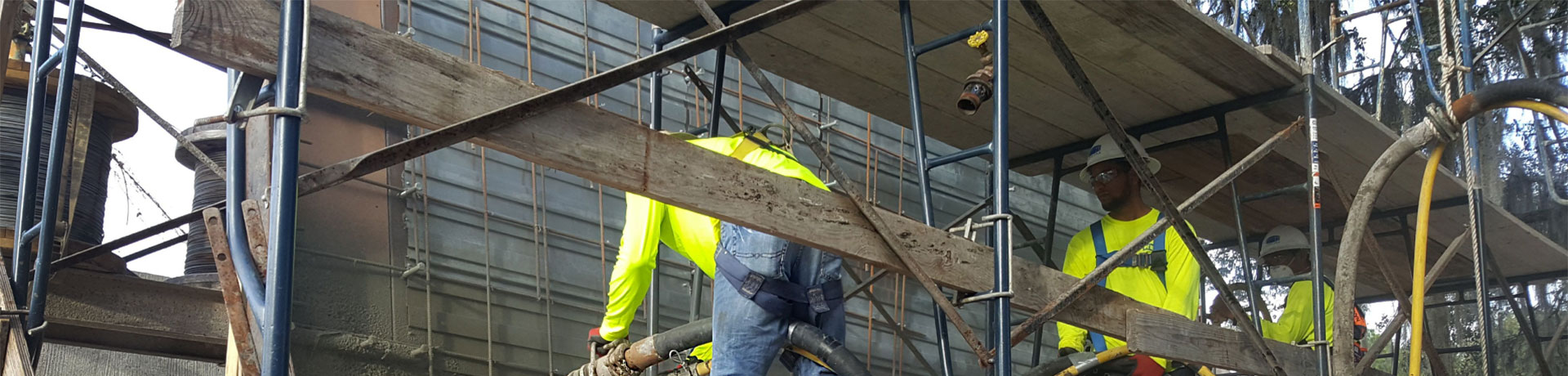
There are prepackaged materials commercially available for impact and abrasion resistance. Please contact material suppliers from “ASA’s Buyers Guide” for product information: shotcrete.org/Buyers Guide.
We have a unique situation where we need to apply shotcrete around a steel plate that is surrounding a beam supporting a floor. Can you provide any UL listings for applying shotcrete to a steel beam, column, or plate?
UL designs are typically for the hourly fire proofing ratings on structural steel members such as I-beams, wide flange beams, and vessel skirts. The beams and columns are tested for specific fireproofing products, beam sizes, and configurations. The thickness of the steel and other considerations factor in the evaluation; therefore, there is no blanket UL design number that you can use for steel plate. You can get guidance on the cover needed for different fire ratings in ACI 216.1-97/TMS 0216.1-97, “Standard Method for Determining Fire Resistance of Concrete and Masonry, Construction Assemblies.”
Remember that shotcrete is a process for applying concrete. You may also consider looking for a similar concrete UL design and submit it for consideration. Applying the shotcrete at a greater thickness to compensate for any variances should be proposed and presented to engineer or the owner for consideration.
When was the 4000 psi (28 MPa) standard set for shotcrete?
ASA has taken the position that structural shotcrete is shotcrete that meets or exceeds a compressive strength of 4000 psi (28 MPa). Looking at pertinent ACI Codes related to watertight concrete, as we would expect in a pool, we find ACI 318-95, “Building Code Requirements for Structural Concrete,” introduced a provision in 1995 that required: “Concrete intended to have low permeability when exposed to water shall have a Minimum f´c of 4000 psi (28 MPa)”. Similarly, ACI 350-01, “Code Requirements for Environmental Concrete Structures,” first issued in 2001 required: “Concrete intended to have low permeability when exposed to water, wastewater, and corrosive gases shall have a Minimum f´c of 4000 psi (28 MPa)”. Since ACI 350 is more directly applicable to water-containing structures, the 2001 date is probably the most relevant, though ACI 318 introduced the concept in 1991. We do, however, see shotcrete specified at lesser levels for different types of uses.
I’m planning to add 6 in. (152 mm) of shotcrete to an existing 12 in. (305 mm) wall of a below-surface concrete tank to accommodate the removal of an existing middle support slab. The soil grade is approximately near the top of the existing tank wall. I’ve been told that since the existing wall is preloaded with soil, adding shotcrete will not increase the strength of the thickened wall and that the only way the wall will act as a whole (based on 18 in. [457 mm] thickness) is if the retained soil load is removed, then the shotcrete is added, and then soil is put back in place. Is this assessment accurate? Is there a way make this wall work as 18 in. (457 mm) without removing the existing soil?
Stress distribution from external loads through the tank wall with the shotcrete lining will depend on the geometry of the tank and the structural function of sections to be removed. A professional engineer experienced in shotcrete and concrete tank design should be consulted to ascertain the structural capacity of the completed wall. It would certainly be important to create a good bond plane by roughening the surface and removing any loose or fractured materials and using sufficient drilled dowels to make the existing 12 in. (305 mm) wall and new 6 in. (152 mm) overlay work well together. Also, it might help to specify the use of a shrinkage reducing admixture.
We are working on a geotechnical project in the northwest to repair an existing rockery retaining wall. The wall is around 750 ft (229 m) in length and up to 12 ft (4 m) in height. The issue is that some of the basalt boulders within the wall are weathered soft and falling apart. The total weathered rocks that are falling apart comprise approximately 7% of the wall. Can we use shotcrete on the weathered rocks to give them more stability as a repair process? If not, is there a process we can use with shotcrete to repair the wall without having to rebuild the entire wall?
Shotcrete has been used in the Northwest to strengthen and overlay existing rockery walls. The need to remove the weathered material is dependent upon the need for the overlay to bond with the existing wall, which is an engineering issue and not a shotcrete issue. Shotcrete can and is shot successfully against soil and other weathered surfaces.
Is shotcrete a viable option to encase galvanized steel beams at a coal unloading facility to protect them from impact and abrasion? Will the galvanizing on the steel inhibit bonding?
Yes, shotcrete would be suitable for this application. A well-installed shotcrete lining will be durable and protect the steel from impact, abrasion, and from the acid attack that occurs from sulfur in the coal. Shotcrete is used to cover both the steel hopper walls and to encase the steel beams. Calcium aluminate cement is typically recommended for coal bunkers because of the mild acid condition that occurs that can attack the steel. Whether or not the steel beams are galvanized or not is irrelevant because the shotcrete will not bond well enough to any steel surface without welded studs and mesh to hold it in place. The beams will need to have studs welded and mesh installed around the beams for the shotcrete placement. With galvanized steel it is often necessary to grind off a spot of the galvanized coating at the spot of each stud weld location to properly weld the studs.
We have a client with a 6 1/2 in. (165 mm) thick reinforced concrete roof slab, the underside of which is in need of repair. There are places where the concrete has spalled, exposing reinforcing bar that has a 3/4 in. (19 mm) cover. There is efflorescence, and there is spalling that does not expose reinforcing bar and some at the steel supporting the concrete slab. In addition, there are hairline cracks and rust spots. Is shotcrete a feasible overhead repair for this situation? What holds the shotcrete to the slab? What is the minimum thickness of shotcrete we should specify? Should we specify shotcrete to be used only at the spalls, cracks, and efflorescence or the whole underside of the slab? Do you have a shotcrete repair procedure that we can put in our specification?
This type of repair is commonly done using the shotcrete process. The extent of the repair is an engineering issue, not a shotcrete issue—shotcrete can and is used for patches and overlays. The shotcrete will adhere to the properly prepared existing concrete. It is installed such that the weight of the plastic shotcrete does not;exceed the adhesion to the existing surfaces; if additional material is needed, it is added at the initial layer or layer set up. The minimum thickness is related to the material used for the repair and the need to establish cover on the existing or added reinforcing. Some repair mortars can be placed as thin as 1/2 in. (13 mm).
Please find a link to a paper on “Concrete Repair by Shotcrete Application”.
The success of the shotcrete repair will be highly dependent upon using a qualified shotcrete contractor and doing an excellent job of preparing the surfaces. Where the reinforcing is exposed, you should require that it be chipped out the entire perimeter allowing for a space of 3/4 in. (19 mm) behind the reinforcing bar so that the repair material can completely encase the reinforcing.
What is the standard method for steel fiber-reinforced shotcrete (SFRS) testing? Are you supposed to core test panels or do you only do that for plain shotcrete? Additionally, is round panel toughness testing on SFRS standard today in the United States?
SFRS is routinely cored from shotcrete test panels or in-place shotcrete linings without difficulty. The shotcrete should, however, have a minimum compressive strength of about 10 MPa (1450 psi) at the time of coring.
Round panel testing of flexural toughness of fiber-reinforced shotcrete to ASTM C1550 is often specified and used for quality control (QC) purposes in tunneling and mining projects in North America and elsewhere (for example, mines in Australia) virtually every day of the year.
We plan to use fiber-reinforced (polypropylene fibers) shotcrete as a brown coat for stucco (three-coat stucco) over a concrete shear wall. Does a maximum thickness of 1.5 in. (38 mm) of shotcrete require any mechanical anchor/connection, or is the bonding strength of the shotcrete layer to the concrete shear wall substrate sufficient?
The addition of fiber will not increase the bond of shotcrete to the concrete shear wall. A 1.5 in. (38 mm) thick layer of properly designed and applied shotcrete should have adequate bond to a properly prepared concrete substrate without additional mechanical anchors. However, exposure conditions, geometry of the wall, shrinkage potential of the shotcrete mixture, application technique, and curing—as well as the age and quality of the shear wall concrete substrate—may affect the bond. These factors should be considered by an engineer experienced with shotcrete overlays in deciding whether additional anchoring is advisable.
In regards to the strength of shotcrete and weather is there a Mine Safety and Health Administration (MSHA) regulation requiring our paste cylinder sample results to be above a certain psi (MPa)?
Shotcrete is normally expected to meet or exceed 4000 psi (27.6 MPa). We are not aware of any specific MSHA requirements. We would suggest you consult a tunnel or mining engineer who is well-versed with shotcrete. Cores taken from field-shot test panels are generally used for the evaluation of compressive strength of shotcrete (ASTM C1140/C1140M-11).