
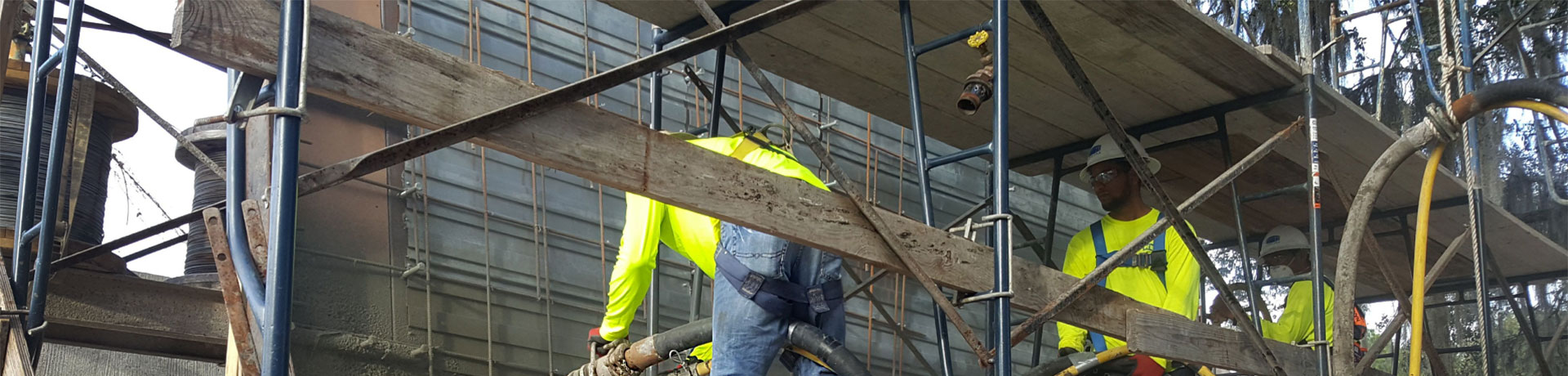
ACI 506R-05, “Guide to Shotcrete,” Section 5.6, on Alignment Control (refer to ASA Bookstore: https://shotcrete.org/bookstore/ProductDetail.aspx?itemid=506R-05) gives specific guidance on proven methods to establish the line and grade of the surface, as well as proper material thickness and cover. Common methods are use of ground wires, guide strips, depth gauges, and depth probes. Please refer to “ASA’s Buyers Guide” (https://shotcrete.org/products-services-information/buyers-guide/) and contact one of our members who provides supplies to the shotcrete industry
I am evaluating a community in central Colorado that contains shotcrete slope reinforcement ranging from 14 to 44 ft (4 to 13 m) in height. Assuming the installation met all required guidelines, what should I anticipate as a useful life for this product?
Shotcrete is a method of placing concrete and properly placed shotcrete should have a service life similar to cast concrete. Generally, concrete structures in normal environmental exposures are expected to have service lives from 50 to 100 years. With particular attention to materials and construction methods, some concrete structures, such as the new San Francisco Bay Bridge, have been designed for a service life up to 150 years. The first step in achieving a long-lasting, high-quality installation is to engage a highly qualified and experienced shotcrete contractor. There are many other factors that influence service life, including using the right mixture design for the anticipated exposure conditions.
We are in the process of designing retaining walls that will be supported by either concrete piers or steel piles. We would like to see some typical details on how the reinforcing is secured to either the piers or piles.
For concrete piers, the reinforcing steel is generally secured to the piles with reinforcing bar grouted dowels. For steel piles, the reinforcing bar is generally secured with Nelson studs.
Is there a specification with regard to cold joints when using shotcrete?
Generally, the interface between sequentially placed layers of shotcrete is not considered a cold joint because the shotcrete abrasion, velocity of impact, and high paste content make excellent bonding conditions. Cores taken through layers of shotcrete on shotcrete often show that it is virtually impossible to ascertain one layer of shotcrete from the next. Please refer to ACI 506R, “Guide to Shotcrete,” for information on joints in shotcrete.
We are working with an architect in New York City on an unreinforced masonry (URM) building where they want to remove brick to provide a larger storefront opening. I would like to use the remaining walls to resist lateral forces but the brick is insufficient. We would like to remove one width of brick and apply 4 in. (102 mm) of reinforced shotcrete in its place. Can you tell me where I can find applicable code and design guidelines for this application?
Your proposed solution is certainly reasonable and is used regularly. Shotcrete has been used to strengthen both URM and tilt-up panels to accommodate enlarged openings. Shotcrete is a method of placing concrete and the in-place properties would be the same. The applicable code would be the code you would use if you were to strengthen this wall with concrete. Designs using the ACI 318 Building Code and Commentary are fully applicable to shotcrete placement, although compressive tests for acceptance are secured using cores from shotcrete test panels per ASTM C1140/C1140M and C1604/C1604M, rather than cast cylinders.
I would like to know the standard operating procedures for cleaning out shotcrete hoses with air and/or water and, in particular, how to keep the hose from whipping when using air.
Shotcrete hoses can be cleaned out using either water or air. In many instances, the site conditions make cleaning with water not feasible. When cleaning with air, the free end or discharge end of the hose should be secured to something to ensure that the hose does not whip as the material and cleaning ball or rag discharges.
I am a Civil Engineer working on a hydropower project. Is it possible to place shotcrete at a thickness of 24 in. (600 mm) inside a tunnel that will be used as a water tunnel to generate power?
Yes, it is possible to shoot 24 in. (600 mm) thick tunnel linings. There are various ways of doing this, depending on the reinforcing steel configuration. One method we have successfully used for shooting tunnel linings this thick with a double mat of reinforcing bar (1 in. [20 mm] diameter bars at 6 in. [150 mm] on center, vertically and horizontally) is to bench gun shoot the walls up to the spring line with a wet-mix silica-fume-modified shotcrete (without accelerator) and then ribbon-shoot (2 ft [0.5 m] wide strips) overhead using the same mixture but with the option of using an alkali-free accelerator added at the nozzle.
If the shotcrete requires a smooth finish (equivalent to a cast-in-place concrete finish), then the initial shotcrete is shot to within about 1 in. (30 mm) of the final shotcrete thickness and allowed to set and harden. Following that, a final non-accelerated finish coat can be applied that can be trimmed to shooting wires with a cutting rod, closed up with a darby, and then trowelled with either a magnesium or steel trowel, depending on the required finished surface texture.
Such work can be done with a remote-control manipulator arm (robot) or, for more precision, with hand nozzling out of a basket on a manlift (provided the tunnel floor is sufficiently smooth for operation of a manlift). The bottom line: hire a contractor who has experience in conducting such work.
I would appreciate if you could comment on a city of Los Angeles shotcrete code that requires that shotcrete lifts not exceed 3 ft (1 m) and that 3 hours must pass before the second lift can be applied. First of all, if you waited 3 hours between lifts, you would have full-length cold joints along the whole length of the wall. You’d also have to wash out the pump after every lift or the concrete would harden in the pump and hoses. Second, you can’t leave a 4000 to 5000 psi (28 to 34 MPa) mixture sitting in the truck for 3 hours! Does it make any sense to you?
This provision has been an issue for shotcrete contractors in the region for many years. ASA and ACI Committee 506, Shotcrete, do not endorse the concept stated in the “Los Angeles Bulletin.” Unfortunately, this provision has shown up in other areas around the country.
A good shotcrete practice is to limit lift height to that which can be placed without sloughing or sagging and to place subsequent lifts at such a time that the previous lift is sufficiently firm to support the subsequent lift. ACI 506R-05, “Guide to Shotcrete,” Section 8.5.8, specifically addresses this point. The following is a link to ASA’s bookstore: https://shotcrete.org/bookstore
Can you send me a document with ASA specifications for gunite coverage of reinforcing bar for swimming pools, please?
ASA does not have such a document. The concrete cover for embedded reinforcing steel is subject to the local Building Codes and may be increased by the structural plans and specifications produced by an Engineer or Architect for a specific project. ACI 350-06, “Code Requirements for Environmental Engineering Concrete Structures and Commentary,” covers concrete structures intended for water containment and would be applicable to pools. The following is a link to ACI’s bookstore: www.concrete.org/bookstore/ProductDetail.aspx?itemid=35006.
Is it critical for the early and intermediate compressive strength at 3 and 7 days, respectively, to be met for shotcrete applications for a rock fall face if the 28-day compressive strength is met?
Compressive strength at 1, 3, and 7 days can be important to all for subsequent operations. In general, 7-day strengths are a good indicator of the ultimate 28-day strength. The need for early strength is an engineering and construction sequence issue, not a normal or typical shotcrete requirement.