
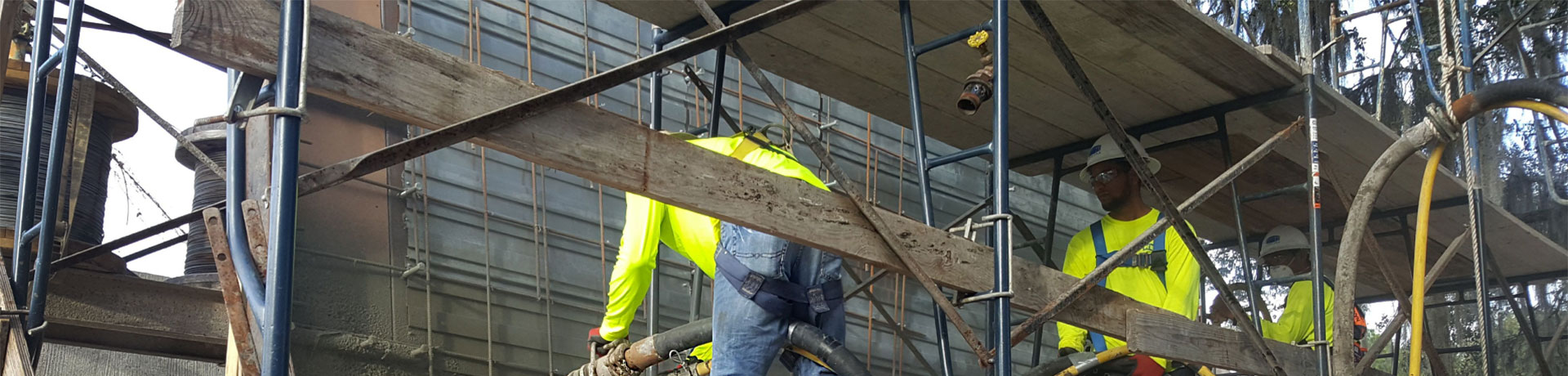
Shotcrete can be applied with many different textures. The nozzle finish shown is very rough, even for a natural gun finish. Nozzle finishes can be done smoother than this. Another technique would be to use a broom to make it smoother after it is shot. Other finishes include wood float, rubber or sponge float, broom, and smooth trowel finishes. There are many examples of finishes shown in articles in Shotcrete magazine.
How might one add fibers to a gunite (dry-mix) application? I have heard of some companies adding them by hand at the base of the auger and others who poured them over their sand and mixed them in with a loader before loading it into the truck. Is there a more efficient way to add them to a dry mixture so that they are distributed evenly throughout?
Many of our members add them by hand at the mixer and have had good success when using an adequate mix time. Another method is to have the mix blended at a bag mix plant with the fibers.
I am an engineer working on a project involving shotcrete and earthwork. The shotcrete that was placed has some expansion cracks, which we expected. I would like to know the best way to repair them. Is there some type of waterproof coating/grout that can be applied between the cracks? Part of the cracks will be continuously under water. The shotcrete is the surfacing material for a diversion ditch at a mine, and we need to recommend some remediation solutions to our client.
There are many products in the marketplace for repairing cracks. Because shotcrete is simply a method for placing concrete, any method for concrete crack repair would be applicable. It would be wise to use a product that filled the cracks and is able to tolerate thermal movement in the future (not a brittle product). Many injectable polyurethane grouts can accomplish this. Surface-applied coatings would need an adequate thickness and elasticity to tolerate moving cracks. We suggest that you contact one of our corporate members who is familiar with your area and get their specific advice. Please refer to “ASA’s Buyers Guide”.
I am interested to know if any shotcrete contractors have shot a magnesium phosphate material (dry-process) before and, if so, could you detail the special requirements necessary in placing such a unique product?
Phosphate-bonded refractory materials were routinely shot in cyclone boilers in the 1970s. These phosphate-bonded materials don’t have a cement bond, but achieve a chemical bond when heat is applied. Without knowing the precise formulation of the mixture and grain sizes involved, we cannot tell you definitively that your specific material can be shotcreted. However, there is a long history of successful past experience with phosphate-bonded refractory materials being shot with the dry-mix process. You may want to consider a field trial before construction to verify your specific mixture works with your dry-mix shotcrete equipment.
We just shot a wet-mix swimming pool for a customer. The shallow end depth starts at 39 in. (991 mm) to the top of the beam and over 10 ft (3 m) linear slopes down to 54 in. (1372 mm). From there we maintain our 1 to 3 ft (0.3 to 0.9 m) slope down to 8 ft (2 m) for the diving end of the pool. The customer would like to raise the entire shallow end pool floor up to the 39 in. (991 mm) depth. We prefer to use wet-mix shotcrete. The overlay would be tapered from the 39 in. (991 mm) start to 15 in. (381 mm) thick at the 54 in. (1372 mm) depth. What would you recommend for this overlay to bond and not “pop loose” or cause crack transfer to pool plaster?
The proposed overlay will be similar to any repair where shotcrete is placed over existing concrete. Proper surface preparation is essential for allowing good bond. Guidance on surface preparation can be found in ACI 506R-05, “Guide to Shotcrete”. It also appears you are suggesting tapering the thickness from 15 to 0 in. (381 to 0 mm). Feathering thickness down to 0 in. (0 mm) is not encouraged, and a minimum thickness should be established. Because the overlay section will be quite thick and experience differential shrinkage from the previously shot material, the overlay will require additional reinforcement to accommodate temperature and shrinkage stresses. You should consult with an engineer experienced in shotcrete design to establish the proper amount of reinforcement. The required reinforcement and cover over the reinforcement will control your minimum overlay thickness.
I have a new construction project where I want to apply shotcrete to cast-in-place concrete columns and an elevated, post-tensioned concrete slab as a finish material. The finished application is intended to be in varying depths from 3 to 12 in. (76 to 305 mm) or more. The desired end result is a smooth, curvilinear, sculptural form. Is this type of application achievable?
Shotcrete can and has been used to increase the size of columns and thicken overhead slabs while providing great-looking linear or curvilinear finishes. Examples of curvilinear finishes can be found in past Shotcrete magazine articles. You can search the Shotcrete magazine archives.
I am a structural engineer working on underground structures such as tunnels and caverns. I would like to know the permissible shear strength of shotcrete to be taken for M30 Grade SFRS (M30 = 30 MPa [4350 psi] at 28 days). I would like to know more about its other properties, as well.
Shotcrete is simply a placing method for concrete. Thus, the in-place material properties are essentially the same as cast concrete. A specific value for the shear is beyond the scope of our Association because many design and material properties can affect the shear capacity. We would suggest you engage a Professional Engineer who specializes in Underground Shotcrete. You should consult our Buyers Guide to find such a consultant. ACI 506R-05, “Guide to Shotcrete”, would be a helpful primer to learn more about shotcrete.
What difference would there be in the density of shotcrete before and after shooting? Is there any shotcrete mixture-design software in SI units available? Or any document of shotcrete mixture design in SI units for optimizing shotcrete design?
Shotcrete is simply a placing method for concrete. Thus, the mixture design and material properties are the same as concrete. We are not aware of any software specific to shotcrete in any units. ACI 506R-05, “Guide to Shotcrete”, has guidance on desirable mixture characteristics (aggregate grading, supplemental cementitious material [SCM], and so on) that would be helpful in developing a concrete mixture design for shotcrete placement.
We have a two-story shotcrete wall enclosing an indoor community pool. We are specifying a board-form finish for the interior and the exterior will have a parge finish coat. Are there any issues with the consistent moisture from the pool that should be addressed in the concrete mixture or topical sealant? How should we deal with the exterior versus interior finishes in regards to water intrusion protection and allowing the green concrete to “dry out” over time?
Shotcrete is a method of placing concrete and the characteristics of shotcrete are those of cast concrete. Although the enclosed swimming pool will increase the interior humidity, the high humidity should have no detrimental effects on the exposed shotcrete, and may even be beneficial in reducing long-term drying shrinkage of the wall.
Both cast-in-place and shotcreted concrete are commonly used for construction of water tanks with constant exposure to water under significant hydraulic pressure. Using good construction techniques with good-quality concrete to build the tank’s walls produces walls with no moisture evident on the exterior face of the tanks. Simply having a high-humidity atmosphere is a much less severe exposure and should not result in interior air moisture being transmitted into and through the shotcrete wall. Any coatings considered for aesthetics should follow the manufacturer’s recommendations for drying time of concrete before application. If there is a concern about the permeability of the shotcrete wall, a premium shotcrete mixture including silica fume might prevent some issues on this application.
We are working on a renovation of an existing shopping plaza where some of the existing walls are split face block. Would it be an acceptable application to resurface the block with shotcrete to achieve a smooth finish? If so, what is the thinnest we would be able to go?
Shotcrete could be used for this application. The thickness of the overlay would be dependent on the material used. A potential concern would be the lines of the existing block showing on the new surface. We would suggest that you search for and review various ASA Shotcrete magazine articles as well as ACI 506R-05, “Guide to Shotcrete”