
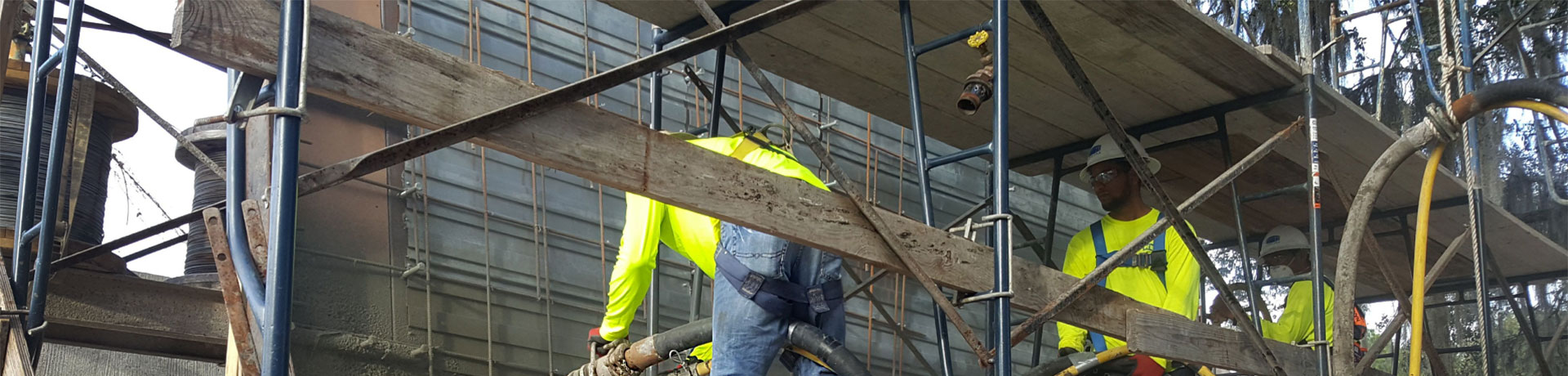
There are many ways to attach a shotcrete facing to a soil nail shoring system or an MSE wall system. For the attachment to a soil nail wall system, you could review the Federal Highway Administration’s “Manual for Design & Construction of Soil Nail Walls.” For MSE wall systems, you should consult with the MSE wall system vendors. Shotcrete facing systems are commonly used on both types of walls, but it is beyond the scope of our association to provide further guidance.
We are developing a tunnel. At the tunnel portal (entrance), we have high walls around the portal about 60 ft (18 m) tall. They will have an inner structural shotcrete layer (4 in. [102 mm]) and outer architectural shotcrete (12 in. [305 mm]). Between the structural shotcrete and rock/soil, we have a drainage system to handle the groundwater. At the same time, we may have water at the top ground surface that will drain from top to bottom of the wall. The owner didn’t want to make the water flow as a sheet over the wall surface. We proposed an inlet and vertical 6 in. (152 mm) pipe drop from the top to bottom and band to a ditch at the base of the wall. Can we locate the 6 in. (152 mm) pipe between the structural shotcrete and the architectural shotcrete?
The Federal Highway Administration’s “Manual for Design & Construction of Soil Nail Walls” should address this issue. Many soil nail wall systems incorporate a drainage ditch at the top of the wall that catches the runoff and takes it to the ends of the wall. Your concept of a catch basin and drain between the layers is not something we have seen in the past and we are not qualified to express an opinion on this. We have seen systems with catch basins at the top of the wall and the drains behind the initial layer of shotcrete requiring notching the subgrade. To answer your question, yes, a 6 in. (152 mm) pipe can be fully encased in shotcrete between the layers. Complete encasement of an embedment of this size needs an experienced shotcrete nozzleman with properly sized equipment, appropriate concrete mixture design, and a trained shotcrete crew. The issue of appropriateness of the approach is better answered by a licensed professional engineer familiar with soil nail systems or retaining walls, and shotcrete/concrete.
We are designing a 41 x 60 ft (12 x 18 m), 2.5 to 4.5 ft (0.8 to 1.4 m) deep swimming pool. The walls and floor are 8 in. (203 mm) thick with No. 4 (No. 13) bars. We are specifying shotcrete to build the pool. What should be the minimum spacing for the expansion joint?
You need to address this question to a professional engineer who is knowledgeable in the characteristics of shotcrete and concrete. Shotcrete is a method of placing concrete and the same parameters used in concrete design apply to shotcrete placements. Many pools of this size are designed and built without expansion joints, but it is beyond the scope of our association to provide further guidance.
My company has been using the gunite process (dry-mix shotcrete) for years now. What I have been finding lately is that a lot more questions are being asked by outside safety services, neighbors to our facility, etc., about the health effects of the shotcrete process. I believe that with the new proposed laws dealing with silica, everyone is paying more attention to products with sand and cement, and shotcrete has both. To try to educate myself and to answer these questions I am on the search for enlightenment and am coming up short. Here is where I am falling short: there is no (or I haven’t found a) general material safety data sheet (MSDS) on shotcrete. Most MSDSs I have found on the Internet are for proprietary mixtures. I have yet to find an MSDS or any safety info on just plain sand and cement mixture.
Shotcrete is a method for placing concrete, so an MSDS for concrete or its constituent components would be appropriate. MSDS sheets for cement, aggregates, and concrete are readily available from cement manufacturers, aggregate suppliers, and concrete producers, as evidenced by a simple web search. This is the type of issue that can be discussed and effectively addressed by networking with other contractors and suppliers in the shotcrete industry. This is a primary benefit of actively participating in ASA—you or your organization should join ASA and attend committee meetings. ASA meetings are held three times a year. Check our Calendar for the next available meeting.
What is the R-value per inch for shotcrete without any integrated insulation?
Shotcrete is concrete, pneumatically applied. So the same R-value fire ratings for concrete would apply to shotcrete. The standard is Joint ACI – TMS 216.1, “Code Requirements for Determining Fire Resistance of Concrete and Masonry Construction Assemblies.”
I need to find the reference in ACI standards indicating the technical and practical reasons why thermal expansion joints and contraction settings are eliminated in the stabilization of nonstructural slopes covered with shotcrete and steel fiber. Can you help?
Shotcrete is a method of placing concrete. Fibrous shotcrete will have very similar, if not identical, properties as fibrous cast concrete. Expansion and contraction joints should be similar in shotcrete to those needed in cast concrete. ACI 224.3R-95, “Joints in Concrete Construction,” covers joints in many different applications. The closest relevant document for eliminating joints is ACI 360R-10, “Guide to Design of Slabs-on-Ground,” where, in Section 8.3, it states:
“To eliminate sawcut contraction joints, a continuous amount of reinforcement with a minimum steel ratio of 0.5% (PCA 2001) of the slab cross-sectional area in the direction where the contraction joints are eliminated is recommended.”
This 0.5% reinforcement is consistent with the provisions of ACI 350-06, “Code requirements for Environmental Engineering Concrete Structures and commentary,” for the minimum reinforcement for temperature and shrinkage without contraction joints.
You can refer to ACI 506 series documents regarding shotcrete, and possibly the FHWA SA-96-069R “Manual for Design, Construction, and Monitoring of Soil Nail Walls” for additional guidance. Copies of the ACI 506 series documents are available in the ASA Bookstore.
We are using wet-mix shotcrete for culvert linings, with an existing corrugated steel plate pipe stream culvert. The pipe is 96 in. (2438 mm) long and deteriorated. There is a water diversion, but there is a pressure gradient forcing water through the voids. Any ideas on leak repair procedures?
Installing a shotcrete lining requires a somewhat dry substrate and certainly is not compatible with running water. The water needs to be blocked or diverted.
A means of blocking the inflow is to inject a swellable urethane grout through the openings in the existing pipe. The grout, if done properly, will expand upon contact with water and seal the outside of the pipe. Another means of diverting the water is to install drainage material over the inflowing area to collect the water and remove it from the pipe. The shotcrete can then be applied over the drainage material.
I have a newly constructed in-ground pool in which shotcrete was used. The pool has been holding dirty water since just after the shotcrete cured. Does the shotcrete have to be cleaned and/or treated before an overlay is applied?
To ensure a good bond between the shotcrete shell and the overlay, the surface should be cleaned and allowed to dry before application of the overlay material.
What are the common standard test methods to measure or assess the permeability of shotcrete?
Boiled absorption and volume of permeable voids testing (ASTM C642) may be required for structures that need enhanced liquid-tightness or resistance to aggressive environmental exposures. The test is sometimes used to provide an overall indication of the quality of the shotcrete mixture, particularly in dry-mix. However, many factors, including admixtures and aggregate, as well as shotcrete placing, can affect the porosity of shotcrete, so it should not be considered an absolute measure of shotcrete quality. When required, the mean average of tests on three specimens from a test panel, or from in-place shotcrete, should be less than or equal to the specified boiled absorption and/or specified volume of permeable voids limits at the specified test age with no single test greater than the specified boiled absorption plus 1%.
The Los Angeles City Bulletin states that no bars over No. 8 (No. 25) shall be used. The structural engineer has No. 10 (No. 32) bars in the columns. I am being told the test panel will get this approved but my City Inspector is balking a little. Is there a publication or code somewhere that allows the test panel to supersede the LADBS Bulletin?
The International Building Code (IBC), Section 1913, allows for larger bars as long as it is demonstrated in a Preconstruction Test Panel. However, the Local Building Code likely takes precedence over the IBC. You may want to present IBC Section 1913, which requires anything over a No. 5 (No. 16) bar to be proven in a Preconstruction Test Panel.
There have been many projects shot in Los Angeles County subject to the LADBS with bar sizes larger than No. 8 bars. ASA is not in a position to give you project references, but perhaps our local members can.
Properly encasing No. 10 (No. 32) bars can be challenging, and should only be attempted by qualified contractors using ACI Certified Nozzlemen who have previous successful experience doing this type of work. You may use our online Buyers Guide to find an ASA corporate member consultant or contractor to assist you.