
In the case of installing a lining inside of an existing pipe, there are robotic methods available, such as spin lining, where the cementitious material is cast from a rotating head as the carrier is moved along the pipe. For pipe smaller than 42 in. (1067 mm) diameter, the spin lining is likely the best method.
For pipe larger than 42 in. (1067 mm) and up to 6 or 8 ft (1.8 or 2.4 m) diameter, either hand shotcrete nozzling or spin lining are applicable. For pipes much larger than 6 to 8 ft (1.8 to 2.4 m), hand nozzling is likely the best solution.
In the case of clearance between a wall to be shotcreted and an obstruction, 3 ft (1 m) is a good rule of thumb, but a qualified and experienced shotcrete contractor can use modified equipment to place quality shotcrete in tighter spaces. A recent article on shotcreting in confined spaces can be found here.
I had wallpapered over a cement interior basement wall years ago. Recently, When I removed the wallpaper and the liner beneath it, the shotcrete came off with the paper. Is there any way I can repair these spots? Can the shotcrete process cover a garage floor that is heavily pitted, has a few cracks, and has some dirt and road salt marks? Will it hold up to road salt and prevent further deterioration?
You mention that you had originally wallpapered over a cement interior basement wall. It is not clear that the cement interior wall was placed using the shotcrete process. If it was installed with the shotcrete process, then the application was flawed due to improper surface preparation or application. There are many concrete repair products on the market which could be used to repair the surface. Many of these are troweled on by hand or sprayed. Check with a local building supply company or on the Internet.
With respect to the garage floor, we would not recommend the shotcrete process for a thin overlay on a horizontal surface. Again, there are many products on the market that are designed for resurfacing floor slabs. Check with a local building supply company or on the Internet for potential products.
Our company is carrying out a tunnel project in rather poor geological conditions, including water seepage and poor rock, with wire mesh and two layers of steel mat. What is the reasonable rebound percentage in such conditions?
Shotcrete rebound varies for many different reasons, many of which you mention in your question. The water seepage must be controlled or the shotcrete will likely not adhere to the surface and will slough off as the water saturates the fresh shotcrete. Accelerator will help, but it is difficult, if not impossible, to achieve good results against a seeping surface. ACI 506R-05, “Guide to Shotcrete,” estimates approximate range of shotcrete losses from 10 to 30%. Some other factors affecting the percentage of rebound are:
Mixture design
- Shotcrete process (wet- or dry-mix)
- Concrete mixture design and materials (for example, microsilica will tend to create less rebound; more than 30% coarse aggregate can cause more rebound)
- Plastic concrete properties (air content, slump)
- Nozzleman competence
- Vertical placement generally has less rebound than overhead
- Thickness of buildup per layer
Reinforcing grid
- Size and spacing of reinforcing
- Stability of reinforcing grid
We are working on an historical renovation project where the existing structure has been reinforced with shotcrete. We need to attach structural studs/furring members to the face of this shotcrete. Is there any difference between standard concrete and shotcrete when it comes to fastener embed depth? We are considering powder-actuated fasteners (Hilti-type) or Tapcons.
The embedment depth of anchors in shotcrete would be the same as it would be for conventionally formed and placed concrete. Shotcrete is essentially a method of placing concrete and the same rules would apply. As with any anchoring system, it is important to make sure that you are anchoring to sound material.
I have been experiencing slow curing times (early set times). Every year during the wet season, my shotcrete curing times go from 1 MPa (145 psi) in 2 hours to 1 MPa (145 psi) in 8 hours. I believe that there is a change in the materials when the groundwater comes up. I have had water tests done, but I’m not sure what to be looking at. The recycled water that was being used had a pH of 5.7. We changed water, the problem was still there, and the pH is now 9.7. What effects does the pH level have?
A pH of 5.7 is slightly acidic, while 9.7 is quite alkaline. According to PCA’s “Design and Control of Concrete Mixtures,” most inorganic acids have no adverse effect on concrete. Organic acids (such as tannic acid) can significantly reduce strength when present in higher concentrations. Some alkaline materials, such as sodium hydroxide, in higher concentrations may cause a quick set. However, because this occurs in the rainy season, another factor that may have an impact is an increase in dissolved solids. PCA states that solid contents exceeding 50,000 ppm can increase water demand, accelerate set, lower compressive strength, and increase permeability of the hardened concrete. The appropriate test for acceptable non-potable concrete mixing water is ASTM C1602/C1602M, “Standard Specification for Mixing Water Used in the Production of Hydraulic Cement Concrete.”
We are, and have been, designing and constructing permanent soil nail and shotcrete retaining walls. Typically, our designs consist of a primary nozzle-finished shotcrete facing to shore during our top-down construction, followed by a secondary shotcrete facing that is shot and sculpted once the full height of the wall has been excavated, drilled, and shot with the primary facing. We had a comment recently that only the secondary facing thickness can be used in our design for the wall’s flexural capacity because the shotcrete layers may delaminate. Our general practice is to pressure-wash the primary nozzle-finished shotcrete facing before our approved and experienced nozzlemen place the secondary layer. From our experience, this procedure has been very effective and we have not experienced any delamination between shotcrete layers on any of the millions of square feet of shotcrete we have placed this way. If installed correctly with our general practice, is there any reason the shotcrete layers would delaminate? If not, have any studies been done to prove this to our reviewer?
All of your points are valid, but the Engineer of Record or the owner makes the final decision on recognizing a composite system or ignoring the value of the initial layer. As your experience shows, shotcrete provides an excellent bond between freshly placed layers and properly prepared concrete or shotcrete substrates. There are many articles available in the Shotcrete magazine archives—found on our website, —that may provide the designer or owner more information to allow them to make their design decision.
We will be shotcreting a pool and the designer has put an expansion joint in the pool going from the top of one wall through the floor to the top of the other wall. It also shows a 9 in. (229 mm) polyvinyl chloride (PVC) waterstop in this joint. I have seen this used with cast-in-place concrete, but not with shotcrete. I was wondering if there are any guidelines on shooting around a PVC waterstop.
This detail is normally only used on very large competition pools on the order of 164 ft (50 m) in length. It takes a lot of skill, technique, and care to properly encapsulate the waterstop and it should only be attempted by a shotcrete contractor with experience in this application. The successful encapsulation of the waterstop is more challenging with the dry-mix process than when using wet-mix shotcrete. The techniques for the proper encapsulation are generally developed by the individual shotcrete contractor and there is no specific “guideline” available for encasing waterstops.
We own a 200-year-old house with a rubble foundation. The foundation is structurally sound, but needs to be repointed, and some of it has no mortar at all. We would like to seal it to make it watertight and keep out radon. Could shotcrete be applied directly to the interior of the rubble wall (which includes small, loose stones; large gaps; and cracks), or would we have to first have the walls repointed and smoothed over?
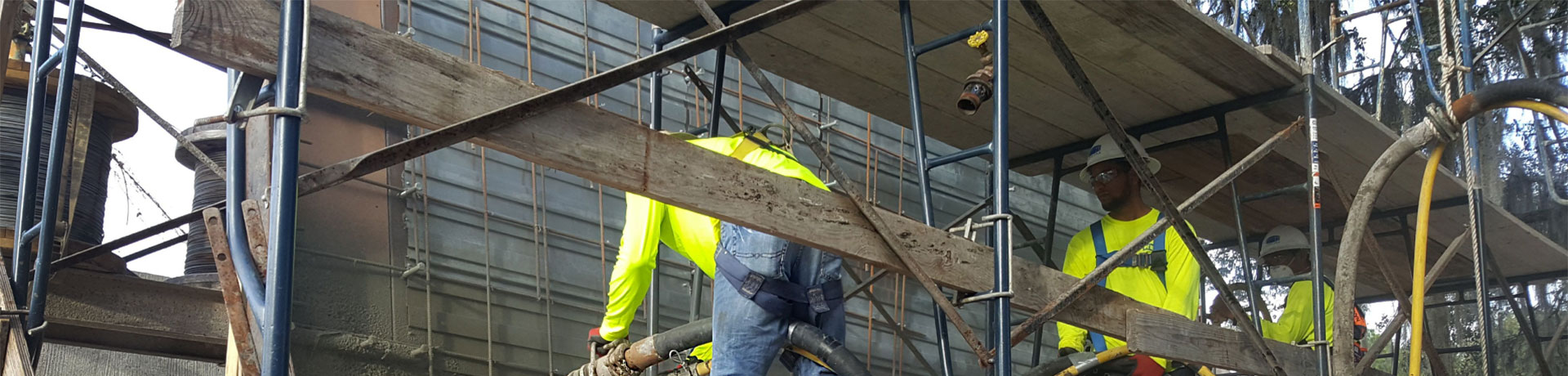
Yes, shotcrete would be an excellent method to fill the voids, open mortar joints, and gun an overlay over the irregular stone foundation. The use of shotcrete would be dependent on the access and ability of the applicator to safely place the shotcrete. A tight or low crawl space would make it difficult. We would suggest cleaning out loose materials with compressed air and water prior to the shotcrete placement. We recommend installing either a 2 x 2 in. (51 x 51 mm) 12-gauge or a 3 x 3 in. (76 x 76 mm) 11-gauge wire mesh over the stone foundation and gunning the shotcrete in place to fill in the mortar joints, creating a shotcrete overlay over the entire stone surface.
I have been hired to design a large concrete pit for a fertilizer plant. The pit will need to be approximately 13 ft (4 m) deep by 55 ft (17 m) long by 15 ft (5 m) wide. The pit will contain water at varying depths and will support grating covering the pit that will support equipment. The state is requiring the pit slab and walls to be a monolithic pour. Could shotcrete be used in this situation and be considered a monolithic pour?
If the directive from the state is to cast (or shotcrete) both the slab and the walls monolithically, this would be a difficult task with either shotcrete or cast concrete. If the directive is to cast the floor monolithically, and then the walls monolithically, shotcrete could certainly be used and would be considered a monolithic placement. Once the state’s intent is clarified, this question should be posed to a shotcrete contractor who might be the actual contractor on the project for their input.
As this is a fertilizer plant, there may be additional considerations due to the potentially aggressive nature of the fluids introduced into this pit.
I’m looking for information on the quantity of rebound expected when applying shotcrete against soil. We have a W4 4 x 4 in. (102 x 102 mm) layer of mesh 2 in. (51 mm) from the soil face that is covered by a 4 in. (102 mm) initial layer of shotcrete. Is there a general ballpark figure that can be used, such as a percent of the total shotcrete placed?
Your question does not indicate the orientation of the application. If the shotcrete is being applied to a sloped surface for a channel or slope the rebound should be incidental. If shooting a vertical wall, the amount of rebound is relative to the skill of the nozzleman, the quality or nature of the mixture, the shotcrete process being used (wet-mix or dry-mix), the stability of the wire mesh, and other parameters. The range could easily vary from 5 to 20% on vertical walls relative to the aforementioned listed parameters.