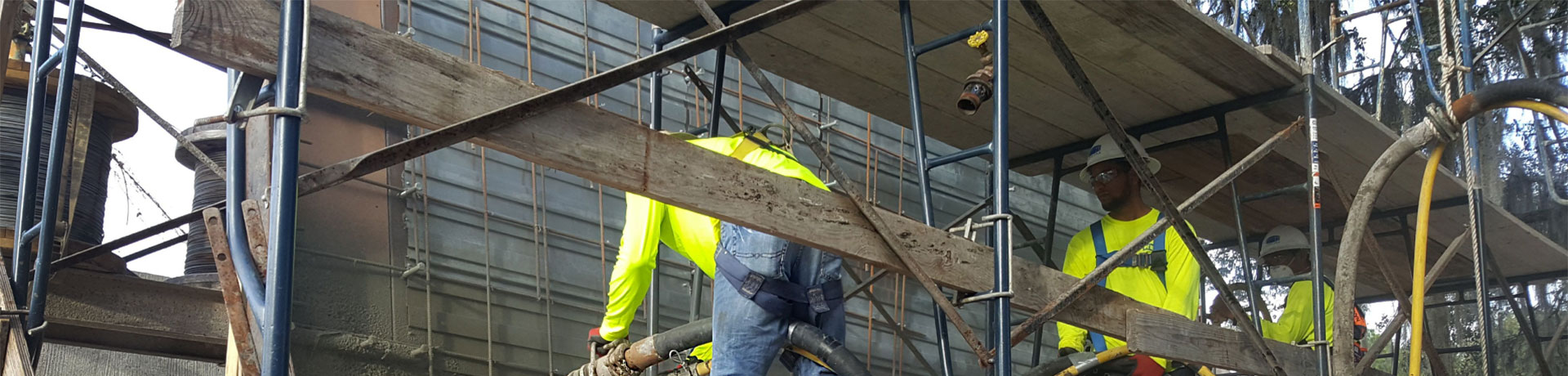
Assuming this is an oscillator on a robotic arm, it should not be disabled. Good nozzling technique, for either wet or dry, requires the nozzle to be moved in a constant overlapping circular pattern. This allows for better encapsulation of reinforcing bar and produces a more uniform surface; and, particularly for dry process, it is required for final mixing of materials that occurs on the surface.
Without proper nozzle technique, which requires oscillation, you will not get uniform, homogeneous shotcrete.
Shotcrete would be a great substitute for the retaining wall. Design-wise, the shotcrete is equivalent to concrete because shotcrete is really just a way of placing concrete.
The No. 4 (No. 13M) at 18 in. (450 mm) on-center spacing is not a problem. A No. 4 (No. 13M) bar can be easily encased by a qualified, experienced nozzlemen using either wet- or dry-mix shotcrete. In longer walls, or anywhere where reinforcing bars are lap spliced, the lap splice bars should be spaced apart. ACI 506R-05, “Guide to Shotcrete,” Section 5.4, provides some good guidance on optimizing reinforcing bar layouts for shotcreting. On the issue of lap splices, it says: “If the design allows, direct contact of the reinforcing splices should be avoided. Non-contact lapped bars should have a minimum spacing of at least three times the diameter of the largest bar at the splice.”
Thus, with No. 4 (No. 13M) bars in a lap splice, you should have the reinforcing bars spaced 1.5 in. (38 mm) apart at the splice to allow the shotcrete material to flow around the bar during shooting.
Chapter 8 of ACI 506R-05, “Guide to Shotcrete,” also provides a lot of guidance on proper shooting techniques for a variety of applications, including walls.
The article “Shotcrete Testing—Who, Why, When, and How” in ASA’s Summer 2011 issue of Shotcrete magazine should help answer most of your questions on testing of shotcrete. ACI 506R, “Guide to Shotcrete,” and ACI 506.2, “Specification for Shotcrete,” also have helpful information on shotcrete testing. Most competent testing labs should be able to test the compressive strength of cores extracted from shotcrete panels or sections, as they are very similar to concrete cylinder tests. If conducting more advanced testing, you may want to consider selecting a lab experienced with shotcrete.
Shotcrete is concrete applied using the shotcrete process. Therefore, any recycling potential that applies to concrete would apply to shotcrete.
Appropriate thickness of the shotcrete layers is impossible to generalize because it depends on many factors, including:
- The type of shotcrete (wet- or dry-mix);
- The texture and stiffness of the receiving surface;
- The physical properties of the fresh concrete used, including a) w/cm ratio; b) slump; c) use of accelerator; d) type of supplementary cementitious materials used in the mixture (microsilica, fly ash, and slag); e) fibers used in the mixture; and f) mixture temperature;
- Weather conditions—Is it hot or cold, dry or wet, and/or windy or calm?;
- The shotcrete equipment used: a) type of nozzle; b) distance from the receiving surface; and c) air pressure and air volume;
- The orientation of the shotcreting (vertical/sloped/overhead)
Experienced shotcrete contracting firms using ACI Certified Nozzlemen have a wealth of experience in evaluating all these factors to achieve the proper results. You may consider subcontracting the shotcrete work to an ASA member contractor with experience in this type of work. You can submit your project details for bids from our ASA Corporate Members using the Web form at shotcrete.org. For further reference, ACI 506R-05, “Guide to Shotcrete,” provides some general discussion of the shooting techniques that may be appropriate. Retaining an engineer or shotcrete consultant experienced in shotcrete application may be of value to assist in evaluating your specific factors and recommend the best solution.
The ability to clean graffiti from the surface will, to some extent, depend on the finish texture. A rough texture will be difficult to coat successfully with a sealer or paint. Commercially available anti-graffiti paints have been used very successfully on shotcrete tanks with relatively smooth float finishes. We do not have any recommendations on the brand of sealer or coating.
We are not aware of specific tolerances for shotcrete in swimming pools. Shotcrete is a method of placing concrete and the cover over reinforcing steel should be the same as that for cast concrete. With respect to the depth of the pool, this would be a building code issue, not a shotcrete issue.
Shotcrete has been used for canal lining throughout the United States. The Bureau of Reclamation published a study on Canal Lining Test Sections constructed in the Bend, OR, area and studies the durability at 5 and 10 years. Shotcrete is a very viable means of placing canal linings. Basically, shotcrete is a method of placing concrete. Care should be taken to ensure that the mixture is designed to withstand the local environmental conditions, such as using air-entraining admixtures to ensure durability due to exposure to freezing and thawing. ACI 506R-05, “Guide to Shotcrete,” contains a lot of useful information in evaluating and using shotcrete in a variety of applications, including canal linings. If liquid-tightness and long-term durability of the canal lining are important, provisions of ACI 350/350R-06, “Code Requirements for Environmental Engineering Concrete Structures and Commentary,” should also be considered in the design of canal lining reinforcement, cover, and joints.
Structurally sound concrete that contains up to 20% fly ash in the total cementitious materials should not present any problems for subsequent bonding of shotcrete. Concrete with fly ash contents up to 30% have been used in recent years without any reported problems with strength and bond. Although concrete mixtures with higher levels of fly ash (up to 55%) have been proposed, we don’t have direct experience with their bonding characteristics. We suspect it would be fine as long as the base concrete develops adequate compressive and tensile strength. This could be confirmed by a simple bond strength test of shotcrete on the concrete substrate in question.
The existing surface needs to be properly prepared, removing all soft or deteriorated material back to sound concrete. For extensive defects in the existing concrete, chipping hammers may be required. For removal of light surface carbonation or laitance, a strong, high-pressure water blast or sand/bead blasting may be adequate. Depending on the thickness of the shotcrete, reinforcing may be required in the overlay. Specific details of the repair are best developed by an engineer experienced in shotcrete repair.
Structurally, using proper quantities of either welded wire or fibers should work well. If fibers are used, they should be specified by an engineer who has the experience to specify the type of fiber and either performance requirements or dosage levels. The advantage of fibers is that they are uniformly distributed through the section, whereas the welded-wire reinforcement can be difficult to maintain in the proper location within the pavement section. The proper thickness should also be determined by a qualified engineer, as soil and groundwater pressures can impact the required thickness.