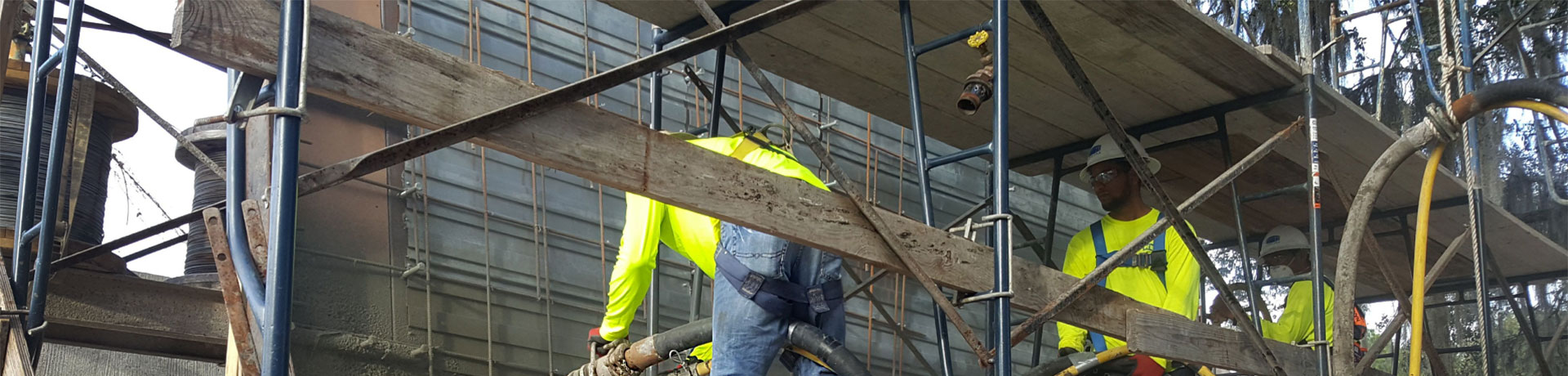
The inclusion of wire mesh must be considered on a case-by-case basis, depending on the thickness and orientation of the shotcrete. Thin sections may well not have any wire mesh. In aggressive environments, at least 2 in. (50 mm) of shotcrete must cover the mesh. The mesh size should be at least 2 x 2 in. (50 x 50 mm) and preferably 4 x 4 in. (100 x 100 mm) to allow for proper encapsulation. Overhead shotcrete usually includes wire mesh for thicknesses greater than 2 in. (50 mm) in case the shotcrete debonds from the substrate. The mesh must be mechanically anchored.
Some designers are eliminating wire mesh and relying on synthetic fiber reinforcement for shrinkage crack control. The use of synthetic fiber eliminates the concern over cover and corrosion in aggressive environments. Specific recommendations on the amount and type of fiber should come from the manufacturer.
The requirements for material temperatures are the same for both wet and dry shotcreting. Refer to Sections 8.7 and 8.8 of ACI 506R-90, “Guide to Shotcrete,” for recommended shotcrete temperatures during placement. Additional information is available in ACI 506.2-95, “Specification for Shotcrete,” in the sections on hot and cold weather shotcreting. Generally, concrete mixtures should be maintained at temperatures above 50 °F (10 °C) and below 100 °F (38 °C). Ambient temperatures should be maintained in a similar range.
Regarding surface temperatures, concrete should never be placed on a frozen substrate. Practical experience in Canadian mines has lead to a suggested minimum temperature of 40 °F (4 °C) for the rock receiving the shotcrete. Without special measures, cold temperatures will cause the shotcrete to set more slowly and result in slower strength development. Remember that in thin sections, the shotcrete will lose its heat more quickly in cold conditions.
ASTM C 94, “Standard Specification for Ready Mixed Concrete” states that concrete must be unloaded within 90 minutes of contact between water, cement, and aggregates, or before the mixer drum has revolved 300 revolutions—whichever comes first. This limit, however, may be waived by the purchaser if the concrete has sufficient workability that it can be placed without the addition of water. In hot weather, the 90-minute limit may be reduced by the purchaser.
The short version of this discussion is that performance specifications provide a list of desired results. The contractor takes this list and selects materials and methods to produce the desired results. The contractor assumes responsibility for results. Prescriptive specifications are very specific as to what materials, proportions, and methods of installation are to be used. The specifier assumes responsibility for the results. The contractor must be able to demonstrate compliance with the specification. Which method is better? The answer to this question is highly dependent on the nature of the project. However, in general, performance specifications produce a higher probability of achieving the desired results as the contractor is better able to use his expertise as it applies to project conditions.
There are four basic reasons to require preconstruction qualification testing:
- To prove the suitability of the fresh shotcrete mixture design for the intended use;
- To verify the proposed mixture will produce the required strength and any other specified hardened shotcrete properties;
- To prove the ability of the nozzleman (and blowpipe operator, if required) to place dense, homogeneous shotcrete completely encasing the reinforcing steel under field conditions; and
- To prove the desired surface finish can be achieved.
This testing must be discussed in detail with the shotcrete contractor in advance with a clear understanding of the expected outcomes and the process for any required adjustments. Requiring ACI Nozzleman certification is an important requirement in screening for qualified nozzle operators. However, it is not a guarantee that the nozzleman has applied shotcrete under the same conditions to be encountered on your project. Therefore, a preconstruction plan is an important part of critical projects. Other prequalification testing may be necessary depending on the nature of the work.
There are a number of ways to treat these stains. Successful treatment will depend on the specific material in the stain and the depth of the stain. The first step would be to try to draw out the material from the surface by applying a poultice of finely ground kitty litter, cement powder, or talc and allow the surface to dry. Repeat this application if necessary.
Next, try a scrubbing a nominally dry detergent powder into the surface. Allow the powder to dry and rinse off the surface. Follow this treatment with a liquid detergent scrubbed with a bristle brush into the surface. Allow the liquid to remain in the surface for 1 to 2 days, then rinse thoroughly. Should the staining persist, you may want to try a proprietary stain remover specifically intended for use on concrete.
Muratic acid is also an option. However, muratic acid can have deleterious affects on the concrete if not thoroughly removed. Because of its potential to attack concrete aggregates and mortar, along with the hazards inherent with applying and removing acid, muratic acid should only be used with the guidance of an experienced consultant. Following a thorough power washing, the surface should be mechanically roughened to ensure proper bond with the shotcrete.
Shotcrete needs to be protected from rain until it obtains its final set, usually 4 or 5 hours. Following final set, it should be wet cured for at least 4 days, preferably 7 days if possible. The exposure to rain would prove beneficial as the rain would assure the presence of moisture for continued curing.
This is a common use for shotcrete. The key elements are as follows.
- Proper surface preparation. To establish suitable surface roughness, use heavy-duty sandblasting, high-pressure water blasting, or mechanical methods such as scabblers or scarifiers, followed by sandblasting or high-pressure water blasting to remove the “bruised” surface material. Refer to ICRI Guideline No. 03732, concrete surface profile Chip 6 (CSP 6), or greater.
- Provide mechanical connection between the shotcrete and concrete by installing L-bar anchors (epoxy or portland cement grouted) on a systematic pattern, with reinforcing bar (or heavy-duty mesh) spanning vertically and horizontally between the anchor bars. Size and spacing of the bars to be determined by the structural engineer. Position anchors and reinforcing bar to ensure adequate shotcrete cover to them. Nonmechanically connected veneers are not recommended.
- Wash concrete surface with clean water to remove dust or any other contaminants to achieve a good bond and presaturate concrete. Allow concrete to dry back to a saturated surface dry (SSD) condition immediately prior to shotcrete application. If concrete dries excessively, bring back to SSD condition with fogging. (A 3000 psi [21 MPa] water pressure sprayer works well for this purpose).
- Apply the shotcrete from the bottom up, taking care not to entrap rebound/hardened overspray. Use proper shotcreting techniques to encase reinforcing bar and anchors. Use 45-degree construction joints (do not construct long tapered joints).
- Use shooting wires, guide forms, or other suitable methods (for example, rods with alignment bubbles) to establish proper line and grade. When the shotcrete has stiffened sufficiently, trim it to line and grade with cutting rods and then finish using fresnos or floats to provide the desired surface texture (wood floats for more textured finish, rubber/sponge floats or magnesium floats for intermediate texture finish, or steel floats with steel toweling for smooth finish). Note: very smooth finishes are not recommended as they tend to show imperfections from hand-finishing procedures. Avoid over-finishing of shotcrete or procedures/timing which could pull tears or sags/sloughs/delaminations in the fresh shotcrete.
- Cure the freshly placed shotcrete using one of the methods prescribed in ACI 506R-90. Our preferred method is fogging/misting until the shotcrete has reached initial set, followed by wet curing for 7 days using presaturated plastic-coated geotextile fabric (for example, Transguard 4000), which is kept wet with soaker hoses. Curing compounds are a (second best) alternative, but should not be used if a paint or coating is to be applied, unless they are approved by the coating/paint supplier for such purposes.
ASTM C 33 contains a variety of aggregate gradations. Gradations recommended for shotcrete applications can be found in ASTM C 1436, Standard Specification for Materials for Shotcrete, or ACI 506, Guide to Shotcrete. Note that ACI 506 includes the caveat that “aggregates failing to comply with gradations shown in Table 2.1 may be used if preconstruction testing proves that they give satisfactory results or if acceptable service records are available.”
Shotcrete is a method of concrete placement, not a product. Therefore, concrete placed by the shotcrete method will exhibit the same characteristics as concrete placed by other methods. Mixture designs and proportions for shotcrete are modified for high-velocity placement. The high velocity provides some performance improvements over conventional cast-in-place methods when properly placed.