
The objective of this paper is to discuss some as-pects of shotcrete pool construction, using Chapter 7, œPool Structure, of the NSPI Builders Manual as a guide. The author came into contact with this manual after being asked, on behalf of ASA™s Edu-cation Committee, to prepare a shotcrete pool class session for the NSPI annual meeting on November 28, 2001, in Phoenix, Arizona. This paper is also to be discussed at that conference.
Lightweight Shotcrete Canoe
Abstract: This paper describes how under-graduate students at Laval University managed to develop and use a shotcrete technique for a small construction application. This technique was developed especially for an engineering competition. The students had to build a canoe made out of concrete. It had to be as light as possible and strong enough to survive a race with four paddlers aboard. So, a pumpable light-weight concrete and a shotcrete technique were developed to construct the canoe.
Every year since 1988 in the USA, Master Builders Technologies has sponsored a civil engineering competition. Undergraduate students are chal-lenged to design a concrete mix to build a canoe. In the USA, there are 20 regional competitions. The winners of these regional competitions are invited to the national competition. The winning team from the Canadian competition is also invited to the national competition as an interna-tional entry. To evaluate teams, they must race the canoe, have a display in which technical information is presented, and give an oral presen-tation. The final product is evaluated at the beginning of the races, and at the middle day of the competition for durability. Each team must also produce a design paper in which they explain how they designed and built the canoe, and also how they developed their concrete mix design.
Teaching Techniques: Pool and Spa Professionals Gain Shotcrete Expertise
Seeing is believing. It’s also a good way to teach. That’s the idea behind a series of scheduled demonstrations slated for the 2001 International Pool & Spa Expo, which will be held in Phoenix, November 27-30. More than just a passive exhibition, this area will offer hands-on instruction covering a variety of pool and spa building and service topics ” from putting tiles on a wall to troubleshooting problems.
This year, the demonstration area will feature shotcrete techniques and training. Hands-on instruction, led by experts in the field, will help shotcreters hone their skills and become better at what they do. Shooting concrete isn™t as straightforward as it seems ” in fact, it™s a craft. The training demonstration will cover the different types of shotcreting, as well as various types of equipment and ways of using it. But, most importantly, a field test will allow participants to take a turn at shooting shotcrete themselves.
Scaffolding
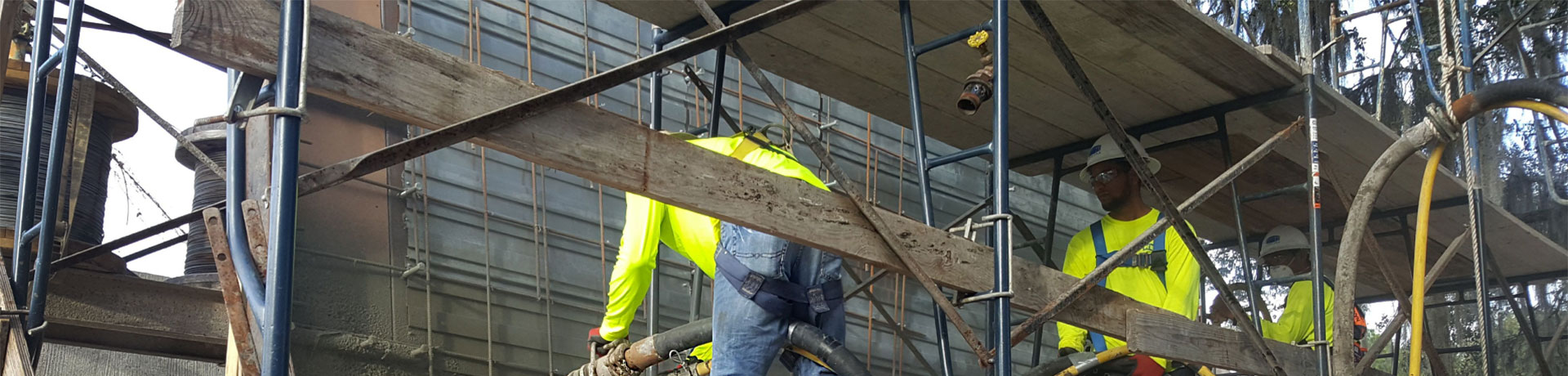
Scaffolding, in my opinion, could be listed as the #1 item on a top ten safety checklist. I believe it becomes 50% more difï¬ cult to work safely and properly on scaffolding than on the ground. Shotcreting using the dry-mix process is much easier to handle because of the weight of the hose, and
Shaping Dreams- Shotcrete Makes it Happen
Some of the world’s dreamiest pools are formed from very concrete ideas.
According to the National Spa & Pool Institute (NSPI), an international trade association of more than 5,200 manufacturers, distributors, retailers, service companies, and builders in the pool/spa and hot tub industry, some 7.5 million people in the continental U.S. currently own pools.
Shotcrete Solution to Tricky Underpinning Problem
A downtown Vancouver excavation and shoring project involving underpinning of two adjacent structures took on a strange twist when it was discovered that the three-level, early 1920s building to the north of the excava-tion had a precariously attached brick wall founded on a rubble footing, which was required to be underpinned to construct the new building to the south. The struc-tural engineer, acting for the owner of the
Shotcrete Specification and Testing
Shotcrete has been an important part of the construction industry for more than 90 years. As a specialty concrete technique, it is basically another means for the placement of concrete with its own peculiarities and characteristics. In the early years after its introduction by the Cement Gun Company of Allentown, Pa., in 1910, relatively little testing was done, prima-rily because the technique had limited use. What testing was performed was done to pro-mote the technique”to show its efficacy for specific applica-tions or to exhibit its superior-ity over other existing concrete technologies. The tests in-cluded were for material and design criteria and properties such as compressive, tensile, and flexural strengths, bond, permeability, shrinkage, and soundness. These tests were based on American Society for Testing and Materials (ASTM) concrete tests adapted for the shotcrete process. When inter-est in concrete durability began to heighten after World War II, freeze-thaw tests were also in-troduced. As in conventional concrete, compressive strength has been the defining property of shotcrete testing. However, if other properties are required for a particular application, they can be arranged at the time of specification. The main dif-ference in the tests is in the preparation of samples, which is usually different because of the unique nature of the shotcrete process.
While interest in shotcrete was limited prior to the 1940s, an upsurge developed, espe-cially in the wet-mix process, in the 1950s. In 1990, ASTM decided that the technology had grown sufficiently enough that a new ASTM subcommittee on shotcrete, ASTM C09.46, should be organized. This would complement the existing American Concrete Institute Committee 506 on Shotcreting. ASTM Subcommittee C09.46, Shotcreting, would absorb the
Shotcrete Retrofil of a Mechanically Stabilized Earth Wall
The Municipality of Maple Ridge in British Columbia, Canada, commissioned a spe-cialty contractor to build a 9 m (29.5 ft)diameter culvert, incorporated in a mechanically stabilized earth (MSE) wall, to provide a street crossing for a stream. The culvert had been partly sunk into the stream bed to adapt to the site conditions. The MSE walls were a maxi-mum 8 m (26.3 ft) high above the ground and 70 m (230 ft) long. Figure 1 shows part of the North Face of the MSE wall.
The fill used in the construction of the MSE wall contained a fraction of fine dredged river sand. After construction, fine particles of the sand dried out and started to migrate through the galvanized metal screen that comprised part of the MSE wall. This resulted in voids at the surface of the MSE walls. The voids were a concern as they constituted a potential cause for future settlement of the sidewalks and asphalt pavement constructed between the MSE walls. The specialty contractor decided to remedy this situation by arresting the migrating fill before it came to its natural equilibrium, by refilling the surface voids and applying a shotcrete lining.
REPAIR SPECIFICATION
The design engineer recommended filling the voids with shotcrete and stabilizing the surface of the MSE walls with a permanent shotcrete lin-ing. The specifications called for the following procedures:
Setting the Standard with Soil Nail Technologies
Nicholson Construction Company was awarded the con- tract to build a reinforced shotcrete soil nail retaining wall along State Route 9900 in Blair County, Penn-sylvania (U.S.). The 330-ft-(100-m)-long, 35-foot-(10.7-m)-high permanent retaining wall was cut into the hillside to provide an access route to the new Blair County Convention Center (see Figure 1). The general contractor for this project was HRI, Inc. and the owner was PennDOT.
Safety Glasses
A crane operator, carpenter, baseball player or a shotcrete crew? Probably everyone listed should use them. On a scale of 1 to 10, the shotcrete crew would rate a 10 with need. œWho on the crew should wear them? I asked one of my superintendents, she said, œThat™s easy, everyone on the crew. The nozzleman and air lance man for obvious reasons, but also the pump operator and potman to protect themselves from dust and shotcrete overspray and rebound. The finishers also need eye protection from constantly working vertical concrete surfaces. The laborers also need protection from rebound, dust and overspray, and the occa-sional burst hose or coupling!
A shotcrete operation requires several high-pressure pieces of equipment, all of which, unfortunately, can burst. The dry-mix