
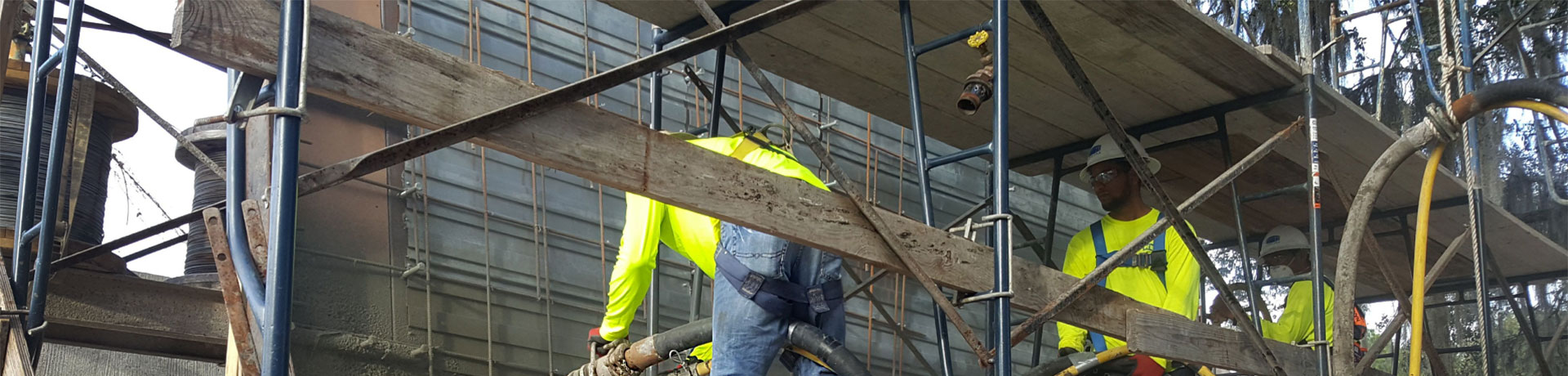
About fifteen years ago, we had a project that involved doing some extensive shotcrete (dry process) window infills. The job required shooting from the inside of the building onto plywood forms and involved about 5 stories of window.
Denver International Airport Road Sand Storage Dome
World’s Largest Dome for Cement Storage (Silica Fume Shotcrete)
This paper describes the construction of a concrete dome facility for cements
The Monolithic Dome Industry
If you have never seen a Monolitchi Dome, the experience is hard to imagine let alone desribe.
United Arab Emirates Project
Bibliography on Shotcrete Domes
If you want tn know more on unique dome constructions, the following is a bibliography on shotcrcte domes:
Residential Shotcrete
Shotcrete Domes
Dealing with Reinforcing
Effect of Shotcrete Consistency and Nozzleman Experience on Reinforcement Encasement Quality
The proper encasement of reinforcement in shotcrete is a criti-cal issue with respect to the quality and the durability of a shotcrete application. One simply has to refer to the Shotcrete Nozzleman Training Course offered by the ASA (see Shotcrete Magazine, Vol. 1, No. 4) or the recently available Nozzleman Certification Program of ACI to confirm this statement. Although many concerns have been raised, mostly by owners, regarding the presence of voids around reinforcement and their potential effects on structural per-formance, there is, unfortunately, little technical data available to back up the shotcrete industry on this problem.
Several years of experience with a certification program for shotcrete nozzlemen, as well as early research (Studebaker, 1939) suggest that the best approach is to apply dry-mix shotcrete1 at its wettest stable consistency, which is defined as œthe consistency at which the moisture content is the maximum, the maximum being determined by the stability of the fresh gunite (shotcrete). How-ever, observations on many job sites and training of nozzlemen show that many apply shotcrete with a relatively dry (stiff) shooting con-sistency, which may adversely affect rebar encapsulation as well as increase rebound.
The Industrial Chair on Shotcrete and Concrete Repairs of Laval University (City of Quebec, Canada) has initiated a thorough inves-tigation into the Evaluation of reinforcement encasement quality and its effect on shotcrete quality. This research program is financed by the partners of the Industrial Chair, the Concrete Research Council of ACI, as well as by the American Shotcrete Association (ASA). It has several objectives, including: