
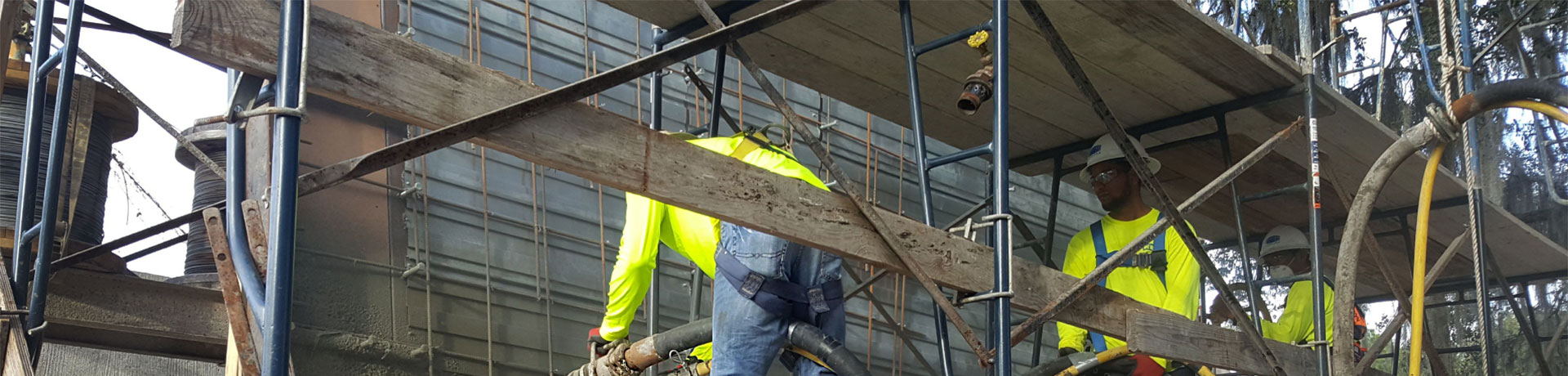
Answer: Respiratory illness can take years to develop. As with smoking, the delayed but high-risk results sometimes make it difï¬ cult, crucial, to convince employees to wear respi-rators in certain environments, even if the air does not appear to be harmful. The key to convincing employees to protect themselves is to educate them on the hazards present in the workplace and the effects on the human respiratory system.
Underground Shotcrete Quality Assessment
During the 1990s, the use of dry-mix shotcrete as a tool for ground support became much more prevalent in Canadian hardrock mines. With this increase in dry-mix shotcrete use came the need to develop a practical and accurate method for determining the quality of the in-place shotcrete. This report summarizes the results of a study undertaken to provide the basis of an under-ground shotcrete quality assessment program for hardrock mines.
Early-Age Test Methods for Fiber-Reinforced Shotcrete
Toughness is at least in part influenced by the compressive strength of the shotcrete matrix, so concrete strength is doubly important for ground control. In time-critical environments such as heading development in mines and most tunnels, the cost of excavation is often strongly influenced by the overall rate of progress; this, in turn, is influenced by the time to safe reentry. The minimum period of time that must elapse before it is safe to reenter under freshly shotcreted ground is directly related to the rate of strength gain in the shotcrete matrix.
Confirming Shotcrete Quality On Site
Construction workmanship contributes signiïcantly to the quality of any concrete project, but it plays a particularly important role in shotcrete projects. Preconstruction testing of cores taken from sample panels can help flag some potential material problems, but the shotcrete crew™s technique determines the quality of the project. Fortunately, methods have been developed to examine, sample, test, and evaluate the quality of in-place shotcrete, as well as to determine the causes of distress or deterioration. This article recounts investigations into several shotcrete pool projects that exhibited various problems and explains the findings and their significance in each case.
ASA Mega-Demo Hits the Jackpot
The American Shotcrete Association (ASA) and Hanley Wood teamed up to present a shotcrete extravaganza in Las Vegas, Nevada, during the 2005 World of Concrete. Encouraged by the successful Mega-Demo in 2001, the leadership
Reentry into a Shotcreted, Underground Heading
Whether in a mine or a tunnel, the concept of keeping all people working under supported ground is an essentially sacred one. Even with the most stable ground, the risk of a ground fall causing injury to persons or possessions is greatly mitigated once proper support measures are installed. This becomes even more critical as the quality of the ground diminishes.
The Changing Job Site
We all know job-site conditions can undergo constant changes. The best safety tip for these changing job-site conditions is to check all job sites before crews are dispatched. This inspection will take a little time and may be a little inconvenient, but after the inspection you will have an understanding of what potential hazards are present for your
Slope Stabilization Using the Shotcrete Grid Beam System in Japan
Continuous grid beam structures made of shotcrete have been used for over 30 years in Japan to stabilize natural and man-made cut slopes. This slope stabilization structure, generally called œGrid Beam, is widely applied in Japan. It was used in more than 4600 slope stabilization sites in Japan in the year 2002 alone. The Grid Beam system is often used independently to protect slope surfaces from erosion, or used as a supporting structure, combined with ground anchors or soil nails to stabilize the slope against failures. The area surrounded by the beams is often revegetated to improve aesthetics and harmonize the installation with the surrounding environment (see Fig. 1). Due to the geometric flexibility of this system, the concrete beams can easily follow the undulations of natural slopes and maintain good contact with the surface.
Curing Silica Fume Shotcrete with Wet-Sprayed Cellulose
Chloride-induced corrosion is the primary cause of deterioration in many concrete bridges in Canada and the northern United States. For corrosion to take place, the chloride ions permeate through the interconnected pores of the concrete toward the embedded steel reinforcement and attack the passive layer that forms around the steel during the hydration process of concrete. Once this passive layer is destroyed, corrosion proceeds, resulting in a reduction in the structural integrity of the structure in addition to the onset of spalling of the concrete cover. To restore the serviceability of the structure and extend its service life, the deteriorated concrete is usually removed, the reinforcement is replaced if necessary, and the concrete is replaced with a durable repair material that has high resistance to chloride ion transport. In the province of Ontario, Canada, partially deteri-orated concrete bridge sofï¬ts are typically repaired with shotcrete containing silica fume.
Quality Management of Shotcrete in North America
As for all construction materials, a proper program of quality management should be implemented in shotcrete construction to protect the owner™s investment. This article briefly examines typical shotcrete Quality Management (QM) practice in North America. QM can be considered to be comprised of Quality Assurance (QA) and Quality Control (QC) functions.