
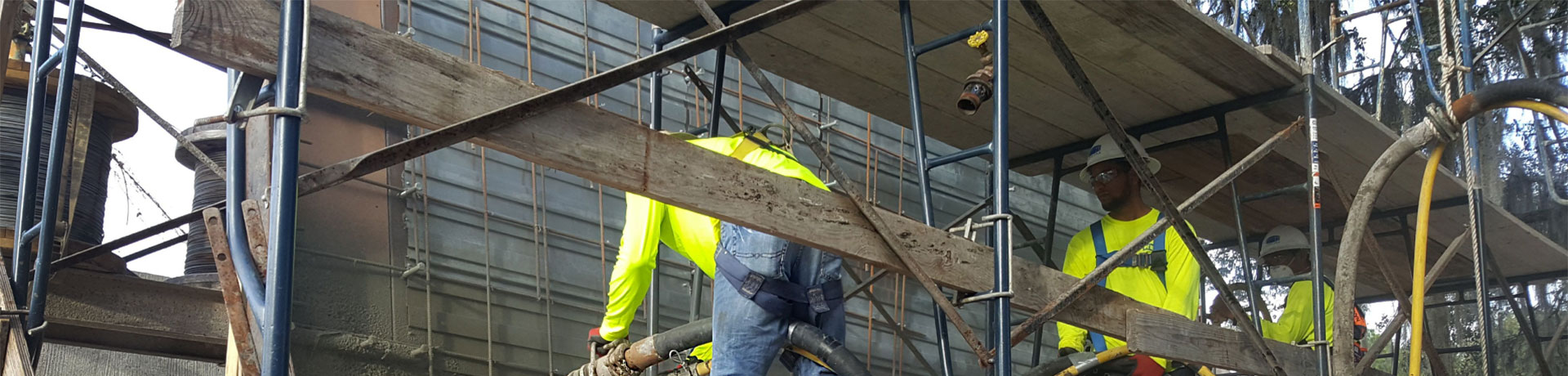
Why do we wear hard hats? Is it because the sky is falling?
U.S. Shotcrete Standards Update
Since the last update on the activities of various shotcrete organizations and committees in the Spring 2005 issue of Shotcrete, steady progress has been made with updating the documents these organizations work on
Energy Efficiency…an Overlooked Resource
As mentioned in previous ?Sustainability? articles, one primary objective of sustainability is energy ef?ciency.
Curing Pneumatically Applied Concrete
E-mails are often sent to the ASA website from engineers, contractors, builders/owners, and home owners asking for information on proper methods for curing shotcreted structures.
Dream Pools and Spas in Cold Climates: Made a Reality with Shotcrete
We see them in Hollywood movies, in luxury hotels and resorts, in state-of-the-art water parks, and now in residential backyards. Exotic, fantasy pools and spas harmo-nized within water gardens, waterfalls, and statues are now gaining in popularity. Whether it is for entertainment, exercise, the occasional dip, or simply pure family fun, pools and spas are deï¬nitely the way to go.
Unfortunately, these dream oasises are most often seen in hot weather climates for obvious reasons. But shotcrete has helped change this trend and has given northerners a chance to own and enjoy wonderful pools and spas.
Art, Animals, and Architecture: Shotcrete Builds National Aquarium in Baltimore
It has been widely known for several decades that shotcrete is an ideal material for constructing naturalistic habitats for animals. When fresh concrete is freed from the constraining requirements of a rigid form, it can be shaped and carved in much the same way a sculptor handles clay or a piece of marble, but on a dimensional scale that is only limited by money or imagination. Shotcrete is also an incredibly versatile building material, which means it can serve many purposes on a project that ambitiously demands the blending of architecture, engineering, and aesthetic innovation.
America™s National Aquarium is located in Baltimore, MD. The designers for the recent Pier 3 Expansion project aspired to replicate the water-shed forest of rural Maryland and, in contrast, the
Swimming Pools: Then and Now
In the late sixties when I started in the shotcrete industry, swim-ming pool construction was the main use for dry-mix shotcrete. Ah, yes, the good old œgunite days. Those were the days when safety was strictly a result of good luck. There were no complaints
if you got hurt”you just got over it.
The day would start at 5:30 a.m. in the yard. I drove the gunite rig, which was old, had no trailer brakes, no tail lights, and was held together with tie wire. Shooting the first pool usually would start around 7:00 a.m. The homeowner would always stay home and serve us coffee and donuts no later than 10:00 a.m. We would ï¬nish the ï¬rst pool by 10:30 a.m. or so. After stopping to buy cold beer, our crew headed for our second pool of the day. Again, the homeowner would always stay home on gunite day, waiting for our arrival. Around noon, the home owner would ask if we would like something cool to drink and we would say beer would be fine, thank you. Believing they were being gracious hosts, homeowners served us beer on the job, which was the American way to work in the sixties. We would ï¬nish the second pool around 3:00 p.m.
Now it was time to head for the yard. That is when we started drinking beer on our own time. Back at the yard, we had a complete room devoted to beer drinking. A full supply of cold beer was always on hand. When it got dark we wanted a change of scenery and would head to a bar to let off a little steam. And so it was in the œgunite industry in the sixties when I entered this industry.
Then came along the words œworkers™ compensation. It changed the way we œworked. Some of the changes seemed so silly and childish.
Environmental Consideration for Shotcrete
This article presents a procedure for up-dating your environmental knowledge and keen awareness for a deeper appreciation of our surroundings. It discusses the new regulations for implementing the procedural provisions of the National Enormental Policy Act.
The Association of Pool & Spa Professionals
In 1956, the National Swimming Pool Institute (NSPI) was established by members of the pool industry to provide a forum for discussion among industry professionals to elevate the standards of the swimming pool industry, to promote swimming and swimming pools, to educate the public about swimming pools, and to achieve uniformity in the regulations applied to swimming pools. NSPI was incorporated in Illinois as a non-proï¬t corpor-ation and was recognized as such with a 501c6 designation by the IRS, which designated the organization as a trade association. In 1980, after the International Spa and Tub Association became a part of the National Swimming Pool Institute, the name was changed to the National Spa & Pool Institute.
“Sustainability”- What’s that about?
It is virtually impossible to hold a discussion at a trade or technical organization meeting without the topic of sustain-ability being raised. Skeptics might describe the intense interest in this subject as one more attempt to burden society, particularly the construction industry, with little or no discernable beneï¬t. Conversely, there are fringe groups with radical political agendas that attempt to use sustainability discussions for their own purposes. There is, however, an important central issue”the need to analyze the long-term impact of how things are designed and constructed to minimize environmental change and maximize resources as the world™s population grows. Building œgreen (constructing buildings that make efï¬cient use of energy, water, and materials; limit impact on the outdoor environment; and provide a healthier indoor environment) is being supported by both public and private entities in recognition of the finite resources available to support a growing population and higher levels of economic activity. This is where mainstream thinking is focused and where reasonable thought resides.
To begin to understand a bit more about sustainability, it is important to answer a few basic questions.
Question: What makes concrete a œgreen building material? Answer: Concrete is a responsible choice for sustainable development. Purely as a material characteristic, durability is a signiï¬cant sustainable attribute of concrete because it will not rust, rot, or burn, requiring less energy and fewer resources over time to repair or replace it. Structures built with insulated concrete have optimal energy performance. Additionally, concrete is easy to use, incurs little waste, and can be readily recycled.
Question: What is energy efï¬cient about concrete?Answer: Concrete on its own is not a very good insulator. Recent developments in building systems, however, have combined concrete with insulation, creating highly efficient, strong, and easy-to-build assemblies. Homes and buildings constructed with insulated concrete walls use the comparative great weight of concrete to moderate daily temperature swings, as did the pueblo dwellers of centuries past. This means home or building owners can lower heating and cooling bills up to 25%. Also, heating, ventilating, and air-conditioning can be designed with smaller-capacity equipment. Along with thermal mass, high-performance insulated concrete wall systems offer high R-value and low air inï¬ltration to provide superior thermal efï¬ciency.
Question: How does concrete relate to recycling?
Answer: Recycling is part of concrete™s life cycle from the beginning. Several common industrial byproducts like fly ash and slag that would otherwise add to landï¬lls are incorporated into concrete mixes. Use of these byproducts also reduces