
The storm water drains in the city of Mumbai, India, are over 100 years old and constructed with brick arch masonry during the British Era (Fig. 1). The storm water drains (SWD) were prone to frequent cave-ins. To prevent cave-ins, enhance their safety, and maintain the SWD system, the Municipal Corporation of Greater Mumbai (MCGM), under the Central Government of India “BRIMSTOWAD” Scheme, initiated a detailed survey and mapping of the SWD for the City of Mumbai.
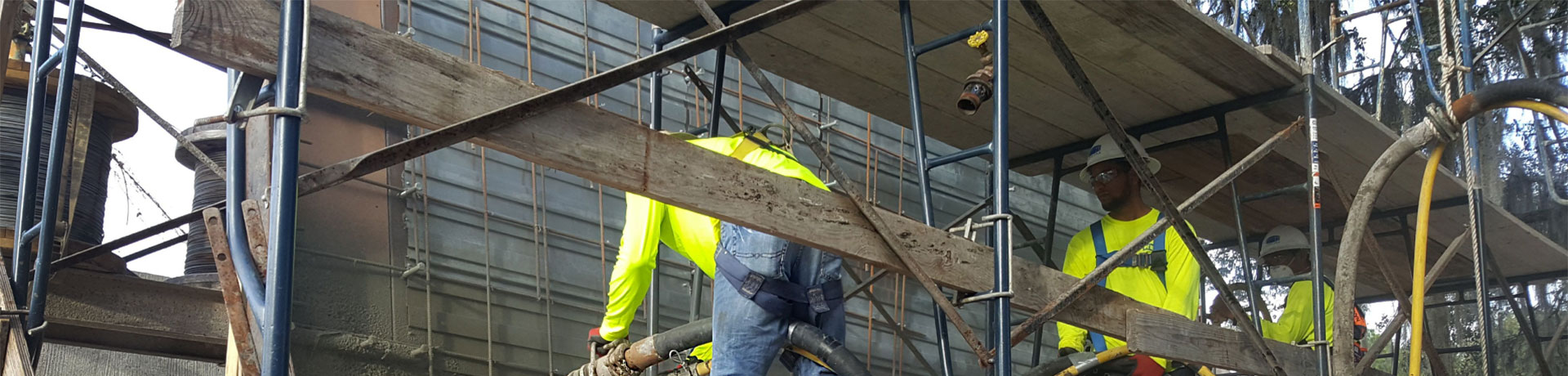
I am working on a fire re-build project near Napa, CA. The existing building has 12 in. (300 mm) thick shotcrete basement walls. There are many areas where the concrete cover spalled off from the rebar. The rebar appears to be ingood condition with no visible buckling. Is it possible to repair these walls with a 1 1/2 to 2 in. (38 to 50 mm) layer of shotcrete to restore the concrete cover? If so, what sort of surface prep is required? Is a concrete bonding agent required?
Yes, this is definitely a good application for shotcrete. To restore the cover:
- Chip or hydrodemo back to sound concrete. If a reinforcing bar is more than half exposed, chip at least 1 in. (25 mm) back behind the bar.
- Make sure the surface is roughened and clean.
- Bring the concrete surface to saturated surface dry (SSD) condition. This means the surface feels damp but water is not picked up on a hand.
- Make sure the shotcrete placement is properly executed. Use of an ACI-certified shotcrete nozzleman is recommended.
- No bonding agent should be used. It will interfere with the natural bonding characteristics of shotcrete placement.
- If chipping out a section do not feather edge. Provide a ¾ to 1 in. (19 to 25 mm)) depth of cut at the edge to provide adequate thickness for the integrity of the shotcreted material at the edge.
This article on the excellent bond between shotcrete provides more detail: https://shotcrete.org/wp-content/uploads/2020/05/2014Spr_TechnicalTip.pdf
Outstanding Rehabilitation & Repair Project
Project Name:
10th Ave SE Bridge Rehab
Location:
Minneapolis, MN
Shotcrete Contractor:
PCiRoads, LLC
Architect/Engineer:
The LiRo Group
Material Supplier/Manufacturer:
TCC Materials & King Packaged Materials
Equipment Manufacturer:
Gary Carlson Equipment / Putzmeister Allentown
General Contractor:
Lunda Construction Co.
Project Owner:
City of Minneapolis
Honorable Mention Project
Project Name:
Surface Reef Silo 4
Location:
North-West Province, South Africa
Shotcrete Contractor:
Shotcrete Africa SCP
Architect/Engineer:
Royal Bafokeng Platinum
Material Supplier/Manufacturer:
FSE Engineering Services
Equipment Manufacturer:
Amsteele Systems
General Contractor:
Shotcrete Africa SCP
We are working on a repair/renovation project in Boston. A long-concealed wall next to an adjacent property is now visible as the adjacent property is being renovated. We have been told that our wall must have a 2-hour fire rating. Our wall is composed of CMU masonry and exposed structural steel members. Applying shotcrete to the CMU and steel is a good solution for several reasons. Would you provide shotcrete specifications that will have a 2-hour fire rating on CMU and structural steel?
Shotcrete is a placement method for concrete. Thus, the fire resistance for shotcrete placement is the same as concrete. The primary reference for fire resistance of concrete is ACI 216.1-14(19) Code Requirements for Determining Fire Resistance of Concrete and Masonry Construction Assemblies.
Shotcrete Incorporated into ACI 318-19 Building Code
Since the shotcrete process originated well over 100 years ago, improvements in materials, equipment, and placement techniques have enabled it to become a well-proven method for structural concrete placement. The efficiency and flexibility of shotcrete have been used to great advantage in sizable structural projects, as the high-velocity impact inherent in the process provides the compaction needed to turn low-slump concrete into freestanding vertical and overhead placements with minimal formwork.
Duck Island Wastewater Treatment Plant- Screw Pump Rehabilitation
The Duck Island Clean Water Facility, located in Lowell, MA, is a 32 million gal./day (120 megaliter/day) activated sludge treatment plant. The facility accepts wastewater from several Massachusetts cities and towns, including the City of Lowell and the towns of Chelmsford, Dracut, Tewksbury, and Tyngsborough. The service area includes approximately 220,000 people. The facility has been in the news for the past decade due to its need for massive repairs
Falls Village Penstock #1 Structural Shotcrete Rehabilitation Project
In early November of 2018, Knowles Industrial Services Corporation (KISC) was issued a contract by First Light Power Resources, Inc. (FLP) to perform a structural shotcrete liner within a steel-riveted penstock at the Falls Village Hydro Electric Plant in Canaan, CT. FLP’s request for bids permitted contractors to provide a design-build approach for a structurally self-sustaining system to be built within the penstock interior. The existing 9 ft (2.7 m) diameter, 360 ft (110 m) long penstock was buried in its entire length on a steep bank and crossed underneath a live highway. Penstock replacement by excavation proved to be too costly, as much of the existing penstock beneath the roadway was encased in reinforced concrete requiring significant demolition and interruption to traffic in this area.
We are working on a repair/renovation project in Boston, MA. A long, concealed wall next to an adjacent property is now visible, as the adjacent property is being renovated. We have been told that our wall must now have a 2-hour fire rating. Our wall is comprised of concrete masonry units (CMUs) and exposed structural steel members. Applying shotcrete to the CMUs and steel is a good solution for several reasons. Can you provide or point me to a shotcrete specification that will have a 2-hour fire rating on CMUs and structural steel?
Shotcrete is a placement method for concrete. Thus, the fire resistance for shotcrete placement is the same as concrete. The primary reference for fire resistance of concrete is ACI 216.1-14(19), “Code Requirements for Determining Fire Resistance of Concrete and Masonry Construction Assemblies.”
I am working on a restoration of a small 1870s train station constructed of serpentine stone in the Philadelphia, PA, area. In many areas the stone has deteriorated, leaving deep “divets” in the exterior wall faces and, in some cases, there is no stone at all. Our intent is to build (infill) the walls back to a flush face for stucco treatment for the lower portions of the wall and to repair or replace stone above that point. Is there a minimum amount of treatment recommended for a shotcrete application? If it can be used for such an application, is reinforcement required? The stone is rather friable and I don’t want to attach too much to it for fear of further damaging the stone.
This is a great application for shotcrete placement of high-quality concrete without formwork. If you are merely adding shotcrete to fill out to a uniform surface profile without any structural requirements you may not need reinforcement. However, it may still be advisable to include fibers in the shotcrete mixture to help control plastic shrinkage cracking. Generally, you would want to keep a minimum thickness of 1 in. (25 mm) to provide enough thickness for finishing. If you need the shotcreted sections to be self-supporting and carry loads as structural concrete, you should consult with a structural engineer to determine the appropriate thickness and reinforcement for the expected loads. Shotcrete is a placement method for concrete, so standard reinforced concrete design is appropriate for shotcreted sections.