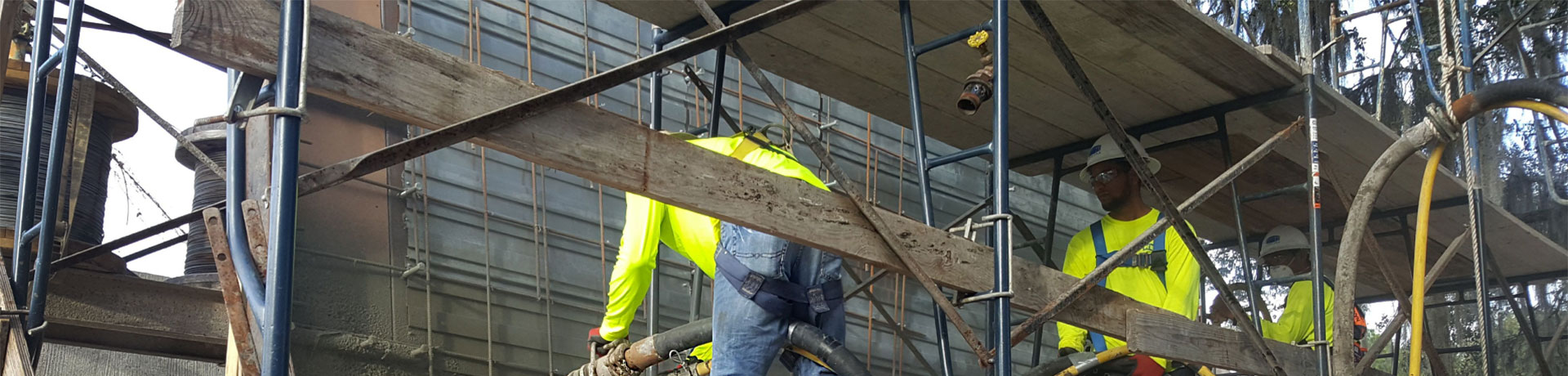
ASA’s “Safety Guidelines for Shotcrete” specifically addresses hose blockages. Use of compressed air to clear blockages or for cleaning the lines is not recommended. The Guidelines state:
“With the variety of shotcrete material delivery systems available, and their placement on individual job sites, the Contractor should establish site-specific safety procedures applicable to the specific delivery systems and site conditions for blockage removal. Any field procedures for clearing blockages should not use compressed air as means to remove or dislodge blockages.”
Using water to clear blockages or the delivery lines when finishing shooting is the recommended procedure. However, if compressed air is used, the hose end must be securely fastened with a substantial fastening system that can routinely and safely handle the forces created if the concrete is discharged explosively. Shotcrete contractors have developed cleanout bins that clamp the hose end into a heavy steel tank and collect the waste concrete from the line for disposal. Others have created clamps that firmly hold the end of the hose to a loader bucket or other heavy piece of equipment, thus depending on the weight of the equipment to hold the hose end. Simply having two people sitting on the hose end is not safe and can result in injury to crew members. Even when holding the hose end with a clamping system on heavy equipment, clearing the line can cause an explosive discharge of concrete with material flying in a wide path from the hose. Unless planned for and contained, the material stream can hit adjacent workers, facilities, equipment, and vehicles.
ASA has closely followed the development of the new OSHA rules for a couple of years before they were put into effect. You can find several articles in Shotcrete magazine that specifically address the rules in consideration of shotcrete application. In the Summer 2016 issue, an article, “OSHA’s New Crystalline Silica Rule–Potential Impact on Shotcrete Operations,” addressed many of the concerns. Unfortunately, with the wide variety of shooting conditions, there are no generic values. The reason for this is that the levels can vary significantly due to a variety of factors, including:
- The materials used—this includes comparing wet-mix to dry-mix and the variations in variability of concrete mixture design ingredients (for example, silica fume, fly ash, and accelerator).
- Equipment
- Dry-mix gun type (rotary or chamber), using a predampener or not (type of wet-mix pump likely doesn’t make much difference)
- Size of air compressor (more air might result in more dust)
- Delivery line and hose (1.5 in. [40 mm] hose versus 2 in. [50 mm]) can change volume of flow, and then level of acceleration and nozzle stream dispersion as a function of air volume)
- Nozzle type can significantly affect the material stream
- Shooting location (inside or enclosed, or open air)
With so many variables it is difficult, if not impossible, to get any reliable “generic” number for shotcrete as a whole. Many of our shotcrete contractors are using air quality consulting firms or testing labs who have the monitoring equipment. You may want to note that silica fume is amorphous silica, not crystalline, so it is not hazardous. Most exposure to crystalline silica is through sawing, cutting, or grinding of hardened concrete. We expect that most shotcrete contractors will need to establish a reliable, accurate level by on-site testing because shotcrete is not directly covered in Table 1 of the OSHA rule.
The ACI 350 Code doesn’t really cover repair in detail because it is more about new environmental structures. Shotcrete is concrete; it provides excellent bond to properly prepared concrete substrates and it inherently creates a composite section with the existing concrete that acts monolithically. The supplemental shotcrete could be considered an additional layer of concrete that acts monolithically and thus provides the needed concrete cover. Reference-wise, you could refer to the article “Shotcrete Placed in Multiple Layers does NOT Create Cold Joints” in the Shotcrete magazine archive, as it discusses the bond issue between layers. There are research papers that discuss a 200 psi (1.4 MPa) bond shear stress is needed for a bonded concrete overlay to act monolithically, and that bond pulloff (tensile) test results should be multiplied by 2 or 3 to represent the bond shear capacity. Because we typically well exceed a 145 psi (1.0 MPa) tensile bond pulloff strength, properly applied shotcrete will easily exceed the 200 psi requirement for the bond to act monolithically.
An additional factor in providing additional cover with shotcrete is that shotcrete has very cement-rich paste, along with low permeability, and thus provides a better alkaline environment to combat corrosion of embedded reinforcement, so is effectively giving even better cover than normal form-and-pour concrete.
Shotcrete is a placement method for concrete. If the sand can be used for concrete, it should be acceptable for shotcrete placement. To some extent, the type of shotcrete equipment may make a difference. If shooting wet-mix shotcrete, the concrete mixture must be able to be pumped. For pumpability, we do recommend a smooth gradation of the fine aggregate. If shooting dry-mix shotcrete, the sand gradation has much less effect, and you should be able to shoot most any sand in your concrete mixture.
“Coquina shell shotcrete” is not a well-defined concrete material. Though it may have been promoted to you as shotcrete, it may well have been a stucco-like application accomplished with low-velocity plastering equipment, and thus not high-velocity shotcrete placement. Without physical characteristics of the in-place material (strength, density, type, and amount of reinforcement), it is hard to delineate the structural enhancement the coating may provide. You could have an evaluation by an engineer or testing lab to ascertain the characteristics of the in-place material. Then refer to ACI 216.1-14, “Code Requirements for Determining Fire Resistance of Concrete and Masonry Construction Assemblies,” to see whether your composite system has enhanced fire resistance as compared to brick alone. Regarding wind resistance, you would need to have a structural engineer evaluate the composite system for any potential increase in strength against wind loadings.
The design of any concrete structure must consider loadings and environmental conditions. This includes drying shrinkage of the concrete, and daily and seasonal thermal changes that introduce stresses within the concrete sections. Domes are thin-shell concrete structures and stress concentrations are expected around any openings through the shell. Typically, the design engineer will provide additional reinforcing bars around openings and especially at corners of openings to accommodate the buildup of stresses in these locations. Also, chain-link fence is not considered as acceptable concrete reinforcement, as it cannot accept tension in a straight orientation within the concrete. Proper concrete reinforcement is either deformed reinforcing bars or steel mesh with smooth wires laid out in an orthogonal pattern.
You should have a professional engineer with experience in concrete shell design and construction evaluate your dome home for structural integrity. If the cracking is determined to not affect the structural integrity, epoxy or polyurethane grout injection is routinely used to seal cracks in concrete.
There is not a fixed value that one can use for maximum lift height. The maximum lift height when bench shooting is controlled by the concrete mixture (admixtures, aggregate, slump), concrete temperature, size and layout of reinforcement, substrate being shot against, and ambient temperatures. These factors must be evaluated by the nozzleman during the placement. The maximum height is constrained by the ability of the fresh concrete in the lower portion of the lift to carry the weight of concrete in higher portions without creating sagging or sloughing. Hot weather conditions will allow higher lift heights than cold weather in non-accelerated concrete mixtures.
Shotcrete placement requires high velocity for full consolidation and compaction of the concrete. Standard shotcrete equipment with a properly sized air compressor will produce a velocity of 60 to 80 mph (95 to 130 km/h). The 400 psi you stated is not a velocity, but a pressure. Sixty psi is a very low air pressure and may not create the velocity needed for proper shotcrete placement. Shotcrete generally uses compressors that create 100 to 125 psi of air pressure. Also, depending on the shotcrete process used (wet-mix or dry-mix), ACI 506R-16, “Guide to Shotcrete,” states you need an air compressor that can produce a flow rate of at least 200 ft3/min (5.7 m3/min) for wet-mix to 600 ft3/min (17 m3/min) for dry-mix for your 1-1/2 in. diameter hose.
Shotcrete is a placement method for concrete. It is routinely used to strengthen existing masonry or concrete walls. The 5 in. thickness can be easily achieved with either dry-mix or wet-mix shotcrete. If using dry-mix, you may want to review available prepackaged bagged dry concrete materials. A comprehensive listing of our ASA member companies supplying bagged dry concrete materials can be found in our online Buyers Guide. If using wet-mix, the local concrete supplier should be able to provide concrete mixture designs that will achieve the 4000 psi compressive strength requirement. Dry-mix and wet-mix processes use different equipment and skills of nozzlemen are somewhat different. We encourage requiring use of an ACI-certified shotcrete nozzlemen in the process to be used on the project. If looking to select a qualified shotcrete contractor, you may want to review our ASA position paper on Shotcrete Contractor and Crew Qualifications.
We could not identify any specific cases of shotcreting onto metal decking for sound dampening. However, shotcrete is used in a wide variety of overhead applications, and as long as we can get good bond to the underside of the metal decking, should perform well. Depending on the surface profile of the metal decking, you may want to consider attaching studs to the decking to enhance the overall bond of the concrete. You may also want to consider using lightweight shotcrete since the concrete sounds like it is more for acoustic purposes, than for structural.