
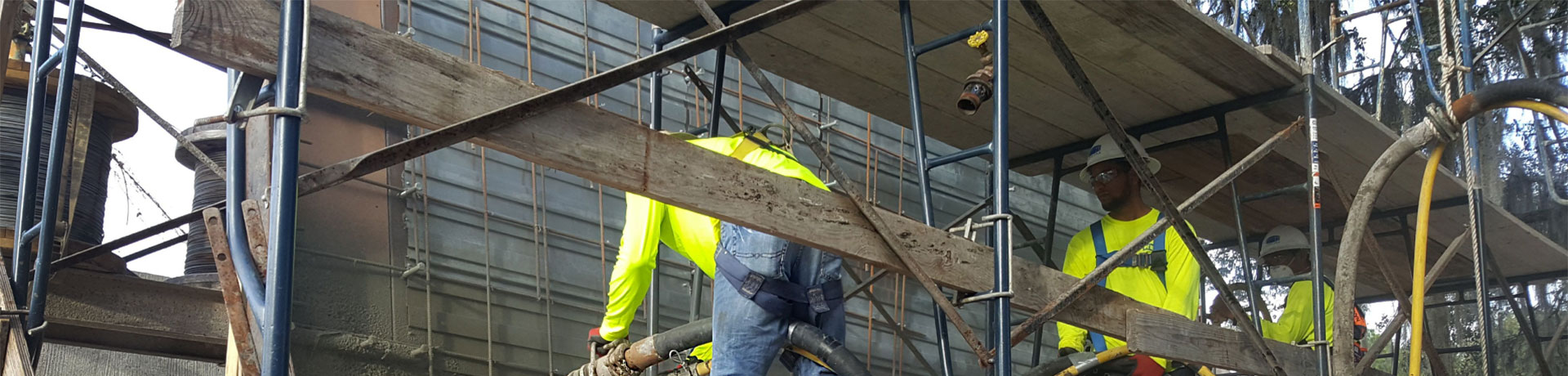
Shotcrete is a method of placing concrete and the properties of properly placed shotcrete are equal to those of cast concrete. We have seldom seen the use of epoxy-coated reinforcing bar in retaining walls with or without waterproofing. (The California Department of Transportation builds many retaining walls with cast concrete and with shotcrete and seldom uses epoxy-coated reinforcing bar or waterproofing.)
It is important that you use a contractor qualified and experienced in this type of work and who uses ACI Certified Nozzlemen and a qualified crew.
I am building a perimeter overflow pool and need to know the best way to finish the trough. I have one shotcrete company that wants to hand-finish the 6 in. (152 mm) wide trough; another wants to shoot up to foam. Can you tell me which is best and why?
This is a classic performance-versus-prescription situation. The owner or customer should specify the desired end product and the contractor should choose the means and methods. Although they may both provide a great product, what works for one contractor or what he/she is comfortable doing may be completely different than another contractor.
We’re designing two steel stacks to be located in Texas and subject to hurricane winds. The diameters are 9.19 and 4.92 ft (3 and 1.5 m), respectively. Both stacks are 118 ft (36 m) high. To reduce the vortex shredding oscillation effects, we want to increase the mass of the stacks by means of internal gunite lining. Our calculation provides good results considering approximately 2 in. (51 mm) thick interior liner. For this scope, is it better to consider external or internal lining? Would there be any advantage to applying an external liner with respect to the interior solution? Which of these two is the most cost-effective solution?
Shotcrete would work well either for the stack exterior or as an interior lining. The 2 in. (51 mm) thickness could be easily applied on either the outside or inside surfaces.
For the 9 ft (3 m) diameter stack, it would be easier and more cost-effective to scaffold and gun the inside of the stack. The work could be done with less difficulty, from an interior hanging platform suspended with sky climbers. There would be less cost involved with rigging than there would be with scaffolding or rigging around the outside circumference of the stack.
For the 4.92 ft (1.5 m) diameter stack, there is much less room to work inside, so unfortunately it may need to be gunned on the outside.
I am lowering the roof of the draft tube on a hydropower dam. The work is all overhead and has a slope to it. The new roof profile will be lowered from 2 in. (51 mm) (initial edge) to 6.25 ft (approximately 2 m) thick. The plan is to use rock anchors to transfer the load to the existing concrete, and tie in a reinforcing bar grid at the lower section of the new roof profile (4 in. [102 mm] cover). Shotcrete is being planned for the infill material. The traditional ACI 318 design method was used for sizing reinforcing bar. The concern I have in the design is the application of the shotcrete. The plan is to allow the contractor to install a wire mat (or reinforcing bar mat) approximately 2 in. (51 mm) from the existing concrete roof, then apply shotcrete until reaching the reinforcing bar location, up to 6 ft (1.8 m) thick, then apply the finish layers. I have concerns about how thick shotcrete can be applied overhead. I have received feedback from some shotcrete companies that one can apply up to 4 ft (1.2 m) thick overhead layers, yet others say to never apply more than 4 in. (100 mm) layers. I also have concerns of delamination between the shotcrete and the existing concrete during the installation process, and potential shotcrete falling under its own weight in the thicker locations. Do you know of any situation where shotcrete was installed overhead to thicknesses of 6 ft (1.8 m)? How thick can the shotcrete be before additional reinforcement is required to hold it for overhead applications? Is there a recommended maximum thickness for overhead application of shotcrete being placed before additional reinforcement is required? For the area that is 6.25 ft (2 m) thick, should I be using multiple layers of reinforcement (or fiber reinforcement) to prevent fallout?
This is a very challenging potential installation and there could be several potential approaches. For the shotcrete to bond to the existing concrete, the existing surface should be properly prepared, removing any unsound concrete, then roughened and cleaned to allow for a good bonding interface. You mentioned using rock anchors or bolts. These should be installed before any shotcrete.
For each 6 in. (152 mm) layer, a layer of welded wire reinforcement or structural fibers should be used. These, in conjunction with the rock bolts, should ensure the stability of each layer of the shotcrete from falling.
The surface reinforcement should not be installed before most of the area is within 6 to 8 in. (152 to 203 mm) of the final surface.
There is currently similar thicknesses being placed on the East Side Access in New York City to build back the overbreak for the initial tunneling to the “A-line” or profile that was intended for the mining.
We are an architectural design firm that specifies extensive amounts of shotcrete to mimic rockwork in our designs for large-scale animal exhibits. We often encounter differing views on the need for galvanized or coated reinforcing bar in our shotcrete work, especially when they are used as pool lining walls containing salt water. Can you tell us your opinion on whether galvanizing or coating of reinforcing bar is necessary if both integral and surface waterproofing are specified?
Shotcrete is a process of placing concrete. The need to use galvanized or any other type of reinforcing is, or should be, based on the needs of the project and the preference of the structural design engineer. For liquid-containing concrete structures, the designer may review ACI 350-06, “Code Requirements for Environmental Engineering Concrete Structures,” which has specific concrete material, cover, and reinforcing requirements for concrete exposed to a variety of chemical and saltwater exposures. (The aforementioned ACI Committee 350 publication may be purchased from the American Concrete Institute at www.concrete.org”.)
How soon after a surface is shotcreted can it be submerged with stream water? What if the water has no velocity?
Shotcrete is a means of placing concrete and the same precautions should be taken. Once the shotcrete had taken final set, exposing it to water and submerging it in water should enhance its curing. If it is a pool or other deep structure, you should ensure that the shotcrete or concrete is strong enough to withstand any hydrostatic loading due to the filling of the structure.
I am considering using shotcrete for lining stormwater conveyance ditches at a project site, and am trying to find any possible information on the potential for shotcrete (or other cement products for that matter) to leach selenium. Please advise if you have any information regarding this topic.
Shotcrete is a method of placing concrete. Thus, testing for selenium appropriate for concrete is suitable for shotcrete. The Portland Cement Association (PCA) has published a paper on testing of cement for various constituent components, including selenium, to meet NSF 61 requirements. Their testing showed “Values for arsenic, cadmium, selenium, and silver were all below detection limits.” The paper can be found at PCA’s website.
We are building a pool using shotcrete, and our pool design team has been asked to use the Aquron pool shell protector. The info from Aquron says for best results, spray the CPSP the morning after the shotcrete has been applied. However, our shotcrete company told us to keep the shell damp for a minimum of 7 days. Could you weigh in on this?
The ICC (International Code Council) Building Code requires a 7-day wet cure, which is good practice for concrete or shotcrete. The Aquron Technical Data Sheet mentions prewetting the surface prior to application, but we do not see the direction on the timing. You may want to question the product representative regarding how to accomplish the ICC curing requirements and also get the best results from their product.
I have a project in Fort Worth, TX, where we will be placing shotcrete on some interior walls that will have steel embeds for other structural supports. Do you have an article or literature regarding good practices of shotcrete placement around steel embeds?
Shooting around embeds can be very challenging. The most important factor is to have the work done by a shotcrete subcontractor who has done this successfully in the past and has ACI Certified Nozzlemen who are also experienced in this type of work. It has been done successfully on many projects in the past, but we do not have a published procedure to do this work.
We are in the process of renovating a commercial pool with a gutter system. The plaster surface has been removed along with some of the concrete. The wall of the gutter on the water side is tiled and is crumbling away. Our plan is to shotcrete the walls and gutter. When we shoot the walls back we will be adding 1 to 2 in. (25 to 51 mm) of shotcrete at a maximum. Is this too thin for shotcrete? Also, the gutter edge will be 2 in. (51 mm) thick and 4 in. (102 mm) in height without any reinforcing bar—will this have much strength?
Shotcrete can be placed as thin as 1 to 2 in. (25 to 51 mm), but will do little more than to provide a new surface to apply the plaster. To do a proper job you need to remove all loose and deteriorated existing shotcrete and should likely add in a layer of reinforcement or use structural fibers (either steel or synthetic) in the shotcrete mixture. The surface preparation should be done to the standards outlined by the International Concrete Repair Institute (ICRI).