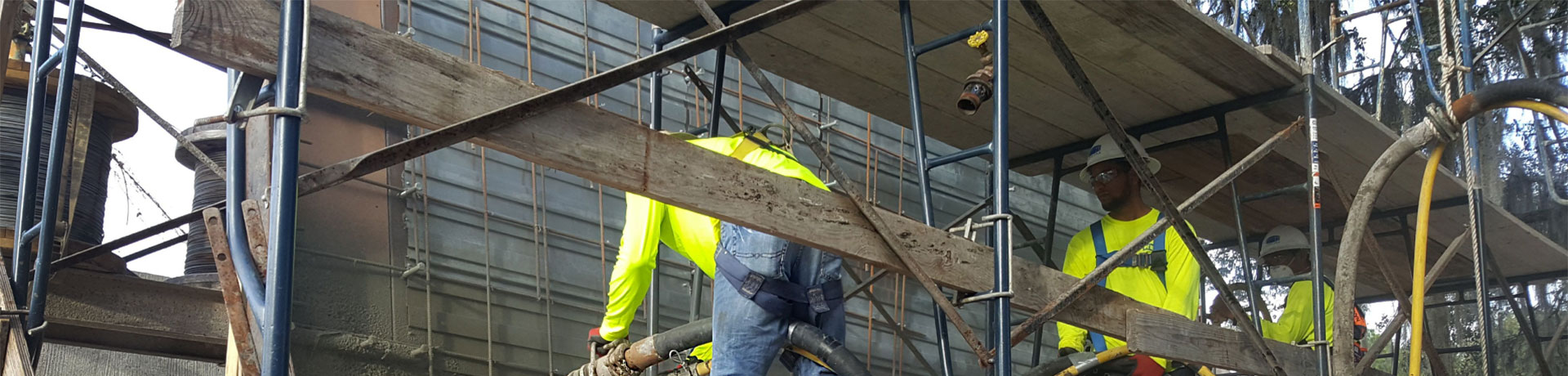
ACI 117 provides an excellent guide for tolerances for concrete structures. Although shotcrete is concrete, ACI 117 specifically excludes shotcrete because shotcrete’s unique method of placement permits a wider variety of applications and uses than that of form-and-pour concrete. Shotcrete can generally be finished to the tolerances required for the application. For example, lining a channel might not need close tolerance control, while an Olympic luge/sledding track or skateboard park may require very exacting tolerances. ACI 506.2-16, “Specification for Shotcrete,” in the Tolerances section (and the Mandatory checklist item) requires the specifier producing the contract documents to provide the tolerances required for the project. ACI 506R-16, “Guide to Shotcrete,” Section 3.8, Tolerances, provides a more descriptive commentary. Pertinent portions of that section include:
Tolerances provide an indication of the finished product expected by the owner, but meeting tolerances may require additional effort and cost. Tolerances given by ACI 117.1R, for placement of reinforcing steel, cover over reinforcing steel, and overall alignment of cast-in-place structural members should be generally the same for shotcrete. Tolerances that require distinct values for shotcrete construction are cross-sectional dimensions, cover, and surface finish (or flatness). Therefore, specifying tolerances that can be consistently achieved are needed so that project expectations can be met at a reasonable cost.
Specified tolerances should be based on use and function and can be the same as concrete, but are typically broader. Some finished surface tolerances may be waived to achieve proper coverage over existing reinforcement.
Although some shotcrete structures have been allowed greater tolerances than allowed for concrete, shotcrete structures can be built to the same degree of accuracy and tolerance as cast-in-place concrete.
You should review the entirety of Section 3.8, Tolerances, in ACI 506R-16 to get a complete description of tolerances for shotcrete placements.
ACI 506.2-95, “Specification for Shotcrete,” is the deprecated version, and is no longer published (it isn’t readily available on the ACI website). Thus, the Tech Note along with the current ACI 506.2-13, “Specification for Shotcrete,” is the current industry standard for evaluating cores. An engineer may specify use of the outdated ACI 506.2-95; however, they are opening up their exposure because it isn’t the current standard. This is similar to the exposure if an engineer uses a much older version of ACI 318, and not the current one.
Shotcrete is a placement method for concrete. So, standard concrete tests for shrinkage are applicable. You will find an article from Shotcrete magazine, “Shotcrete Testing—Who, Why, When, and How,” helpful. The specific section on drying shrinkage tests says:
“Drying shrinkage of the shotcrete can be tested using general provisions of ASTM C157. Because the shotcrete is shot into a large panel and not into the relatively small mold specified by ASTM for the shrinkage test beam, it is recommended that a beam approximately 11.25 in. (285 mm) in length be sawed from a test panel. As most shotcrete uses coarse aggregate less than 1 in. (25 mm), a 3 in. (75 mm) thick panel with a 3 in. (75 mm) wide cut should approximate the ASTM requirements. The A/E should specify in the contract documents drying shrinkage limits that are appropriate for the design of the structure.”
Shotcrete compressive strength should be tested using cores from test panels. Shotcrete cannot be shot into closed cylinder forms and be representative of the in-place shotcrete. ASTM C1140-11 and C1604-05(2012) provides the panel configuration and compression testing requirements. However, if using the wet-mix process for shotcreting and one wants to verify the compressive strength, air content, or temperature of ready mixed concrete materials as delivered, rather than as shotcreted in place, samples can be taken from the truck before pumping. These cylinders would follow ASTM C31-15 for making and curing concrete test specimens.
Shotcrete is a placement method for concrete. So, standard concrete tests for shrinkage are applicable. You will find an article from Shotcrete magazine, “Shotcrete Testing—Who, Why, When, and How,” helpful. Here’s a link to the archived PDF of the article (shotcrete.org/wp-content/uploads/2020/01/2011Sum_Hanskat.pdf). The specific section on drying shrinkage tests says:
“Drying shrinkage of the shotcrete can be tested using general provisions of ASTM C157. Because the shotcrete is shot into a large panel and not into the relatively small mold specified by ASTM for the shrinkage test beam, it is recommended that a beam approximately 11.25 in. (285 mm) in length be sawed from a test panel. As most shotcrete uses coarse aggregate less than 1 in. (25 mm), a 3 in. (75 mm) thick panel with a 3 in. (75 mm) wide cut should approximate the ASTM requirements. The A/E should specify in the contract documents drying shrinkage limits that are appropriate for the design of the structure.”
Since shotcrete is simply a placement method for concrete, the R-value is the same as cast concrete. ACI 122R-14, “Guide to Thermal Properties of Concrete and Masonry Systems,” would be a good reference.
Each manufacturer of concrete constituents needs to have their products tested by NSF if they want NSF 61 certification. Whether the fibers need NSF 61 certification is an issue with the local authority having jurisdiction for exposure of components to potable water supply systems in your state. Generally, this is the state EPA-type agency, but maybe a federal agency if on a federal project.
We don’t maintain a database of manufacturer products that meet NSF 61. However, you can readily identify contacts for the fiber manufacturers who are ASA corporate members with our Buyers Guide at https://shotcrete.org/products-services-information/buyers-guide/. When entering the Buyers Guide, you can select “Fiber + Reinforcement Sales” and the fiber type subcategory to get a list of our member fiber suppliers.
Membership supports the mission of ASA to provide knowledge, resources, qualification, certification, education, and leadership to increase the acceptance, quality, and safe practices of the shotcrete process.
Annual Dues (Sustaining Corporate Membership includes three Corporate Additional Individual memberships and special recognition in ASA’s Buyers Guide and on the ASA website)
$1500
$1200
$100
$375
$65
Free
Free
Company and specialty information listed in ASA’s online Buyers Guide
X
X
Discount on ACI Shotcreter Certification and Education
X
X
Opportunity to be featured as either a Sustaining Corporate or Corporate Member Profile, respectively, in Shotcrete magazine
X
X
Exclusive opportunity to submit items for the Industry News and New Products & Processes columns in Shotcrete magazine
X
X
X
X
Discounted ASA member prices on all ASA products
X
X
X
X
X
X
X
Contacts to receive bid requests from our Online Project Bid Request Tool
4
1
1
Subscription to quarterly Shotcrete magazine (hard and electronic copy)
X
X
X
X
X*
X
X*
Permission to include ASA logo on corporate letterhead and business cards
X
X
X
X
Permission to display ASA logo on company website
X
X
Discounted pricing on advertising in Shotcrete magazine
X
X
X
X
X
Complimentary inclusion of advertising company logo from the ASA website to your company website during your advertising quarter
X
X
Voting privileges at committee meetings and director/officer elections
4
1
1
1
Fulfills membership requirement for ASA’s annual Outstanding Shotcrete Project Awards Program
X
X
Complimentary annual On-site Learning Seminars**
2
1
1
Corporate Additional Individual memberships are available for company employees ($200 savings per employee)
X
X
Access to ASA’s “Safety Guidelines for Shotcrete” via ASA’s member Communities portal through “My ASA” at www.shotcrete.org
1
1
Complimentary ASA shotcrete brochure each year
25
25
5
5
Complimentary ASA reflective hardhat sticker each year
10
10
1
1
1
*Members outside North America will only receive electronic copies. **Further education for in house, specifiers, or government agencies (1-2 hours)
Any redistribution or reproduction of part of all of the contents in any form is prohibited other than the following:
You may print or download extracts for your personal and non-commercial use only.
You may copy the content to individual third parties for their personal use, but only if you acknowledge the website as the source of the material.
You may not, except with the ASA’s express written permission, distribute or commercially exploit the content. Nor may you transmit it or store it in any other website or other form of electronic retrieval system.
About ASA Committees
Committee meetings are open to the public and ASA welcomes and encourages the participation of all interested parties in the shotcrete industry.
Board of Directors
The Board of Directors shall have supervision, control, and direction of the affairs of the Association, shall determine its policies within the limits of the ASA bylaws, shall actively pursue its purpose and shall oversee the disbursement of its funds.