
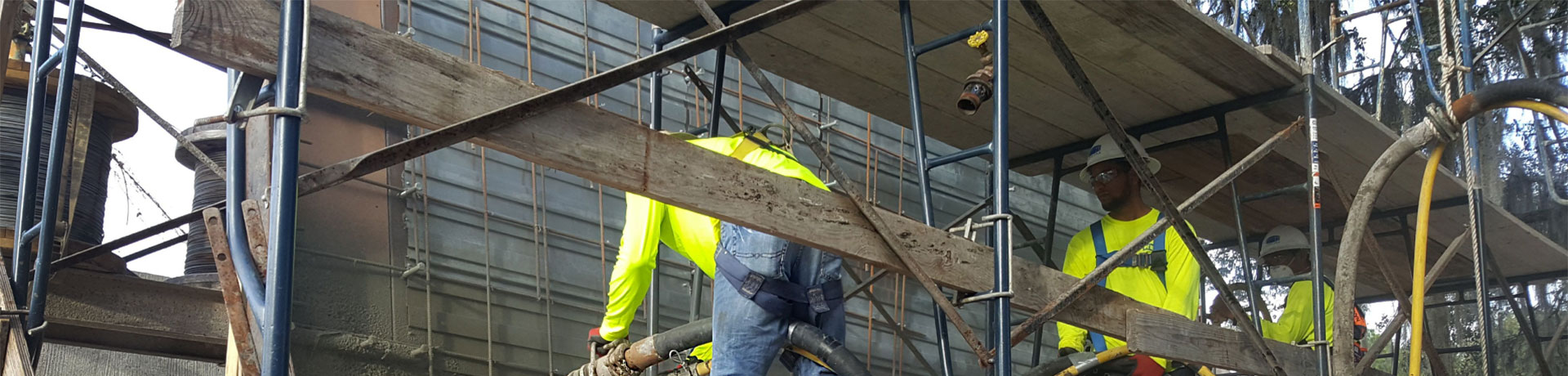
Since the shotcrete process originated well over 100 years ago, improvements in materials, equipment, and placement techniques have enabled it to become a well-proven method for structural concrete placement. The efficiency and flexibility of shotcrete have been used to great advantage in sizable structural projects, as the high-velocity impact inherent in the process provides the compaction needed to turn low-slump concrete into freestanding vertical and overhead placements with minimal formwork.
Performance of Synthetic Sheet Waterproofing Membranes Sprayed with Steel Fiber-Reinforced Shotcrete
The recent Position Statement #2, “Spraying Shotcrete on Synthetic Sheet Waterproofing Membranes,” published by the ASA Underground Committee, pointed out many aspects critical to successful performance and raised some potential issues affecting the placement.1 In the position statement, specific techniques are presented to prevent problems such as delamination, voids, or fallouts. In the discussion, the potential issue of steel fiber-reinforced shotcrete (FRS) causing damage and potentially puncturing the membrane was raised. From the experience of the committee and the available information, it was concluded that: • The forces acting on the fiber are not strong enough to push the fiber into the membrane; and • The fibers tend to orient parallel to the membrane on impact, thus reducing the risk of damage. In parallel, a research project on this subject had been undertaken at Université Laval’s Shotcrete Laboratory, with the results only recently available. This article presents the results of this investigation.2 It is intended to support ideas presented in the ASA position paper and to help in the decision-making process when dealing with waterproofing membranes and FRS in underground projects.
Fiber-Reinforced Shotcrete Applications and Testing Overview
The addition of fibers to concrete and mortars as reinforcement is not a new concept. The ancient Egyptians used straw to reinforce mud bricks for use in structures like the core walls of the pyramids. During the first century AD, the Romans incorporated horsehair fibers in the construction of structures like the Coliseum to help prevent drying shrinkage cracking of the concrete. In the modern era, the first scientific studies on the use of steel fibers to reinforce concrete date back to the 1960s and 1970s.1,2 The use of steel fiber-reinforced shotcrete (FRS) was first introduced in the 1970s.3 The first documented use of FRS was in 1973 by the U.S. Army Corps of Engineers in a tunnel adit project at the Ryrie Reservoir in Idaho. Soon thereafter it became well recognized that soil and rock excavations could effectively be stabilized with steel FRS and its use and acceptance increased globally. In the mid-1990s, the use of macrosynthetic fibers in shotcrete was developed and has increased with particular success in temporary support in underground mines where large deformation capacity is desired. Since the 1970s, thousands of projects have been successfully completed using fibers as reinforcement, including shotcrete, slabson-ground, composite steel decks, slabs-on-pile, and precast elements.
The Newly Launched ACI Shotcrete Inspector Certification Program
The Shotcrete Inspector Certification program began out of the need in the industry to have knowledgeable individuals inspecting shotcrete projects. Shotcrete contractors often find themselves having to educate project inspectors on the details needed for quality shotcrete placement. Shotcrete is a superior placement option in many cases, yet unfortunately, the expertise in evaluating the work is often non-existent. Many contractors and specifiers are faced with situations on jobsites where the lack of shotcrete-specific knowledge from the inspector has either limited the use of shotcrete or created potential litigious situations. The industry needs a knowledgeable on-site inspector, not necessarily an expert in contract documents or even a laboratory tester. As is the case with form-and-pour concrete, an inspector who has demonstrated basic shotcrete knowledge will
Improving Shotcrete Inspections
Shotcrete is a placement method for concrete. Even though the shotcrete process is over 100 years old, it constantly evolves and today, it is a modern, costeffective, and more sustainable method of concrete placement. Those of us who regularly shotcrete a variety of work will at times have inspections and therefore have to work with inspectors. Understanding the inspector’s role as a safeguard or agent for the owner is important. However, we often find dealing with inspectors can be a cumbersome part of our job. Knowing how to do something properly and being able to fully explain the means and methods of a specialized process (shotcrete) to someone who has little to no firsthand experience are two completely different animals
Common Test Panel Mistakes
Frequently, shotcrete contractors are required to shoot test panels at the beginning as well as throughout projects. Several tests are performed from these panels; however, compressive strength testing is the most common. This article will primarily address compressive strength testing. At some point, every contractor has missed a required break strength on a core extracted from one of their panels. Frequently, those bad results are not caused by bad material or poor workmanship. They are caused by poor test panel handling and improperly performed test standards. Often, the causes of those bad test results could have been easily avoided. Let’s discuss some of the more common test panel mistakes witnessed in the field
Please review the error(s) below.
I live in a 10-story condo building built in the 1960s. The entire building is made of gunite. We use masonry drill bits for holes, but nothing seems to grip well. We have tried concrete screws, metal drywall anchors (which seem to work the best), and a plethora of other anchors and screws, but nothing seems to work. They all cause mushrooming and they either don’t grip or turn the wall to powder. What are the best tools to affix things to the walls?
Shotcrete is a placement method for concrete. Dry-mix shotcrete (the old tradename is gunite) using proper materials, equipment, and application techniques should have easily been able to reach a strength of 4000 psi (28 MPa) in the first month. After 10 years in-place the concrete should be even stronger. The level of concrete strength developed by quality shotcrete should easily accommodate drilling in anchors or concrete screws. In my experience it would have been highly unusual to build an entire 10-story building with shotcrete even in the 1960s. I’d suggest based on the extremely weak material properties and the wall turning to dust what you think is shotcrete may be sprayed plaster or stucco. Those materials don’t have near the same strength as shotcrete and would exhibit many of the problems you have mentioned.
The ASA Buyers Guide provides a detailed listing of the products and services offered by our Corporate Members.
Shotcrete Africa SCP (pty) Ltd
472 Spionkop Rd Off Boundry Rd, Northriding null, 2169 South Africa
Sustaining Member
Sika Corporation (USA)
201 Polito Avenue, Lyndhurst NJ, 07071 United States
Sustaining Member
Sika STM- Shotcrete, Tunneling & Mining (Canada)
555 Michigan Dr Suite 100, Oakville ON, L6L 0G4 Canada
Sustaining Member
South Shore Gunite Pools & Spas Inc.
12 Esquire Road, North Billerica MA, 01862 United States
Sustaining Member
Spohn Ranch SkateParks
6824 S. Centinela Ave, Los Angeles CA, 90230 United States
Sustaining Member
Strata LLC
1738 Amarillo Street Suite 205, San Juan PR, 00926 Puerto Rico
Sustaining Member
Structural Technologies
10150 Old Columbia Rd, Columbia MD, 21046 United States
Swank Construction Company, LLC
632 Hunt Valley Circle, New Kensington PA, 15068 United States
Terra Engineering & Construction Corporation
2409 Vondron Rd, Madison WI, 53718 United States
Sustaining Member
Thorcon Shotcrete & Shoring LLC
10900 Chatfield Lake Road, Littleton CO, 80125 United States
Sustaining Member
Top Gun of Virginia Inc
10017 Richmond Highway, Lorton VA, 22079 United States