
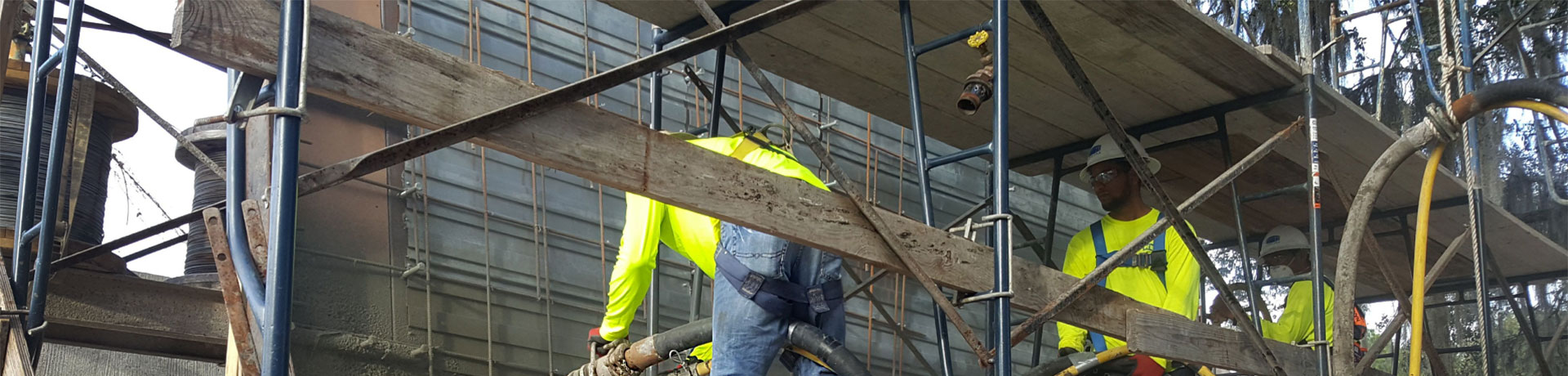
Yes, this is definitely a great application for shotcrete. Either wet- or dry-mix shotcrete can easily be used in tunnels with hose lengths of 200 ft (61 m). An experienced shotcrete contractor will be able to select the appropriate process based on the site, availability of material, and their particular equipment and trained shotcrete crews.
Is there a reference where I can obtain some guide regarding the tensile strength of fiber-reinforced shotcrete (steel and poly)?
ACI 506.1R-08, “Guide to Fiber-Reinforced Shotcrete,” is a good reference for general use of fibers in shotcrete. If looking at underground applications for shotcrete, ACI 506.5R-09, “Guide to Specifying Underground Shotcrete,” will also offer guidance. The ACI 506 documents are available in hard copy format on our bookstore website with ASA member discounts (shotcrete.org).
Because shotcrete is a method for placing concrete, many, if not most, of the properties of fiber-reinforced concrete, as found in ACI 544 committee documents, are applicable to shotcrete.
I have a very small job to do that would normally be handled by a gunite or sprayed-on application. I need to form the inside of a concrete box into a cylindrical shape. I would like to get a few hints or suggestions on how I might accomplish the “gunite” solution using my hands/tools only. Does this require a special mix of the mortar mixture?
Shotcrete is concrete placed at high velocity to achieve compaction. It is dependent on the projection of material with air velocity of 60 to 80 mph (97 to 129 km/h) from the nozzle to consolidate the concrete material in place. It cannot be hand-applied. You may consider hand-applied pre-packaged mortar mixtures to achieve your results, although strength and durability may be less than a similar section with shotcrete because the hand-applied material is not fully compacted. Another alternative is to create an inner cylinder and cast concrete in the space between the box and the form. The concrete could then be vibrated for consolidation.
We are planning on placing shotcrete over rock face and are concerned about water seeping out of the rock and forming ice behind the shotcrete. Could you please offer some insight?
Shotcrete is a functionally impermeable material when properly designed and placed. Thus, if water accumulates between the rock substrate and shotcrete, depending on temperatures and thickness of the shotcrete, it may freeze. As with all concrete, shotcrete material can be air-entrained to enhance resistance to freezing-and-thawing exposure. You should consult with an experienced engineer to determine whether the type of rock, geometry of the sections, and anchoring of the shotcrete (such as with soil nails or rock bolts), along with the bond of shotcrete to the rock, will provide the desired performance.
What is the standard materials delivery rate velocity for shotcrete applications?
Recent research into velocity of the material stream shot from the nozzle is approximately 60 to 80 mph (97 to 129 km/h) in the middle of the stream. Outer portions of the stream are slowed and show speeds of about 45 mph (72 km/h). Here’s a link to the Technical Tip published in the Fall 2013 Shotcrete magazine that provides more complete documentation of the research: shotcrete.org/wp-content/uploads/2020/01/2013Fal_TechnicalTip.pd.
I’ve been testing shotcrete cores for compression strength according to ACI 506, ASTM C1604, and ASTM C1385. The only thing that we have been doing out of specifications is the panel. Our panels are 18 x 18 in. (457 x 457 mm). We have been coring at the center of the panel 2 days after it has been cast. We test these cores at 7 and 28 days, and the strength of cores reflects passing at 7 days but failing at 28 days. Can you please tell me what could be the cause of this?
ASTM C1140/C1140M-11, “Standard Practice for Preparing and Testing Specimens from Shotcrete Test Panels,” is the appropriate ASTM standard for producing and coring test panels. ASTM C1140 specifies panel size as a minimum of 24 x 24 in. (610 x 610 mm) with a minimum 3.5 in. (89 mm) depth. Without more information on the materials used in the shotcrete and the type of shotcrete, it is impossible to identify what may be causing the lower compressive strength tests.
The compressive strength should increase between 7 and 28 days on a curve equivalent to cast concrete. Strength degradation between 7 and 28 days may be a result of poor shotcrete application or problems with coring or curing of the samples.
We have a school project in California. It is for a structure with shotcrete walls and a shotcrete dome roof shot with an inflatable form. There is disagreement on the nozzlemen qualification panels. One group says that a panel should be shot for each nozzleman for each position (three panels: one vertical, and two for different slopes of the dome) in a single layer with the most congested reinforcing bar in any single layer to simulate job conditions. A second group maintains that the same three panels should be shot, but they should be built up over a period of 6 days in gradual layers to represent the layering of the actual shooting. I think that the first group is correct and complies with the intent of ACI 506. Shooting one-layer panels with the most congested reinforcing bar to be placed in any one layer would best simulate the job placement conditions. I don’t see any added advantage in shooting qualification panels over a period of days in layers and seems to be reading too much into “simulating” jobsite conditions.
In construction of shotcrete dome roofs with inflatable forms, the structural thickness of the dome is built out in layers to prevent overloading the support offered by the inflatable form and foam. Thus, your nozzleman qualification panels should be representative of the dome construction methods. This would include shooting orientation (vertical and varying slopes), shooting procedures (layers), and with the most congested reinforcing. When shotcrete is applied in layers, all you need to do is wait for the first layer to stiffen sufficiently (usually called initial set), before applying the next layer. It is not necessary to wait for days before applying the next lift.
We are considering sealing off the openings of some existing water tunnels by constructing reinforced concrete walls within the openings. One wall, for instance, is 9.25 ft wide by 12 ft high (3 x 4 m) and is to be 22 in. (559 mm) thick. Other walls will be in the range of 18 to 26 in. (457 to 660 mm) thick. What are the limits as to the maximum thickness/size wall that shotcrete can be used to construct? Also, I noticed that in the latest revision of ACI 506R-05 that the previous recommended limits on the reinforcing bar size have been removed. I believe in the past, the reinforcing bars were limited to the smaller-size bars to reduce the development of sand pockets behind the bars. Is there a recommended limit on the size bars that can be used? Perhaps it was in the ACI standard but I just overlooked it.
Experienced shotcrete contractors with qualified crews have often shot structural concrete sections 24 to 30 in. (610 to 762 mm) thick with reinforcing bars up to No. 11 in size. There is no real limit to how thick you can build a shotcrete “wall.” Though earlier versions of ACI 506R, “Guide to Shotcrete,” did recommend limiting reinforcing bars sizes, modern equipment, concrete mixtures, and shooting techniques have proven that large-diameter steel reinforcing bars can be properly encased on a routine basis by experienced shotcrete crews. Thus, ACI 506R was updated to reflect the successful industry practice.
There is a pre-stabilized steep slope (nailing is used along with shotcrete). The client wishes to benefit from the maximum achievable area in plan and is asking for excavation of the stabilized slope to shift back the wall face around a few meters. The new stabilization plan shall include a safe gradual excavation of the existing wall from top to bottom along with the destruction of the existing shotcrete face, reinforcement, and the installed nails. What is the most common destruction method for the existing shotcrete? At the same time, I think pulling out the nails using hydraulic jacks would be applicable.
The existing shotcrete can be removed by many methods, such as using a Hoe-Ram. The existing soil nails could be removed as suggested or left in place and trimmed back to some distance behind the new plane. We would assume that this work would be done from the top down installing new soil nails and shotcrete facing in lifts of approximately 4 to 5 ft (1.2 to 1.5 m).
Is it possible to apply shotcrete on glass? Can shotcrete or concrete bond with glass? If it is an issue due to the smooth surface properties of glass, will sandblasting help? We have made test holes and it is adhered very well, except where moisture penetration through the parapet has compromised adhesion. This is installed with five layers approximately 1 in. (25 mm) thick. We are considering leaving the material in place, patching as required, and removing the existing nonpermeable paints (which are peeling). Our thought is to coat the surface with a variegated colored stain, allowing for permeability of vapor. Can the material be patched as necessary? What is the recommended finish? Do we need to be concerned that the material could permit water penetration? Are there certified contractors in the Cleveland, OH, area?
We are not aware of any specific applications of shotcrete to glass. The glass would have to be tough or strong enough to withstand the sprayed application. We have seen shotcrete stick to smooth surfaces like glass and glossy paint, but have not seen any data on the bond. In general terms, better bond is achieved with roughened surfaces so sandblasting the glass would likely improve the bond.