
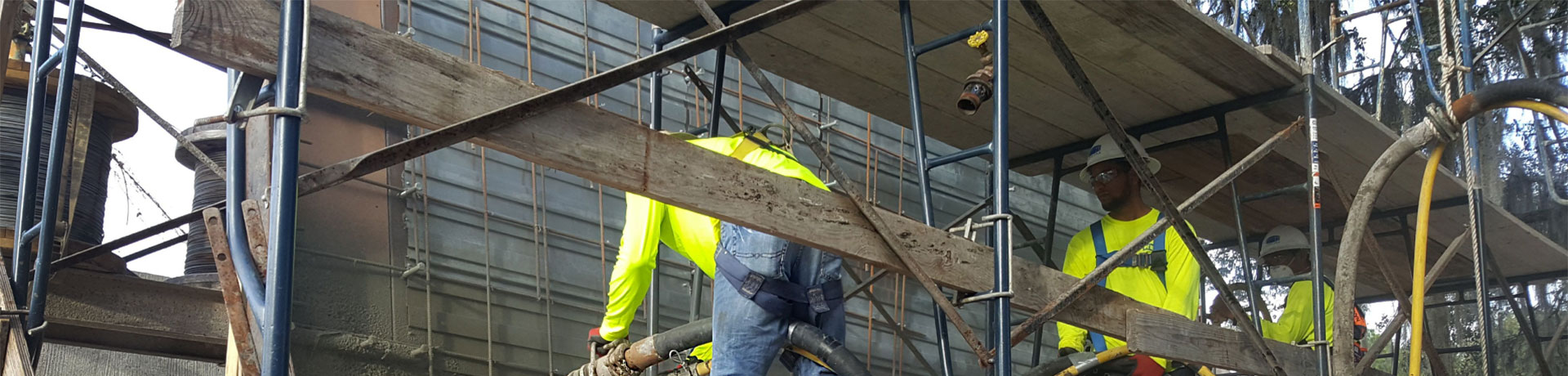
Some mines have used chain link mesh in shotcrete in severely deforming ground and claim that it is better in holding the ground than mesh after large deformations, in which the shotcrete sustains major cracking with deformations. Other than for such unusual applications, we do not recommend the use of chain-link reinforcement in shotcrete. It cannot be fixed “tight” and as such is susceptible to vibration and movement during shooting, resulting in shotcrete sloughing and formation of voids in the shotcrete. Also, the mesh interconnections are conducive to the formation of voids during shooting. Additionally, there don’t appear to be any consistent material standards on the strength, flexibility, or brittleness of the steel (or other materials) used in the fencing material, so a designer has no way to establish the tensile or flexural strength of the concrete sections. In brief, don’t use chain-link mesh if you want to produce quality, durable shotcrete.
The plaster color installed in my pool was the wrong color. The plaster has been chipped out. My concern is damage to the shotcrete shell in the process. There are deep holes and gauges and there was water seepage in a few areas behind the shotcrete. There is also evidence of honeycombed areas in the shotcrete, as well as some other shotcrete concerns since reading up on the shotcrete process. Please help, as I’m being told that they will just plaster over these concerns. However, the plastering information reads that plaster thickness should not exceed 7/8 in. (22 mm) thickness (but can be a little thicker around plumbing fixtures).
Shotcrete is a placement method for concrete. When the pool shotcrete contractor uses quality materials, properly sized and maintained equipment, and experienced crew members, the shotcreted pool shell should be watertight. Proper shotcrete application would also not exhibit voids, honeycomb, or major seepage through the pool shell. Before replastering, the pool shell should be evaluated and all defects (voids, cracks, porous sections, deep holes, and so on) repaired using industry-standard methods and materials. You may consider retaining a professional engineer or experienced pool consultant to evaluate the pool shell and make specific recommendations on the appropriate repair for your specific issues. You can use our Buyers Guide (shotcrete.org/products-services-information/buyers-guide/) to locate consultants in your area. You also may want to review our pool-specific Position Statements on our website at shotcrete.org/products-services-information/resources/. The “Watertight Shotcrete for Swimming Pools” would be particularly informative for you to assist in discussions with your pool contractor.
Is there a way for me to find out what the standard or appropriate repair for exposed reinforcing bar in a shotcrete swimming pool shell?
Because shotcrete is a placement method for concrete, standard concrete repair techniques are applicable. If the repair is being done by shotcreting new concrete on the existing concrete, the repair should include these steps:
- Chip the poor or weak concrete back to sound concrete.
- If reinforcing bars are exposed, they should be cleaned of any rust.
- If more than half of the perimeter of a reinforcing bar is exposed, the concrete should be chipped back to provide at least a 0.75 in. (19 mm) space behind the bar to allow shotcrete to flow around the back of the bar.
- Before shooting any additional shotcrete, the surface should be cleaned and then wetted to a saturated surface-dry condition (SSD).
- SSD means the substrate is damp, but there is no flowing water. It should feel damp to the touch, but no water is picked up on your hand when placing it against the surface.
- Do not use bonding agents, as they can interfere and reduce the bond of the new shotcrete to the old shotcrete surface.
- When the new shotcrete is in place, the contractor should initiate water curing as soon as possible. In warm, dry, or windy weather, fogging of the fresh surface immediately after finishing would be helpful.
- Water curing (where the concrete is kept continuously moist) should be supplied for at least 7 days.
Can we find an appropriate and easy way to evaluate the shrinkage performance of shotcrete?
Shotcrete is a placement method for concrete. So, standard concrete tests for shrinkage are applicable. You will find an article from Shotcrete magazine, “Shotcrete Testing—Who, Why, When, and How,” helpful. Here’s a link to the archived PDF of the article (shotcrete.org/wp-content/uploads/2020/01/2011Sum_Hanskat.pdf). The specific section on drying shrinkage tests says:
“Drying shrinkage of the shotcrete can be tested using general provisions of ASTM C157. Because the shotcrete is shot into a large panel and not into the relatively small mold specified by ASTM for the shrinkage test beam, it is recommended that a beam approximately 11.25 in. (285 mm) in length be sawed from a test panel. As most shotcrete uses coarse aggregate less than 1 in. (25 mm), a 3 in. (75 mm) thick panel with a 3 in. (75 mm) wide cut should approximate the ASTM requirements. The A/E should specify in the contract documents drying shrinkage limits that are appropriate for the design of the structure.”
We are building an area of a park that is on an existing pier in Brooklyn, NY. We are researching using shotcrete to form contours on certain areas. Weighting of the pier is an issue. Our question is, can lightweight concrete, or cellular concrete, be used in shotcrete? If so, what are the weights?
Shotcrete is a placement method for concrete. Lightweight concrete usually ranges from 90 to 115 lb/ft3 (1400 to 1800 kg/m3). In wet-mix shotcreting, lightweight concrete should use presoaked aggregate to make the mixture pumpable. When it’s pumpable, as with conventional concrete mixtures, it is then accelerated to a high velocity by air at the nozzle and projected onto the surface. Lightweight aggregates can also be used directly in dry-mix, and there you don’t need to worry about pumpability because the dry materials are conveyed through the delivery hose. Water is added at the nozzle.
Here’s the specific reference on lightweight from ACI 506R-16, “Guide to Shotcrete”:
2.1.3.2 Lightweight aggregates—Lightweight aggregates should conform to ASTM C330/C330M if used in shotcrete. The aggregate should meet one of the gradations shown in Table 1.1.1. Wet-mix shotcrete with lightweight aggregate is seldom used and is difficult to pump because the aggregate absorbs water, which reduces the consistency of the mixture. Presaturating the lightweight aggregate before batching improves pumpability. Lightweight aggregate mixtures have been shot for wall and floor construction. Shotcrete is frequently employed for fireproofing structural steel members using lightweight aggregates in the mixture.
We suspect that cellular concrete cannot be shot because it uses injection of a pre-formed foam into a cement slurry and is highly fluid. That would preclude any stacking of material to make a vertical surface, and would instead just be pumped in place like a high slump concrete.
Can you please provide me a technical recommendation on whether or not expansion joints should be used in a large shotcrete pool that is approximately 230 ft x 135 ft (70 m x 41 m)? In my design I am calling for two expansion joints which would break the pool into three approximately 76 ft-8 in. (23 m) sections. The contractor is telling me that he typically does not use expansion joints in the pool and that they are unnecessary. I do not typically work with shotcrete and have limited pool design but given the size of the structure I would think it would be best to include expansion joints. Can you please recommend whether or not the expansion joints should be used? Any help would be greatly appreciated.
Shotcrete is a placement method for concrete. All normal concrete experiences drying shrinkage that creates a volume change in the hardened concrete. Pools will also experience volume change in the concrete due to thermal changes, especially summer to winter seasonal swings. Contraction and expansion joints are common in all kinds of concrete liquid-containing structures especially with walls of this length. Though we can’t provide a firm design recommendation you should consider these factors:
- What are the weather conditions when the pool is anticipated to be built? If during hot summer months, could there be enough seasonal temperature swing to require expansion joints?
- If expansion joints wouldn’t be needed would contraction joints be needed to handle anticipated temperature swings, and drying shrinkage?
- Will the pool be empty for extended times (this could lead to more shrinkage or direct exposure to solar gain or cold conditions?
- Is the pool to be kept full or empty during the winter months? (if the pool is in a geographic region where extending freezing conditions are prevalent)
Overall, the design for a shotcrete pool should be the same as one for a cast concrete pool.
I am a homeowner who is having a pool built in my backyard. The company used shotcrete last Thursday, but didn’t tell us we needed to keep it wet for the next few days. We found out on the following Monday that we should have been keeping the shotcrete wet. The 4 days that passed before we began wetting the shotcrete were very windy and hot (low 80s). The pool company is now telling us that it’s probably not a big deal that the shotcrete wasn’t kept wet for 4 days. My question is this: How has the shotcrete been compromised by not keeping it wet for 4 days? What can I expect to happen to the shotcrete (cracks?) What would you recommend as far as a fix??
ASA recommends a minimum of 7 days curing to help control shrinkage issues in young concrete sections. Lack of curing, and exposure to windy, hot or dry conditions will certainly increase the potential for shrinkage and cracking of the concrete. Lack of curing will prevent the concrete from achieving its maximum potential strength. However, shotcrete generally exceeds the minimum 4000 psi (28 MPa) 28-day compressive strength ASA recommends, and required strength depends on the pool design. If you want to confirm the compressive strength of your in-place concrete, cores taken from the pool should be tested for compressive strength by a qualified testing lab. ASTM C1604 Standard Test Method for Obtaining and Testing Drilled Cores of Shotcrete gives guidance on taking cores from existing structures. A minimum 3” diameter core is recommended. Before coring it is recommended to use ground penetrating radar (GPR) or similar equipment to identify the location of reinforcing in the pool section, and then take cores to avoid cutting through the reinforcing wherever possible. The core holes would then need to be filled with a high strength, non-shrink cementitious grout. Once you learn the actual strength, you would need to check with the pool design engineer to verify the strength is adequate for the design. If the strengths are not adequate, you should consult with the pool designer or a licensed professional engineer experienced in pool design for potential solutions.
I modified an existing pool and had a new 20 ft (6 m) wall built that was subsequently back filled. The rebar was epoxied and tied into existing pool wall/floor. The wall is 4.5 ft to 6 ft (1.3 to 1.8 m) tall. 60 days later we have two vertical hairline cracks that run top to bottom. I watered the wall properly and there are no cracks in the other sections we shot (spa, etc). We backfilled 12 days after the wall was shot with hand equipment only. The sample test taken when shooting came back at 6500 psi (4.1 MPa). The original pool bottom is below the wall and has no issues. The wall appears to be 12 to 14 in. (300 to 350 mm) thick from top to bottom. My question is if the wall was shot too thick would the lack of additional rebar cause the wall to fail? And is the necessary course of action to demo the entire wall and reinforce the rebar, then shotcrete again?
There are many variables that can cause cracking. Vertical cracking is often the result of drying shrinkage of the concrete. You said you cured (watered) the wall properly, but don’t give any specifics. ASA recommends a minimum of 7 days of curing, with a wet cure preferred over a spray-applied membrane. You should have a licensed engineer evaluate the structural sections, and determine if there were any problems with the amount or placement of reinforcing in your wall section.
What is the R-Value per inch of shotcrete?
Since shotcrete is simply a placement method for concrete, the R-value is the same as cast concrete. ACI 122R-14, “Guide to Thermal Properties of Concrete and Masonry Systems,” would be a good reference.
We have a backwash tank on a waste water treatment plant which is made by a secant wall. The lower area for this structure will receive a shotcrete liner approximately 12 ft (3.7 m) tall on average, the interior perimeter of the structure includes 104 lineal ft (32 m) of unreinforced and 440 ft (134 m) reinforced sections which are a 12 in (300 mm) minimum thickness. The drawings call for vertical control joints with waterstop approximately every 30 ft (9 m). We don’t believe the control joints are necessary and could achieve the same desired performance with one monolithic installation of the shotcrete. Are the control joints really necessary when you are installing the shotcrete against a solid secant wall which does not contain any control joints?
By control joints, we assume you mean contraction joints. Shotcrete is a placement method for concrete. All normal concrete experiences drying shrinkage that creates a volume change in the hardened concrete. Though shotcrete has a lower w/cm than most form and pour concrete, it will still undergo shrinkage. In being shot on an existing concrete wall the shotcrete liner will be restrained by the bond to the substrate and the restraint of the horizontal volume change from shrinkage can create internal tensile stresses in the concrete. This is likely the reason the designer has specified contraction joints in the section. 30 ft (9 m) spacing between joints is common in new construction of concrete tanks. The question becomes whether the bond of the shotcrete to the existing substrate is high enough to restrain the volume change and prevent cracking along the hundreds of lineal feet of wall you will be lining. The thickness of the lining, the type and duration of curing, the concrete mix design, the strength of the concrete, the strength of the substrate, the quality of shotcrete application, proper surface preparation and exposure to seasonal temperature changes will impact the effect of the volume change of the lining. With the many variables we’ve pointed out you can see there isn’t a clear answer that covers all situations. We recommend you discuss your opinion with the designer or consult with a professional engineer experienced in shotcrete repairs to fully evaluate the specific structural sections you’re shotcreting.