
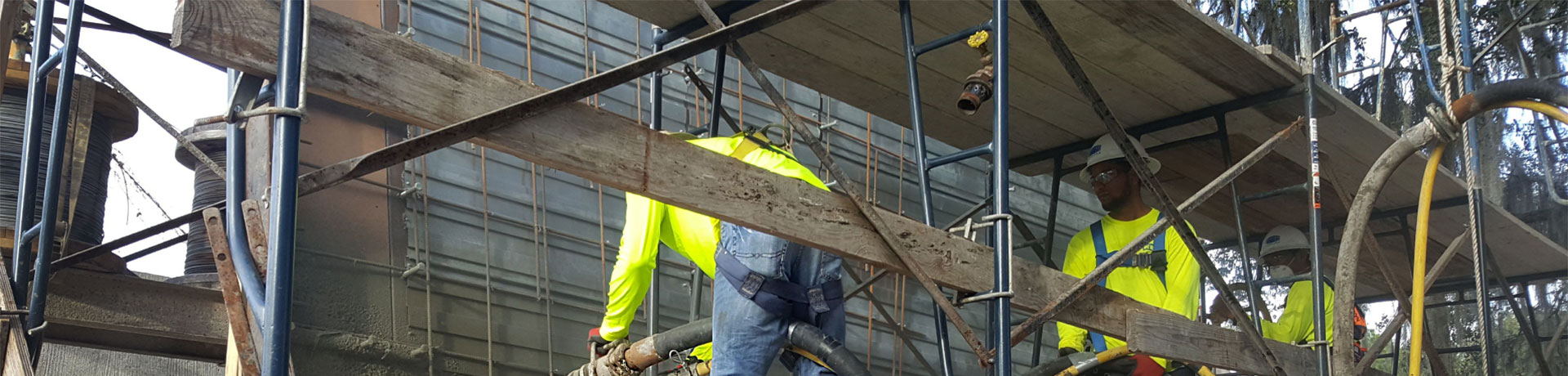
We all know job-site conditions can undergo constant changes. The best safety tip for these changing job-site conditions is to check all job sites before crews are dispatched. This inspection will take a little time and may be a little inconvenient, but after the inspection you will have an understanding of what potential hazards are present for your
Safety Shooter : Working Safely in Cold Weather
Once again the frost is on the pumpkin by guest author and Old Man Winter is at the door. With Todd Bennett less daylight and colder temperatures, we need to adjust our safety programs from avoiding heat exhaustion, dehydration, overexposure, and sun-related illnesses to preparing our ï¬eld crews to deal with the other extreme.
Safety and Common Sense
Often when the subject of safety is brought up, we start thinking of regulations, special protective equipment, programs, inspections, reporting, meetings, insurance, and so on. Common sense tells us that it is in our best interests to have good safety practices and to enforce company safety policies. However, sometimes our attitude toward safety is not very positive, treating safety programs and policies as a necessary evil rather than a critical part of daily operations. Having a safe work place starts with instilling a positive attitude in all employees. Doing even the simplest things safely creates an atmosphere that tells employees that the company is concerned about them beyond what is required by law.
Let™s look at two examples”one obvious, and one less apparent:
Pump Safety Tips: Protecting Pump Operators and Ready Mix Truck Drivers
Here is an important safety tip: Reducers and pumping lines should be directed away from the operator, whenever pumping conditions allow. This means reverse the 90-degree reducers and run the pumping system away from the pump operator and the ready-mix truck driver (refer to Fig. 1).
What happens on one-way streets, such as in San Francisco, where you cannot change the way the system can be run? We also have found out that running the shotcrete line system per Fig. 1 can be difï¬cult when pumping shotcrete material that may tend to plug easily. The operator always seems to be going to the other side of the pump to unplug the lines, making it hard to access the ready-mix truck at the back of the pump.
After some serious brainstorming, we came up with a protective solution that would contain the concrete if a hose or reducer broke. We wanted to ï¬nd something that could be bought almost anywhere and was priced right. Some type of rubber mat seemed to make sense. Our idea was to use a rubber mat from the bed of a pickup truck. To test this idea, we dumped all the tools out of a foreman™s truck and used that mat. We cut it in half and used the special shotcrete attachment device (tie wire) and tied it off. It worked great. We now buy mats for approximately $75, install holes, and attach bungee cords (refer to Fig. 2).
Pump Clean Up
Protecting reducers and couplings is not only a safety concern but an environmental issue as well. We pump a lot of shotcrete
Pump Safety – The Forgotten Screen
It seems like every time we take delivery of a new pump, everybody wants to climb all over it. They love to check out all controls and features, comparing them to the equipment they have been using.
Shotcrete Pump
The shotcrete pump. Every shotcrete crew needs one. Unfor-tunately, the pump that pushes all the material we need to do our job gets more abuse than any of the other equipment. Pumps come in various sizes and shapes, anywhere from a trailer single axle to a boom truck or robot. They all have one thing in common: they pump concrete at very high
Hear, Here…
Construction sites can be very noisy places”kind of like a Rolling Stones concert, but much longer in duration. A lot of the equipment we use on a regular basis in the construction industry can produce sufï¬cient levels of noise to cause hearing loss when a worker is exposed to that noise for extended periods of time. Complicating this loss of hearing is the fact that the loss comes over an extended period of time. A worker who cannot hear may be in more danger on the job site. He also may develop tinnitus (a ringing sound in the ears), increased stress levels, and increased blood pressure. The ability to hear what is happening around us is an important part of working safely.
Noise levels are measured in decibels (dBA). The scale used for measuring decibels is a bit like the scale used to measure earthquakes. The noise at 73 decibels is about 2 times louder than the noise at 70 dBA. The Occupational Safety and Health Administration (OSHA) has developed rules regarding how long a worker can be exposed to noise levels before hearing protection becomes mandatory.
How to Plan Your Safety Training Program
The subject of safety training necessarily starts with the question, œWhat do we need? A training-to answer this question. These answers will begin to deï¬ne the content, frequency, categories of employees to be trained, and documentation required.
Some training is required by law. Federal, state, and/or local laws detail required training for speciï¬c operations. A good ï¬rst step is to determine what is legally required by various government agencies. On the federal level, the Occupational Health and Safety Administration (OSHA) and the Environmental Protection Agency (EPA) are good examples
Scaffolding is Serious Business
According to the Occupational by Joe Vierra of Safety and Health Admini-Concrete Structures stration, 2.3 million construction workers work on scaffolding on
a frequent basis. Every year, approximately 4500 injuries and 50 deaths occur in scaffold-related accidents with an estimated $90 million in lost workdays in addition to the medical, workers compensation, and other costs resulting from these incidents.
Safety Shooter: Daily Inspection Can Improve Safety
It’s 5:30 in the morning in our yard. All of the compressors, trucks, shot-crete pumps, and related equipment are on their way out of the yard for the day™s operations. It™s important that the equipment gets to the various jobsites, which could be anywhere from 10 to 150 miles away, on time and without incident. But what can be done to assure that everything is road-worthy?