
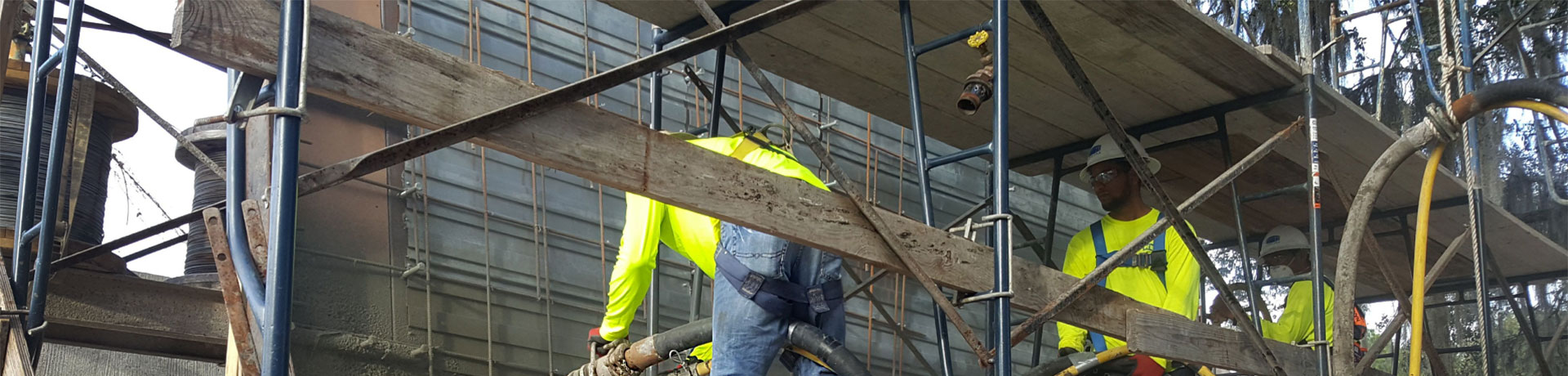
Pump Safety Tips: Protecting Pump Operators and Ready Mix Truck Drivers

Here is an important safety tip: Reducers and pumping lines should be directed away from the operator, whenever pumping conditions allow. This means reverse the 90-degree reducers and run the pumping system away from the pump operator and the ready-mix truck driver (refer to Fig. 1).
What happens on one-way streets, such as in San Francisco, where you cannot change the way the system can be run? We also have found out that running the shotcrete line system per Fig. 1 can be difficult when pumping shotcrete material that may tend to plug easily. The operator always seems to be going to the other side of the pump to unplug the lines, making it hard to access the ready-mix truck at the back of the pump.
After some serious brainstorming, we came up with a protective solution that would contain the concrete if a hose or reducer broke. We wanted to find something that could be bought almost anywhere and was priced right. Some type of rubber mat seemed to make sense. Our idea was to use a rubber mat from the bed of a pickup truck. To test this idea, we dumped all the tools out of a foreman™s truck and used that mat. We cut it in half and used the special shotcrete attachment device (tie wire) and tied it off. It worked great. We now buy mats for approximately $75, install holes, and attach bungee cords (refer to Fig. 2).
Pump Clean Up
Protecting reducers and couplings is not only a safety concern but an environmental issue as well. We pump a lot of shotcrete

U.S. Shotcrete Standards Update

This is an attempt to keep you informed about the activities of various organizations and committees developing standards and recommendations related to the shotcrete industry. Readers are invited to provide supplemental information related to the initiatives of ACI, ASTM International, or any other organization active in shotcreting.

Matching Equipment to Process: The Predampener

As one who promotes choosing process before product, I believe that the success of any project also depends on matching the appropriate equipment to the process/product chosen. Specialty equipment offers several opportunities to achieve effective results. This article will discuss the predampener, a machine used in dry-mix shotcrete application.
In wet-mix shotcrete application, the water- cement ratio (w/c) is controlled prior to discharge into the mixer-pump apparatus. High-velocity air pressure propels the mixture to the receiving surface. In a dry-mix shotcrete application, the w/c is controlled by the nozzleman. Because it is not desirable for the nozzleman to introduce all the water at the water ring, a predampener must be used to ensure proper hydration of the cement.
The predampener facilitates the process as follows: the bagged product, or œsuper sack material, is dropped into the predampener™s front hopper and moved by an auger system through a fine mist of water that dampens the product prior to it being dropped into the shotcrete gun and propelled by compressed air up to the nozzle, where the appropriate amount of additional water is then added.
When shotcrete is delivered by a ready-mix concrete truck, the mixture is already predampened from the moisture in the sand. Avoid the use of

Pump Safety – The Forgotten Screen

It seems like every time we take delivery of a new pump, everybody wants to climb all over it. They love to check out all controls and features, comparing them to the equipment they have been using.

Shotcrete Construction Joints

Shotcrete construction joints are required in situations such as the following. When the volume of shotcrete is greater than that which can be conveniently applied and finished in a single shift. In the construction of top-down shotcrete installations, such as soil-nailed walls, where the element is constructed in a series of horizontal lifts and in segmental shotcrete construction, such as used in the underpinning of buildings.

Shotcrete Pump

The shotcrete pump. Every shotcrete crew needs one. Unfor-tunately, the pump that pushes all the material we need to do our job gets more abuse than any of the other equipment. Pumps come in various sizes and shapes, anywhere from a trailer single axle to a boom truck or robot. They all have one thing in common: they pump concrete at very high

What You need to know about Wet-Mix Shotcrete

Wet-mix shotcrete is a mixture of cement, aggregates, and water that may contain admixtures, which is hydraulicallypumped to the nozzle where compressed air is added to provide high velocity for placement and consolidation of the material on the receiving surface. The purpose of this article is to illustrate the uses of wet-mix shotcrete for small (repair), medium, and large output applications. There are several factors that dictate good wet-mix shotcrete practices: the right concrete pump for the job; a suitable mix design; the right nozzle (for the best material velocity); the distance the material has to be pumped; crew experience; good nozzling technique; and implementation of proper safety precautions for the pump and the hoses, including the clamps; and the overall safety of the workers.

Dry-Mix Guns

Basically, three different types of shotcrete guns exist for the dry-mix process, all of which work on the suspension-conveying principle. Used occasionally today, was invented by Carl E. Akeley in 1907.1 It employs two connected chambers arranged one above the other, with the discharge outlet at the bottom of the lower one. The feed opening of the upper chamber and the connection between the two chambers can be closed off hermetically with bell-shaped valves independently of one another. The bottom chamber is subjected to the same air pressure as the discharge line. The procedure starts with dry mix being filled into the upper chamber with the bell valve between the two chambers closed. Next, the feed opening is closed hermetically and the upper chamber is pressurized just like the lower one. Now the valve between the two chambers can be opened, allowing the mixture to slide from the upper into the lower chamber. After this has happened, the valve between the two chambers can be reclosed and the pressure released in the upper chamber to permit reopening of the inlet valve. In the meantime, the dry mix is discharged from the lower chamber by a pneumatically driven feed wheel and is picked up by the air stream in the discharge line. The upper chamber is refilled at the same time, and the cycle is repeated.

Hear, Here…

Construction sites can be very noisy places”kind of like a Rolling Stones concert, but much longer in duration. A lot of the equipment we use on a regular basis in the construction industry can produce sufficient levels of noise to cause hearing loss when a worker is exposed to that noise for extended periods of time. Complicating this loss of hearing is the fact that the loss comes over an extended period of time. A worker who cannot hear may be in more danger on the job site. He also may develop tinnitus (a ringing sound in the ears), increased stress levels, and increased blood pressure. The ability to hear what is happening around us is an important part of working safely.
Noise levels are measured in decibels (dBA). The scale used for measuring decibels is a bit like the scale used to measure earthquakes. The noise at 73 decibels is about 2 times louder than the noise at 70 dBA. The Occupational Safety and Health Administration (OSHA) has developed rules regarding how long a worker can be exposed to noise levels before hearing protection becomes mandatory.