
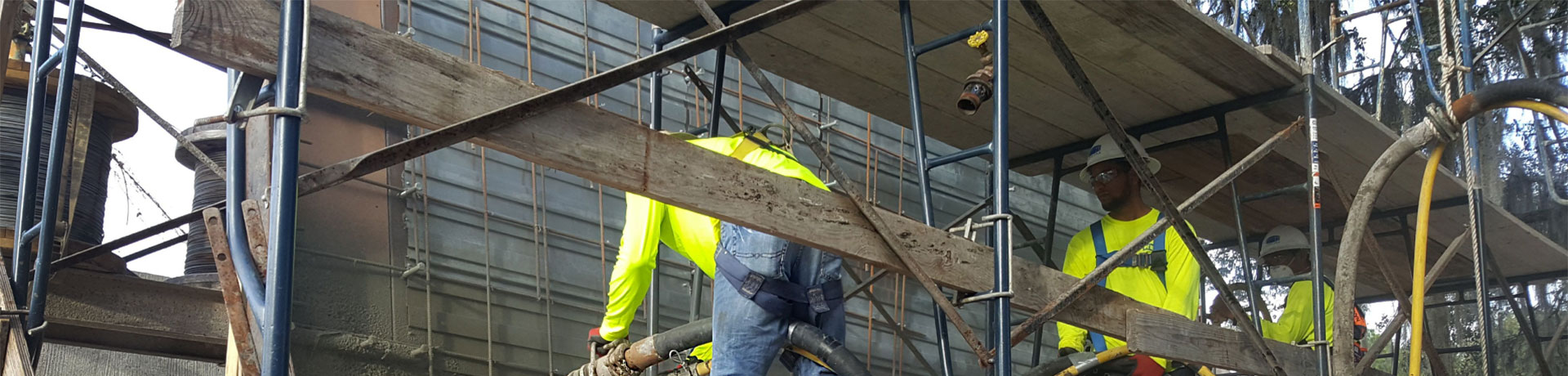
Quality and Shotcrete

Many factors affect the quality of shotcrete. The shotcrete process itself provides a unique and effective placement technique for portland cement concrete. For the shotcrete process to yield the highest possible quality product, however, many factors must be considered. The shotcrete process has both obvious and not-so-obvious factors that affect the quality of the end product.

Respiratory Protection

Answer: Respiratory illness can take years to develop. As with smoking, the delayed but high-risk results sometimes make it diffi cult, crucial, to convince employees to wear respi-rators in certain environments, even if the air does not appear to be harmful. The key to convincing employees to protect themselves is to educate them on the hazards present in the workplace and the effects on the human respiratory system.

ASA Mega-Demo Hits the Jackpot

The American Shotcrete Association (ASA) and Hanley Wood teamed up to present a shotcrete extravaganza in Las Vegas, Nevada, during the 2005 World of Concrete. Encouraged by the successful Mega-Demo in 2001, the leadership

The Changing Job Site

We all know job-site conditions can undergo constant changes. The best safety tip for these changing job-site conditions is to check all job sites before crews are dispatched. This inspection will take a little time and may be a little inconvenient, but after the inspection you will have an understanding of what potential hazards are present for your

U.S. Shotcrete Standards Update

Much has happened since the last update on the activities of various shotcrete organi-zations and committees in the Summer 2004 issue of Shotcrete. Probably the most important, at least to this author, is that I have retired from full-time employment from SI Concrete Systems and will consult in the industry if anyone will put up with me. I plan to continue my work with the various organizations discussed below. Readers are requested to contact the editor and author if inaccuracies are found or if additional activities should be reported.

Safety Shooter : Working Safely in Cold Weather

Once again the frost is on the pumpkin by guest author and Old Man Winter is at the door. With Todd Bennett less daylight and colder temperatures, we need to adjust our safety programs from avoiding heat exhaustion, dehydration, overexposure, and sun-related illnesses to preparing our field crews to deal with the other extreme.

Safety and Common Sense

Often when the subject of safety is brought up, we start thinking of regulations, special protective equipment, programs, inspections, reporting, meetings, insurance, and so on. Common sense tells us that it is in our best interests to have good safety practices and to enforce company safety policies. However, sometimes our attitude toward safety is not very positive, treating safety programs and policies as a necessary evil rather than a critical part of daily operations. Having a safe work place starts with instilling a positive attitude in all employees. Doing even the simplest things safely creates an atmosphere that tells employees that the company is concerned about them beyond what is required by law.
Let™s look at two examples”one obvious, and one less apparent:

Innovative Synthetic Fibers

After four years of research and development on improving the bonding capabilities of synthetic fibers, we recently patented a high-tensile-strength synthetic fiber that partially fibrillates upon mixing and shooting, increasing its final surface area and bonding capabilities to the concrete.1 The fibers are introduced into the concrete mixer as monofilament units of relatively low surface area (F4-a in Fig. 1), allowing up to 2% vol. (18.5 kg/m3 [31.2 lb/yd3]) fiber dosages. During the mixing process, each fiber transforms into a unit having several fibrils at its ends (F4-b in Fig. 1). The fibrils anchor each fiber so their bonding capabilities are superior to those of

Waterproofing Your Shotcrete Tank

When it comes to preventing water damage and preserving the integrity of concrete structures, waterproofi ng is essential. In of concrete tanks, however, effective, reliable waterproofi ng is especially critical. Concrete tanks play a vital role in many communities. They function as drinking water containers, wastewater treatment plants, and water storage reservoirs. Not only is a leak in a facility like this expensive and time-consuming to repair, it can be inconvenient and even dangerous to the community.

High Cost of Steel Not the Only Reason for Using Fibers as Shotcrete Reinforcement

The rising cost of conventional steel reinforcement has dramatically increased the demand for synthetic, as well as steel, fibers as an alternative to wire mesh in shotcrete applications. More importantly, with the shift to the shotcrete industry is discovering that reinforcement yields significant economic advantages, as well as definite engineering benefits for long-term shotcrete durability.
Significant economic benefits result from the elimination of placing wire mesh. In addition, the use of fibrous reinforcement in lieu of wire mesh reduces rebound from the receiving face by up to 20%.
Suitable shotcrete applications include slope stabilization, tunnel liners and water diversion channels, structural repairs, swimming pools, arti-ficial rock, waterscapes, and thin overlays. These applications benefit from the three-dimensional network of reinforcement formed by the fibers, which reduces plastic shrinkage cracking and drying shrinkage cracking. The fibers also provide quanti-fiable toughness and enhanced durability, including increased surface abrasion resistance and impact resistance. Performance is predicated on the proper selection of the fiber type, length, configuration, and addition rate. Elimination of potential voids created by the wire mesh pattern is just one more advantage of using fiber.
General Product Information
There are three fiber types that contribute to the physical properties of shotcrete: steel fibers, micro- synthetic fibers, and macro-synthetic fibers.
Although the price of steel fibers has risen, the fact remains that the in-place cost of steel fiber-reinforced shotcrete is less than the cost of fixing and placing conventional steel. In general, steel fibers must meet the requirements of ASTM A 820 and may be manufactured from either drawn wire or slit sheet steel. Steel fibers, first introduced in the mid 1970s, are generally available in four lengths: 3/4, 1, 1-1/2, and 2 in. (20, 25, 38, and 50 mm). The standard unit of sale is typically 50 lb (22.7 kg) boxes or bags.
Micro-synthetic fibers can be nylon mono-filament or polypropylene monofilament and fibrillated fibers. They have been in use since the early 1980s for secondary temperature-shrinkage