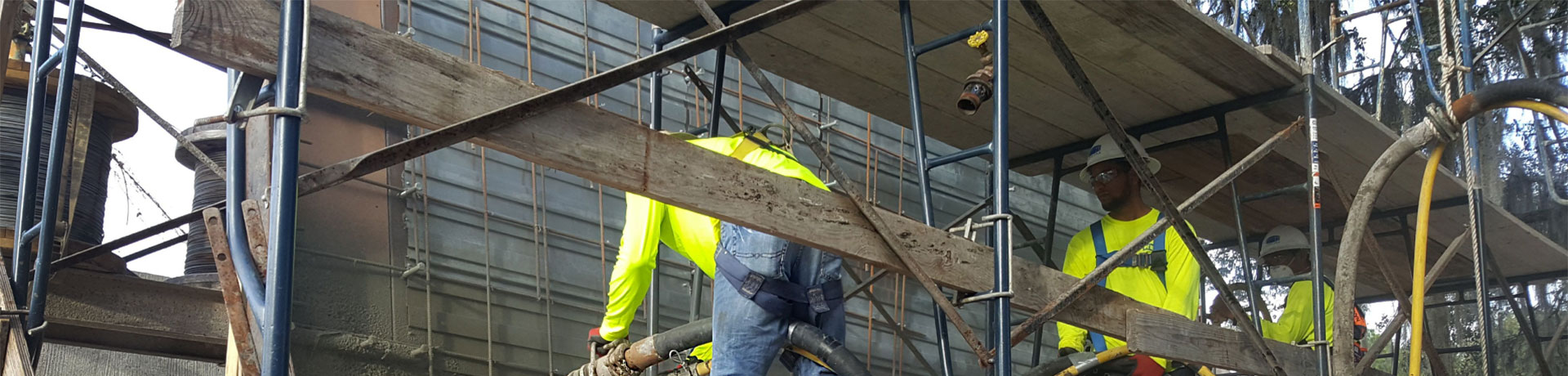
Wet-mix shotcrete depends on air flow at the nozzle to accelerate the concrete to 60 to 80 mph (100 kph to 130 kph). Most air compressors produce their air flow capacity at 100 to 120 psi (7 to 8.4 kg/cm2) at the compressor. However, depending on the size length and couplings in the air hose, there may significant pressure drops when the air reaches the nozzle. Here’s what ACI 506R-16 Guide to Shotcrete Section 4.4.2 states for wet-mix:
“The recommended ft3/min (m3/min) needed for the wet-mix process is between 200 to 400 ft3/min (5.7 to 11.3 m3/min) air volume at 100 psi (7 bar). Higher air volume capacities are needed for higher volume and higher-velocity shotcrete applications. If a blowpipe is to be used during the shooting process, more air will be required to run both operations simultaneously. Conducting a test during the preconstruction testing phase using a blowpipe while gunning the wet-mix material will indicate if the air compressor has enough air volume capacity to perform both tasks at the same time. Long, small-diameter lines may not provide sufficient air volume capacity, even with a large air compressor. Test and consider increasing the size of the air line.”
Though there is no direct guidance for air pressure at the wet-mix nozzle you may consider the guidance for dry-mix air pressure in ACI 506R Section 4.4.1:
“The operating air volume (ft3/min [m3/min]) drives the material from the gun into the hose, and the air pressure is measured at the material outlet or air inlet on the gun. The operating pressure varies directly with the hose length, the density of the material mixture, the height of the nozzle above the gun, and the number of hose bends. Experience has shown that operating pressures should not be less than 60 psi (4 bar) when 100 ft (30 m) or less of material hose is used, and the pressure should be increased 5 psi (0.34 bar) for each additional 50 ft (15 m) of hose and 5 psi (0.34 bar) for each additional 25 ft (7.5 m) the nozzle is above the gun.”
The minimum 60 psi (4 bar) necessary for dry-mix could be applied to the wet-mix air supply as the velocity created by the air flow is similar.
The M4-M5 Link Tunnels in Sydney, Australia, is approximately 7.5 km (4.7 mi) long and accommodates up to four lanes of traffic in each direction. It connects the New M4 Tunnels with the M8 Tunnels to form the 33 km (20 mi) long Westconnex Motorway, mostly underground.
Project Name:
Exchange Place Station – 9 Car Program West Corridor
Location:
Jersey City, NJ
Shotcrete Contractor:
Patriot Shotcrete, LLC
Architect/Engineer:
WSP USA, Inc.
Material Supplier/Manufacturer:
Eastern Concrete Materials
Equipment Manufacturer:
Western Shotcrete Equipment, Inc.
General Contractor:
Walsh Construction Company II, LLC
Project Owner:
Port Authority of NY NJ
Project Name:
Pennsylvania Turnpike Commission – Tuscarora Tunnel Rehabilitation
Location:
Burnt Cabins, PA
Shotcrete Contractor:
Mosites Construction Company
Architect/Engineer:
Gannett Fleming Inc.
Material Supplier/Manufacturer:
New Enterprise Stone & Lime Company Inc.
Equipment Manufacturer:
King Shotcrete Equipment, Inc.
General Contractor:
Mosites Construction Company
Project Owner:
Pennsylvania Turnpike Commission
Project Name:
Atlanta Airport Plane Train Tunnel- West Extension
Location:
Atlanta, GA
Shotcrete Contractor:
Guy F. Atkinson Construction
Architect/Engineer:
McMillen Jacobs Associates
Material Supplier/Manufacturer:
Master Builders Solutions Admixtures US LLC
Equipment Manufacturer:
Normet Americas, Inc.
General Contractor:
Clark Construction Group
Project Owner:
City of Atlanta/Department of Aviation
I n early September of 2019, Gulf Coast Underground (GCU) received a call from the City of Baton Rouge and their construction manager, Jacobs Engineering Group (JEG). There was an issue at the South Wastewater Treatment Plant that would require a unique contractor skillset to properly repair. The problem was that the cast-in-place influent structures receiving 65 million gallons (246 ML) of sewer flow daily, were corroding and needed to be repaired quickly
The Park Avenue Tunnel, formerly known as the Murray Hill Tunnel, is a 1,393-foot-long (425 m), 16-foot-wide (5 m), 9-foot-tall (3 m) thoroughfare traversing six New York City blocks. The tunnel was originally constructed in 1837 as an open rock-cut, with a brick arch constructed over the cut in 1854 to create the tunnel profile. For the next 150 years, the tunnel would be plagued with issues ranging from mechanical system failures to liner wall leakage due to the soil volume above, which is where the idea of shotcrete stabilization was introduced within the project scope.
When you are faced with a project with limited access, material delivery by helicopter, the nearest personnel access is 5 miles (8 km) away, and the closest outside access to the shotcrete placement location is a half mile away, the only solution to handle all of these issues is shotcrete. The Poe Tunnel is a 15 mile (24 km) long tunnel in the foothills of the Sierra Nevada Mountains and is in an area of steep canyons. The tunnel transports water from a forebay on the North Fork of the American River to the Poe Powerhouse where electrical power is generated. The tunnel is almost 20 ft (6 m) in diameter and was constructed in the 1950’s.
Shotcrete is just a placement method for concrete. Shotcrete placement with proper materials and application techniques should provide monolithic concrete with a 28-day compressive strength of at least 4000 lb/in2 (28 MPa). Thus, any systems that work in concrete should be fine. Either mechanically-fixed or epoxy-set anchors are commonly used in concrete. You should consult with the anchor suppliers for the size and type of anchor appropriate for your specific application.
Recruiting, training, and retaining skilled shotcrete nozzlemen is mission-critical for a company’s success. Virtual, immersive training offers an effective, engaging mode of learning that supports the modern trainee. For beginning nozzlemen, virtual reality training gives them a safe, repeatable experience that can be completed in a classroom, free of job costs. Practice without cost or risk also helps improve job performance and satisfaction. These disruptive virtual reality (VR) technologies can provide safe, hands-on learning experiences without the field costs associated with hands-on training. Virtual learning is also valuable in today’s socially distanced world with its shifting remote learning requirements. Interactive digital tools will deliver meaningful, adaptive training for skilled trades now and in the future. Though some level of hand nozzling experience is still needed the best nozzlemen will be trained, in part, using virtual reality.