
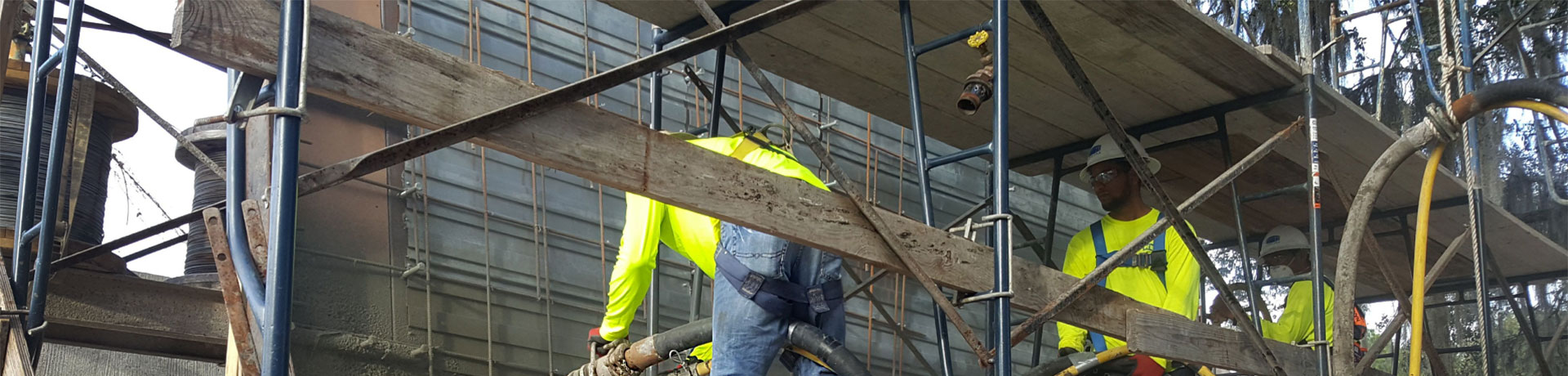
The Tuscarora Mountain Tunnels in Pennsylvania have a fascinating history. The older of the two tunnels, built between 1938 and 1940, was designed to carry a railroad that never came into service. Industrialists of the day, William Henry Vanderbilt and Andrew Carnegie, were backers of the scheme which was halted when they struck a deal with rival railroad owners.
SHOTCRETE VS FIRE AND WATER REPLACEMENT OF FLUME 4/5/6 AND 30
On August 14, 2021, the Caldor Fire started in Northern California near Pollock Pines, CA. The fire ended up consuming almost 222,000 acres (90,000 hectares) and seriously threatened South Lake Tahoe. Besides the over 1000 structures that were lost, the fire also burned along a major portion of the El Dorado Irrigation District’s Canal (EID) which provides drinking and irrigation water to numerous communities throughout the area
Honorable Mention Project
Outstanding Repair & Rehabilitation Project
I have a project with a segmental retaining wall. The project is located in Maryland. The CMUs of the retaining wall have significantly deteriorated in several areas. The geo-grid fabric appears to be in good condition in the areas where it could be observed. I suspect the deterioration is caused by saltwater runoff during snow events combined with the freeze/thaw cycles. There are some localized areas where the masonry units have completely disintegrated. The largest area being approximately 4 ft2 (0.37 m2). Is it feasible to remove the deteriorated masonry material, down to a sound surface, and shotcrete the face to restore (or exceed) the structural integrity of masonry units? If so, will this restore the structural integrity of the segmental retaining wall?
Shotcrete is routinely used for the repair of deteriorated concrete masonry and brick. Shotcrete should easily have a minimum compressive strength of 4000 psi (28 MPa) when properly shot and cured. According to the National Concrete Masonry Association, current CMU units have a minimum 2000 psi (14 MPa) compressive strength. Older CMU had a lower 1500 psi (10 MPa) minimum. Thus, the shotcrete placement will be significantly stronger and less permeable than the in-place CMU. This should give the wall better resistance to saltwater and freeze-thaw exposures thus extending useful life.
Depending on the depth of the new shotcrete placement, you may consider mechanically tying the shotcreted layer back to the sound CMU with epoxy or mechanically embedded anchors or j-bolts. Thicker sections may also benefit from the use of a steel wire mesh or fibers.
When shooting onto existing CMU sections, the surface must be properly prepared and then shotcreted with proper shotcrete materials, equipment, and placement techniques. Shotcrete placed onto an existing CMU surface will provide an excellent bond IF the following conditions are met:
- Make sure the surface is roughened and clean.
- The amplitude of roughness should be +/- 1/8th in. (3 mm) or more.
- A high-pressure water blaster (5000 psi [34 MPa] or more) or abrasive blasting can help to roughen and clean the surface.
- Bring the CMU surface to a saturated surface dry (SSD) condition. This means the surface feels damp, but water is not picked up on a hand.
- Make sure the shotcrete placement is properly executed with high-velocity placement and quality materials.
- The shotcrete should have a minimum 28-day compressive strength of 4000 psi (28 MPa).
- Be sure the shotcrete contractor is using an air compressor able to produce at least 185 CFM (5.2m3/min) for wet-mix and 375 CFM (10.6 m3/min) for dry-mix (gunite) of air flow at 100 to 120 psi (0.7 to 0.8 MPa).
- Use of an ACI-certified shotcrete nozzleman is recommended.
- No bonding agent should be used. It will interfere with the natural bonding characteristics of shotcrete placement.
Finally, without details on the loading conditions, and structural details of the original construction, we cannot comment on the structural integrity of the repaired wall. You should contact a professional engineer experienced in concrete repair to evaluate the structural integrity of the wall when repaired.
Sorry, we don't have any articles to show you. We will add relevant articles as they become available.
ASA Outstanding Shotcrete Awards Program
The ASA Outstanding Shotcrete Project Awards Program exists to recognize excellence and innovation on projects in which the application of shotcrete has played a significant role.
ASA’s Annual Outstanding Shotcrete Project Awards Program provides an exciting real-world demonstration of the exceptional advantages of placing concrete via the shotcrete process. Many sustainability advantages are also inherent in the shotcrete process and play a significant role in winning projects as well as the project owner’s ultimate decision to use shotcrete as the method of concrete placement. Projects can be submitted in the following areas:
- Underground
- Architecture | New Construction
- Infrastructure
- International Projects
- Pool | Skatepark
- Repair | Repurpose
To assist in your submission, we have provided submission resources to inform you of the submission guidelines, a list of questions, and a copy of the owner release form. Please email any questions to [email protected].
Award Archive
2025 – Twenty First Annual Outstanding Shotcrete Project Awardees
Enhancing Efficiency and Safety in Concrete Shaft Restoration: A Shotcrete Success Story
In September 2021, American Concrete Restorations Inc. was contracted to perform 60 yd³ (46 m³) of concrete repairs to an existing shaft that is used to access an underground tunnel system in a southern suburb of Chicago, IL. The job was for the Metropolitan Water Reclamation District of Greater Chicago, Thornton Construction Shaft. The dimensions of the shaft are 250 ft (76 m) deep and 30 ft (9 m) in diameter, and the only access is from the top using a crane basket. The project specifications called for the use of a polymer-modified, bagged product using the formand-pour method to replace the old concrete.
Sobre Productividad, Cálculo de Costos de Trabajo y Éxito en el Shotcrete
Como miembro de la Sociedad de Honor Internacional en Economía y con una doble licenciatura en Finanzas y Banca, ingresé al mundo del shotcrete preparado de manera un poco diferente que la mayoría de los que ingresan a esta industria. Eso fue hace más de 20 años, pero los principios de comprender el tiempo, el valor del dinero y los costos de oportunidad están indeleblemente grabados en mi psique. En la actualidad, junto con mi socio comercial, quien también proviene de un entorno de fabricación y negocios en un campo internacional, dirigimos una empresa de transporte, una empresa de concreto lanzado vía seca, una empresa de PebbleTec y una empresa de diseño, todo bajo un mismo techo. En conjunto, tenemos entre 55 y 60 empleados en cualquier día dado. En un negocio de este tamaño, la productividad y la comprensión de los costos laborales son clave para sobrevivir.