
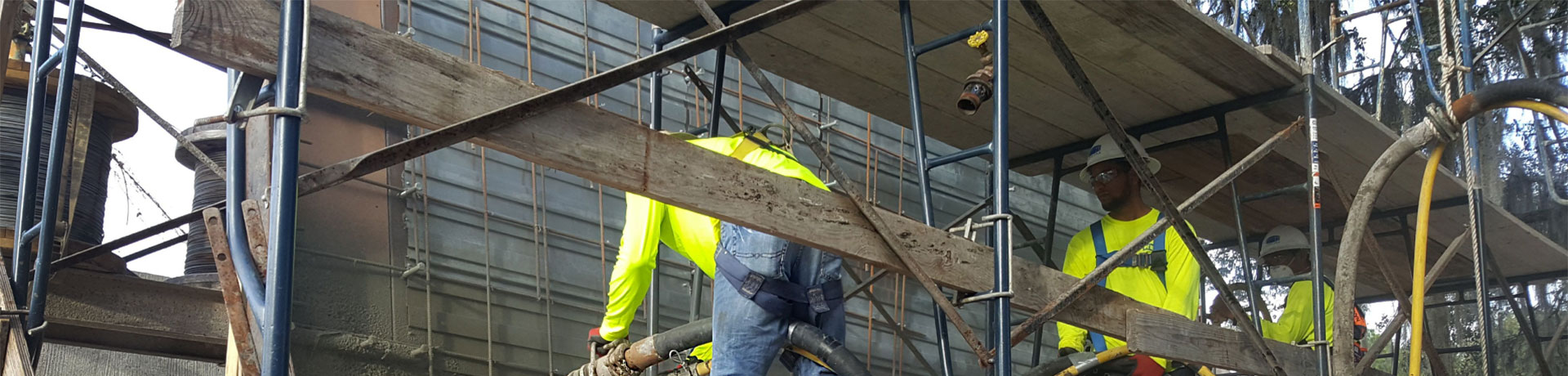
The equivalent dosage of fibers to replace embedded steel reinforcement needs to be evaluated by the design engineer for the specific project or application. Guidance for the designer is available in ACI 506R-05, “Guide to Shotcrete,” and ACI 506.1R-08, “Guide to Fiber-Reinforced Shotcrete.”
Is it possible to use a penetrating sealer, such as those used on driveways, to make shotcrete repel moisture? If so, will the sealer improve the shotcrete’s freezing-and-thawing performance?
It is possible to use a penetrating sealer on shotcrete in the same manner as cast-in-place concrete. We are not aware of research on the durability of such a sealer and do not know if it would enhance the freezing-and-thawing characteristics. A high-quality shotcrete mixture that is properly placed will exhibit excellent freezing-and-thawing characteristics with or without a sealer.
Can you provide any information or research on the sound absorption performance of shotcrete?
We are not aware of any testing done specifically for the sound absorption performance of shotcrete. Shotcrete is a method of placing concrete and, once hardened, it should have similar parameters as cast concrete. With shotcrete, one has the ability to use many different finishes, which might influence the sound absorption characteristics. A smooth troweled shotcrete wall would be the most similar to a formed cast-in-place wall. On the other end of the spectrum, a nozzle-finished wall would likely absorb far more sound. A recent design of a concert hall at a major university was to be built with oval concrete or shotcrete perimeter walls covered with fabric curtains for sound purposes. The ceiling was to be suspended nozzle-finished shotcrete.
We want to shotcrete a porous rock wall to stop water leakage out of a small pool that is home to an endangered fish. The wall is quite rough and uneven. The pool will be drained to do the work. How long should we allow the concrete to cure before refilling the pool with water? Does this sound like a good application for shotcrete?
This is a great application for shotcrete. Once drained, the existing surfaces should be cleaned by water blasting or sandblasting to provide a good bonding surface. The shotcrete can be submerged within a few hours or upon reaching the final set (hardened). One factor to be concerned about is the chemical reaction and alkalinity of the area around the shotcrete during the curing period. A good solution would be to submerge the pool for a period of at least a week, drain and waste the water, flush the shotcrete surfaces, refill the pool, and test the pH before reintroducing the fish. This should eliminate the danger of the alkalinity to the fish.
What are the requirements for selection of the shotcrete lift height and delay between successive layers? ACI 506R describes only a general approach.
Although some have tried, there are not and should not be specific recommendations for lift height or time between lifts of layers. Shotcrete is a method of placing concrete, and concrete properties vary with many parameters, such as admixtures, ambient temperature, concrete temperature, slump, and age of concrete, to name a few. The lift height is also influenced by the surface on which you are shooting (rough, porous, smooth, dense, and so on); the orientation being applied (vertical, sloped, or overhead); and the size and density of the reinforcing steel, if it is present. Regardless of the period of time between lifts or layers, the receiving surface must be clean and moisture-conditioned to create a good bond between lifts or layers. As you can see, there are too many variables to spell out recommended guidelines or rules of thumb for lift heights or time between lifts or layers. The goal is to place the lifts or layers in heights or thicknesses that do not slough or sag. The time between lifts or layers is the time required for the initial lift or layer to support the subsequent lift of layer. These decisions must be made on the job on a daily and hourly basis by a properly trained and experienced nozzleman and shotcrete foreman. These decisions may vary during the day to meet the current situation. It is critical that the shotcrete is placed by a shotcrete contractor with trained and experienced crews who is experienced and successful in the type of work being installed.
What is the impact force on formwork resulting from a shotcrete application? I am designing the formwork for a wall to be placed via shotcrete and need to know the forces imposed on the wall forms.
In structural applications, most of the impact force from nozzling shotcrete is directed toward compacting the shotcrete in place rather than against the formwork. This was the subject of a study conducted by Marc Jolin of Laval University, Quebec City, QC, Canada, and reported in the Fall 2007 issue of Shotcrete magazine. There is virtually no hydrostatic pressure on the forms from the application using the shotcrete process. A copy of this study can be viewed on the ASA Web site at www.shotcreteweb.wpengine.com/archivesearch/ArchiveSearch.asp.
I would like to add fibers to a shotcrete mixture. Many research articles discuss steel fibers and sometimes synthetic. I’d like to consider glass or synthetic fibers because the exterior wall will be visible and I don’t want to see the corroding steel fibers toward the surface of the concrete. What are the pros/cons of glass fibers versus steel fibers and how much should I add to the mixture design to achieve a product that can be submerged in water and experience as few cracks as possible? Is there reference material for these questions?
Refer to ACI 506.1R-08, “Guide to Fiber-Reinforced Shotcrete,” at www.concrete.org for guidance on fiber types and dosages. Glass fibers are seldom (if ever) used in shotcrete because they tend to break under the high velocity required for shotcrete. Steel or macrosynthetic fibers should be used at about 0.4 to 0.5 volume percent to control hardened shotcrete cracking, 50 to 66 lb/yd3 (30 to 39 kg/m3) for steel (specific gravity (SG) of 7.85), and 6 to 7.5 lb/yd3 (3.6 to 4.5 kg/m3) for macrosynthetic polypropylene (SG of 0.91). Fiber suppliers can provide more technical guidance for their products. You can locate fiber suppliers by visiting the ASA Online Buyers Guide at www.shotcreteweb.wpengine.com/pages/products-services-information/buyers-guide/.
Are there any guidelines/regulations as to how close in proximity the installer/nozzle person can be to the receiving surface? I have a chimney job (existing chimney repair) that has an opening of 3.5 x 3.5 ft (1.1 x 1.1 m) and the interior is calling for a gunite (dry-mix) liner to be installed. Is there an issue with splash-back or any other concern with using gunite in such a confined space?
When gunning in tight areas, you have to allow for the bend in the hose and the length of the nozzle, which will require at least 2 to 2.5 ft (0.6 to 0.8 m). An area 3.5 ft (1.1 m) wide is a very tight area to gun in, but it can be done. In areas that restricted, it’s not possible to always maintain a 90-degree shooting angle, so you will get much more rebound from the deflection when shooting at less than desirable angles. Also, with the dry process, you have to reduce the air pressure and volume to keep from blowing the material off the walls. Ideally, you would like the nozzle to be at least 3.5 to 5 ft (1.1 to 1.5 m) from the receiving surface, depending on the nozzle you use. For a tight area like you are proposing, in addition to reducing the air pressure and running it slowly, we would recommend using a double-bubble nozzle, as it has a wider spray pattern, allowing the nozzleman to be closer to the receiving surface and still get an adequate spray pattern. A double-bubble nozzle is also flexible, which will help in extremely tight areas. You can locate organizations that sell a range of nozzles by visiting the ASA Online Buyers Guide at www.shotcreteweb.wpengine.com/pages/products-services-information/buyers-guide/.
I am searching for a sample specification that calls for the use of a polymer-modified cement mortar in lieu of one that does not have the polymer additive. My thought is that this material would be more durable. I am also wondering if it would have greater bond to the old substrate.
Most of the industry does not endorse the use of polymer-modified additive in shotcrete. Please refer to ACI RAP Bulletin 12 and ACI 506R for further information and insight from the American Concrete Institute (ACI) at www.concrete.org. Shotcrete applied by competent contractors to properly prepared surfaces exhibits excellent bond characteristics to the substrate. Additionally, a good shotcrete mixture that is properly applied will yield a durability equal to or superior to cast concrete. There are many examples discussed in various articles of Shotcrete magazine at shotcrete.org/archivesearch/ArchiveSearch.asp.
I am working on an existing slope with a ratio of 3:1 (horizontal:vertical) and a total height of 6 ft (1.8 m). The slope has been surfaced with asphalt concrete. Will shotcrete adhere to the asphalt concrete surface, or should the asphalt concrete be removed prior to applying shotcrete?
Shotcrete will adhere to properly prepared asphalt concrete. Shotcrete bond is generally related to the preparation of the surface that you want to bond with. If the surface is dirty, the shotcrete will not bond very well.