
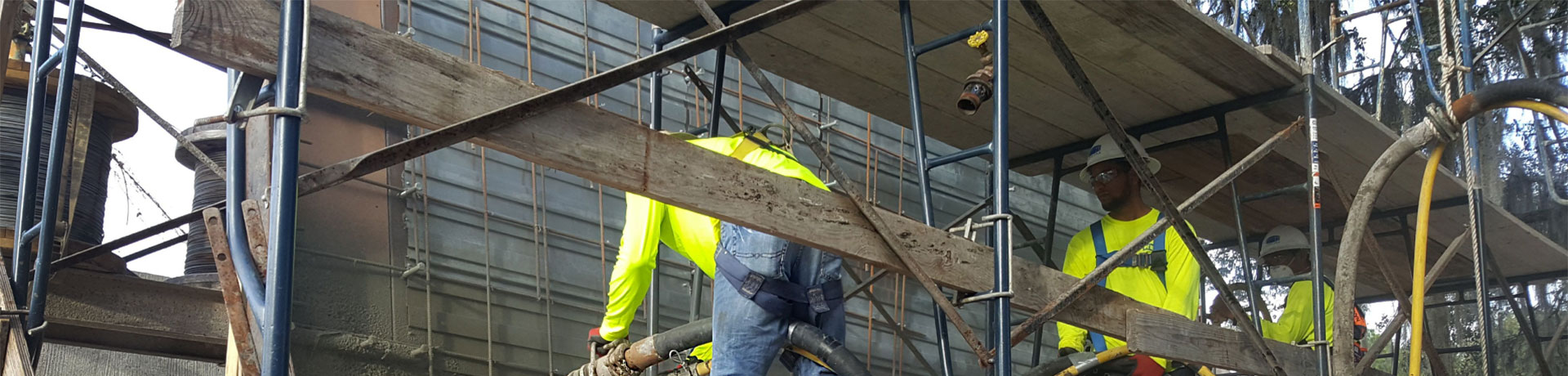
Shotcrete is just a placement method for concrete. Shotcrete placement with proper materials and application techniques should provide monolithic concrete with a 28-day compressive strength of at least 4000 lb/in2 (28 MPa). Thus, any systems that work in concrete should be fine. Either mechanically-fixed or epoxy-set anchors are commonly used in concrete. You should consult with the anchor suppliers for the size and type of anchor appropriate for your specific application.
We have shotcrete test panels, 12 by 12 by 6 in. (300 by 300 by 150 mm). My question is it OK to move the panels right after shooting to different location for initial curing or should the panels be left untouched for certain period of time at the spot of shooting?
In normal weather conditions test panels should be undisturbed for at least 24 hours. In cold weather you must protect the panels from freezing and preferably keep the concrete surface temperature above 50 to 55 °F. That allowsthe young concrete to gain enough strength to tolerate movement. Also, your test panels are very small in comparison to current ACI 506.2 Specification for Shotcrete requirements that have a minimum of 16 by 16 by 51⁄2 in. (400 by 400 by 140 mm) dimensions. When coring your smaller panels you should be sure to have the nearest edge of the core 3 in. (75 mm) from the sides to preclude the effect that rebound collection in the corners may cause.
The Value of VR Training for Today’s Shotcrete Nozzlemen
Recruiting, training, and retaining skilled shotcrete nozzlemen is mission-critical for a company’s success. Virtual, immersive training offers an effective, engaging mode of learning that supports the modern trainee. For beginning nozzlemen, virtual reality training gives them a safe, repeatable experience that can be completed in a classroom, free of job costs. Practice without cost or risk also helps improve job performance and satisfaction. These disruptive virtual reality (VR) technologies can provide safe, hands-on learning experiences without the field costs associated with hands-on training. Virtual learning is also valuable in today’s socially distanced world with its shifting remote learning requirements. Interactive digital tools will deliver meaningful, adaptive training for skilled trades now and in the future. Though some level of hand nozzling experience is still needed the best nozzlemen will be trained, in part, using virtual reality.
Y Not Try a Double Nozzle System
Although many shotcrete workers “claim” to be capable of placing massive amounts of concrete in a daily shift, or shooting with the pump turned “wide open,” in reality, the nozzleman tends to ultimately be the limiting factor on production speed and daily placement volume. Plain and simple they get tired. Shooting too fast diminishes accuracy and overall quality.
Can carbon nanotubes be used in shotcrete?
Shotcrete is a placement method for concrete so most admixture or supplemental cementitious materials that can be used in cast concrete will work with shotcrete placement. In fact, shotcrete contractors have been some of the most innovative adopters of new concrete technologies. Silica fume (microsilica) is a ultrafine particle 100 times smaller than cement that enjoys early and wide use in shotcrete due to its ability to make concrete stickier and more cohesive. This facilitates overhead placements and can provide thicker layers. Shotcrete has also used other ultrafine and nanoparticles, like colloidal silica, clay-based particles and the carbon nanotubes you mentioned.
The ultrafine and nanoparticles can provide many benefits to fresh concrete, as well as hardened properties. This may include:
• Improve the pumpability of wet-mix concrete;
• Reduce rebound and dust due to increased “stickiness”;
• Ease the finishing process;
• Reduced permeability by filling pores between cement in the paste;
• Enhanced corrosion resistance for embedded reinforcement;
• Enhanced resistance to chemical attack.
Can a gunite bridge surface be painted? And if so, what preparation/materials are recommended.
Yes, shotcrete is a placement method for concrete, so any coating appropriate for concrete would be applicable specify new concrete should be a certain age before applying their coating. Generally, the concrete surface should be clean and dry before coating. The surface texture provided on the shotcrete can affect the coating application. A hard, smooth steel trowel finish will tend to be quite slick, and the coating may not bond as well as a floated or sponge finish. A light abrasive blast may be considered to roughen the surface and give more bond. If using a gun or rodded finish for the shotcrete, the coating will generally require quite a bit more material to be able to fill the depressions in the surface.
Code of Conduct
As an ASA Qualified Shotcrete Contractor we agree to ongoing compliance with the requirements and standards set forth in the ASA Shotcrete Contractor Qualification Program Description. We will not knowingly or purposefully violate any project specifications or requirements. We agree to maintain the required insurance coverage, staff our projects with trained and certified personnel, and strive to produce a high-quality product in a safe and professional manner.
Agreement
- a) The ASA decisions concerning qualification, including but not limited to the decision of the CQC shall be final and binding;
- b) The applicant will not institute legal action of any kind to challenge those decisions;
- c) Neither the ASA nor its members, officers, employees or representatives (including but not limited to the members of the CQC) shall be subject to any claim for legal or equitable relief (including but not limited to money judgements and injunctive relief) arising out of those decisions; and, in any event,
- d)Neither the ASA nor its members, officers, employees or representatives (including but not limited to the members of the CQC) shall be liable for consequential or incidental damages of any kind as a result of the ASA Qualification program. The applicant further agrees that if it commences legal action in violation of this agreement, it shall be responsible for paying all costs and expenses, including attorney fees incurred by ASA and/or its members, officers, employees or representatives in the course of defending that legal action.
Indemnification:
In the event that any party asserts a claim for personal injury, property damage, economic loss of other damages against ASA and/or its members, officers, employees or representatives arising out of or relating to the acts or omissions of an ASA Qualified Shotcrete Contractor, the ASA Qualified Shotcrete Contractor shall, upon request, defend and indemnify ASA and/or its members, officers, employees or representatives and hold them harmless from all damages, judgement, costs, losses and expenses, including attorney fees, resulting from said claim.
Authorization:
I have read and agreed to the above disclosures. I authorize the verification of the information provided on this form and declare that it is accurate to the best of my knowledge. By checking this box, I authorize my consent.
Contractor Qualification Program
When you have completed your application and compiled all required documents, you are ready to submit your application.
Checklist of Required Materials to Upload:
- ASA Seminar Certificate of Completion
- ASA CQ Program Status Report (Exam score)
- Current Contractor’s License
- Current Insurance Certificate
- Current Letter of Bonding Capacity
- Completed ASA CQ Application pdf
- Completed ASA CQ Application xlsx – 3 tabs: Equipment, Field Teams, & Projects
- Application Fee – Payable online after submission
Copyright © American Shotcrete Association